Is inequality a problem economics can solve?
From wealth gaps to optimal taxes to cash transfers: what the tools actually say and where they go silent
See as debate graphThe gap you can't unsee

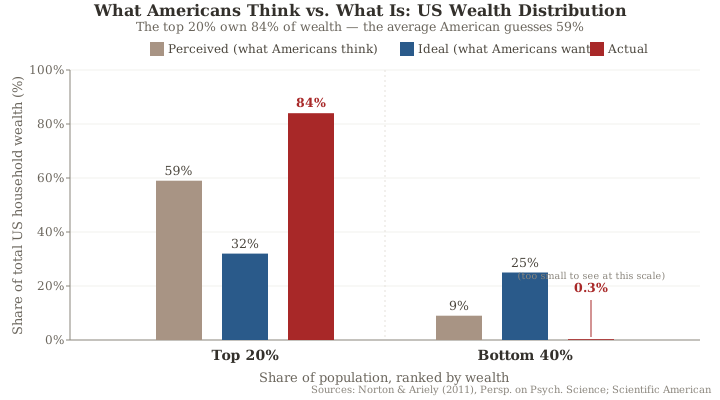
20 million views. The gap between what Americans think wealth distribution looks like and what it actually is.
The video hits hard because the mismatch is real. Americans think the top 20% own about 60% of the wealth. The actual number is closer to 85%. The bottom 40% own essentially nothing. But staring at a chart isn't economics. Economics asks whether this distribution matters, and if so, for what. The answer depends on the tools you use to measure welfare.
Total surplus and the silence of efficiency. The first tool economists reach for is total surplus, the sum of consumer surplus and producer surplus in a market. The First Welfare Theorem says that competitive markets maximize this total. It is one of the most celebrated results in economics. And it says nothing about who gets the surplus. A market can be perfectly efficient while one person holds 99% of the wealth. Total surplus treats a dollar to a billionaire identically to a dollar to a person in poverty. That is a deliberate choice, and the source of the tension in everything that follows.
Social welfare functions: choosing how much to care. Welfare economics tried to fill the silence with social welfare functions (SWFs), rules for aggregating individual utilities into a social ranking. A utilitarian SWF sums all utilities: $W = \sum u_i$. A Rawlsian SWF cares only about the worst-off: $W = \min(u_i)$. The Atkinson SWF introduces a dial, the inequality aversion parameter $\epsilon$:
When $\epsilon = 0$, you don't care about distribution at all; total income is everything. As $\epsilon \to \infty$, you become Rawlsian. The choice of $\epsilon$ is the moral question that economics gives you the vocabulary for but refuses to answer.
Think of it as a dial. Turn it to zero and you care only about the total size of the pie, regardless of who gets which slice. Turn it all the way up and you care only about the person with the smallest slice. Economics built the dial; it won't tell you where to set it.
In theory, the efficiency-equity problem has a clean solution: let the market maximize the pie, then redistribute the slices with lump-sum transfers. The Second Welfare Theorem guarantees this works, since any efficient allocation can be achieved by redistributing initial endowments and then letting markets operate. The problem is that lump-sum transfers don't exist. Every real transfer tool (income taxes, means-tested benefits, minimum wages) distorts behavior. You cannot slice the pie without changing its size. The Second Welfare Theorem is a beautiful proof about a world that doesn't exist.
Tax incidence says the economic burden of a tax falls on whoever has less elastic behavior, regardless of who legally pays. A payroll tax nominally split 50/50 between employer and employee falls mostly on workers if labor supply is inelastic. The efficiency framework tells you the cost of redistribution (DWL) but not whether paying that cost is worthwhile.
"The three wealthiest people in the United States — Bill Gates, Jeff Bezos, and Warren Buffett — now own more wealth than the entire bottom half of the American population combined, a total of 160 million people or 63 million households."
— Institute for Policy Studies, Billionaire Bonanza Report, 2017
"Should billionaires exist?"
Three Americans own more wealth than the bottom 50% combined. Is this a sign of a broken system or a functioning one? The answer depends on whether you think the market got the prices right.
Is the distribution a market outcome or a class outcome?
"Accumulation of wealth at one pole is, therefore, at the same time accumulation of misery, agony of toil, slavery, ignorance, brutality, mental degradation, at the opposite pole, i.e., on the side of the class that produces its own product in the form of capital."
— Karl Marx, Capital, Vol. I, Ch. 25 §4 (“The General Law of Capitalist Accumulation”), 1867
Marx's claim is not that distribution is unfair within a market. It is that the apparatus surveyed just above — supply and demand, marginal productivity, total surplus — sits on a property relation that the apparatus itself refuses to question. Capital and labor face each other in the market as buyer and seller of a commodity (labor power), and the exchange is voluntary; but the prior fact that one class owns the means of production and the other owns only its labor is what makes that exchange the kind of exchange it is. On Marx's reading, the efficiency framework's silence on distribution is itself the position that the property relation underwriting the market is not a subject of economic analysis. Marx's critique of political economy in the History of Economic Thought textbook carries the lineage. The same property-relation point runs through Was Marx right about anything? and Should Big Tech be broken up?, where the platform-dominance question turns on it.
"Changes in technology have allowed a small number of highly educated and exceptionally talented individuals to command superstar incomes in ways that were not possible a generation ago."
— N. Gregory Mankiw, “Defending the One Percent,” Journal of Economic Perspectives 27(3), 2013
Mankiw's defense, the mainstream within-discipline response to Marx and his descendants, is that the rise of the top 1% is best explained by skill-biased technological change and superstar-economics scale effects. People at the top are paid what they contribute, and what they contribute now is bigger than it used to be because technology lets one person serve a billion. He concedes that the system has flaws — inherited advantage, distorted markets, regressive loopholes — but his frame keeps the property relation as background and treats the distribution as the output of a fair process operating on unequal inputs. The tension Marx's frame surfaces: if the inputs are themselves the output of prior class relations, "fixing the inputs" is the redistributive politics the marginal-productivity defense is supposed to make unnecessary. Mankiw and Marx are not arguing inside the same framework. The full Ricardo-through-Piketty distribution lineage is traced in Distribution: Ricardo through Piketty.
Where this leaves us
The efficiency framework tells you the cost of redistribution but stays silent on whether to pay it. Social welfare functions give you the vocabulary to express your values; picking the values is still your job. Marx's countercharge, that the framework's silence is itself a class position, since the apparatus takes the property relation as exogenous, is not refuted by an apparatus that proceeds as if the property relation were given. The video's gap is real, and economics built the tools to measure it precisely. The consensus on what to do about it was never inside the toolkit. Whether the toolkit itself can ever sit outside the distributional politics it claims to be neutral on is the question Marx puts on the table and nothing that follows fully answers. The long lineage from Ricardo's tripartite distribution to Marx to the marginalists to Piketty is a thread Distribution: Ricardo through Piketty traces in full. Globalization, financialization, and the great moderation in the Economic History textbook traces the within-country widening from the 1980s on.
But what if inequality isn't just unfair? What if it's also inefficient? Stage 2 makes the case that some redistribution doesn't sacrifice the pie for fairness. It makes the pie bigger.
Measurement wars
"Poverty is not just a lack of money; it is not having the capability to realize one's full potential as a human being."
— after Amartya Sen's capability approach, in Development as Freedom, 1999
Sen reframed inequality from income to capabilities, what you can actually do with your life.
Sen's reframing matters because it forces economics to confront a question the efficiency framework dodges: inequality of what? Income? Wealth? Opportunity? The capability approach says none of these captures the real problem. A woman in rural India with the same income as a man may have far fewer capabilities: restricted mobility, denied education, no political voice. A child in a rich country born into poverty faces credit constraints that lock them out of education even if they have the talent for it. The distribution doesn't just feel unfair; the economy itself is leaving value on the table.
Poverty as a negative externality. Concentrated poverty creates costs that fall on everyone: higher crime, strained public health, reduced civic participation, lower human capital in the next generation. These are textbook externalities. When the private cost diverges from the social cost, there is a market failure. And market failures justify intervention on pure efficiency grounds, no fairness argument needed.
Credit constraints turn poverty into a productivity drag. A talented child born into poverty who could have become an engineer but drops out of school doesn't just suffer an equity failure. The economy loses potential output. When talented individuals lack access to education or capital because they are poor, not because they lack ability, the economy is operating inside its production possibility frontier. Redistribution that relaxes credit constraints (scholarships, subsidized loans, public education) moves the economy outward.
The efficient level of education spending satisfies:
$$MSB = MPB + \text{External Benefit} = MC$$where $MSB$ is the marginal social benefit and $MPB$ is the marginal private benefit. The gap between $MSB$ and $MPB$ justifies the subsidy, and the subsidy disproportionately benefits those who couldn't otherwise afford the investment. This is redistribution justified on efficiency grounds alone.
Every person locked out of education by poverty is a factory the economy never built. The return on educating them exceeds the return to the individual; their colleagues, communities, and future children all benefit. Subsidizing that education corrects a market failure; calling it charity misses the mechanism.
Then there is the question of how public goods get paid for. Core public goods (rule of law, infrastructure, basic research) are non-rival and non-excludable. They must be tax-financed, any progressive tax system makes that financing redistributive, and the public goods themselves raise everyone's productivity.
Sen's capability approach says that even when the economy is "efficient" in the surplus sense, it may be wasting human potential. The efficiency-equity tradeoff, while real in general, has a region where the two goals are complements. That region (education, health, basic safety nets) is large.
"A basic income is not a utopian proposal. It is a practical one, justified by the simple observation that the administrative costs of means-testing often exceed the savings from targeting."
— after Philippe Van Parijs's case for basic income, Basic Income Earth Network
Should we just give people money?
The externality argument says we should invest in the poor. Conditional transfers (with work requirements, school attendance mandates) are one way. Universal basic income is another. The efficiency comparison depends on whether the conditions actually improve outcomes or just add bureaucracy.
Is poverty reduction an efficiency argument or a moral one?
"Economic growth without investment in human development is unsustainable, and unethical."
— after Amartya Sen's case linking growth to human development, 1990s
Sen's argument goes beyond standard welfare economics. He doesn't just say poverty has externalities; he says measuring welfare by income alone misses the point. A person with \$10,000 in a country with public healthcare and free education has vastly more capability than a person with \$10,000 in a country without either. Sen's framework says inequality should be measured in what people can do and be. This influenced the creation of the UN's Human Development Index and reframed development economics from GDP growth to capability expansion.
"The Great Escape from poverty and death has been the story of the last 250 years. But inequality is both a consequence of that escape and a potential threat to its continuation."
— after Angus Deaton, The Great Escape, 2013
Deaton, a Nobel laureate who spent his career measuring poverty and consumption, offers the nuanced position. Some inequality reflects differential returns to innovation, risk-taking, and hard work, and those incentives drive the growth that lifts everyone. Inequality that arises from rent-seeking, political capture, or denial of opportunity is unjust and inefficient at the same time. The challenge is distinguishing the two and designing policy that preserves the good kind while reducing the bad.
Where this leaves us
Some redistribution passes the efficiency test even before you invoke fairness: education subsidies, public health, poverty reduction that addresses externalities. Sen's contribution was showing that the "efficiency" framework itself measures the wrong things. The policy floor that efficiency alone demands is substantial. Universal education, public health, and basic safety nets all qualify. The live question is how far above that floor to go. The postwar high-marginal-rate consensus (and the broad welfare state that came with it) is the historical example of a society that chose to go well above the floor. The postwar golden age and decolonization in the Economic History textbook covers that regime's mechanics and how it ended. Sen's capability reframe is the modern terminus of a longer development-economics lineage running from Lewis through the basic-needs school; Development economics, from growth to capabilities, in the History of Economic Thought textbook carries that thread.
So there's a case for redistribution even on cold efficiency grounds. But the moment you try to redistribute, you face a problem: how do you take from the rich without killing the goose that lays the golden eggs?
The efficiency-equity tradeoff
"The art of taxation consists in so plucking the goose as to obtain the largest possible amount of feathers with the smallest possible amount of hissing."
— a maxim long attributed to Jean-Baptiste Colbert, undocumented before the 1880s, c. 1665
The optimal taxation problem, stated 350 years ago.
Colbert was Louis XIV's finance minister. He needed to fund the Sun King's wars and palaces without provoking revolts. Modern optimal tax theory formalizes exactly the same problem, with equations where Colbert had instinct.
The information problem. If the government could observe each person's innate ability (their productivity, talent, potential), it could levy lump-sum taxes on ability. High-ability people would pay more, low-ability people would receive transfers, and there would be zero distortion because the tax is independent of any choice. This is the Second Welfare Theorem's dream. But ability is private information. The government can only observe income, which depends on both ability and effort. And effort responds to incentives. Tax income too heavily and high-ability people work less, earn less, generate less tax revenue. The goose hisses.
The Mirrlees framework. James Mirrlees (1971) turned this into mathematics. The optimal income tax balances the social desire for redistribution against the incentive cost of discouraging effort. For the top of the income distribution, the optimal marginal tax rate is:
where $a$ is the Pareto parameter of the income distribution (roughly 1.5 for the US) and $e$ is the elasticity of taxable income. If $e \approx 0.25$, then $\tau^* \approx \frac{1}{1 + 1.5 \times 0.25} = \frac{1}{1.375} \approx 73\%$.
The optimal top tax rate depends on two things: how quickly rich people's incomes thin out as you go higher (the Pareto tail), and how much they change their behavior when rates go up (the elasticity). If the income distribution has a fat tail (many super-high earners) and behavior doesn't change much, you can tax heavily. Diamond and Saez (2011) ran the numbers and got 50–70%. The current US top rate of 37% is well below.
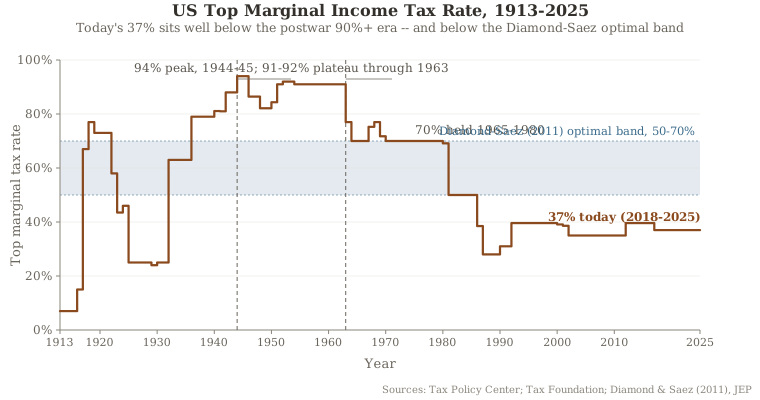
The Laffer intuition. When taxes are very high, further increases can reduce total revenue because people work less, shift to untaxed forms of compensation, or relocate. The elasticity $e$ captures the size of that response; the empirical estimates ($e \approx 0.25$, mostly avoidance) are what pull the Diamond-Saez optimum down from 100% to the 50–70% range.
Piketty's challenge: $r > g$. Thomas Piketty argued the optimal tax framework misses the big picture. If the rate of return on capital ($r$) persistently exceeds the growth rate ($g$), wealth concentrates automatically over time, as a structural feature of capitalism.
If the savings rate on wealth $(r - c)$ exceeds $g$, the wealth-to-income ratio rises without bound. Piketty argues this is capitalism's default trajectory absent wars, hyperinflation, or deliberate policy intervention.
If your investments grow at 5% per year and the economy grows at 2%, your wealth's share of the total pie increases every year. Do nothing and dynastic wealth accumulates automatically, as a matter of arithmetic alone.
"Is a wealth tax workable?"
Saez and Zucman proposed a 2% annual tax on wealth above \$50 million. Warren made it a campaign centerpiece. The economics says it's feasible. The politics says it's a minefield. The history says Europe already tried and mostly gave up.
Is the efficiency-equity tradeoff a hard constraint?
"The tax system now asks less of those at the very top than at any time in the last century. The optimal top marginal income tax rate, including all taxes, is between 50 and 70 percent."
— after Emmanuel Saez & Gabriel Zucman, The Triumph of Injustice, 2019
Saez and Zucman's work gave the progressive case hard numbers, estimating that America's 400 richest families paid a lower effective tax rate than the working class for the first time in 2018. Their proposed wealth tax, adopted by Elizabeth Warren's campaign, moved the Overton window. Whether or not a wealth tax passes, the empirical work on who pays what has permanently changed the debate.
"The wealth tax sounds appealing until you try to implement it. European countries that tried it found it raised less revenue than promised, created enormous compliance costs, and drove capital flight. There are better ways to tax the rich."
— after Lawrence Summers & Natasha Sarin, Washington Post, 2019
Summers is not defending the status quo; he wants higher taxes on the rich. His objection is to the specific instrument. He argues that reforming capital gains taxation, eliminating stepped-up basis at death, and strengthening the estate tax would raise more revenue with fewer distortions than a separate wealth tax. This is the technocratic center: agree on the goal, disagree on the tool. The irony is that political systems that can't pass a wealth tax may also be unable to pass the "better" alternatives.
Where this leaves us
Optimal tax theory says current top rates in most developed countries are below the revenue-maximizing level. There is substantial room for more redistribution at modest efficiency cost. The efficiency-equity tradeoff is real but its slope is gentle in the relevant range. Colbert's problem has a quantitative answer. The question is whether the political system will use it. The post-1980 widening of the within-country distribution, the empirical record the optimal-tax literature is responding to, sits in Globalization, financialization, and the great moderation in the Economic History textbook. The European wealth-tax repeals invoked in the take above sit in the long aftermath of Stagflation and the neoliberal turn in the Economic History textbook. The Mirrlees apparatus is the policy face of a lineage on taxation under hidden information. Information economics in the History of Economic Thought textbook traces the asymmetric-information turn that makes the whole optimal-tax problem a screening problem. Piketty's $r > g$ belongs to the post-2008 empirical-distribution program covered in Modern pluralism in the History of Economic Thought textbook; the asset-pricing foundation for why $r$ behaves the way it does is in Finance Basics in the economics textbook.
The theory says higher taxes are feasible. "Feasible" and "actually happening" are different things. The next stage shows why: a viral investigation into who actually pays and how the system was built to ensure it wasn't the people at the top.
Who really pays

Vox breaks down how the ultra-wealthy use the "buy, borrow, die" strategy to legally avoid paying taxes, and why the system was designed this way.
The 2021 ProPublica tax revelations exposed nothing illegal; legality was what made them damning. Jeff Bezos reported negative taxable income in 2011 and paid zero federal income tax. Elon Musk's true tax rate (taxes paid relative to wealth growth) was 3.27% from 2014 to 2018. The system worked exactly as designed.
Standard tax incidence analysis (Stage 1's tool) tells you who bears the economic burden of a tax. The consumer share of a per-unit tax is:
This is a clean, positive result. But it analyzes taxes that actually exist. The ProPublica story is about taxes that don't exist, the gap between statutory rates and effective rates created by legal avoidance strategies.
Economics textbooks teach you who bears the burden of a tax. The ProPublica story is about the burden of taxes that aren't levied. Billionaires grow wealth through unrealized capital gains, borrow against that wealth to fund consumption, and die with a stepped-up basis that erases the gain. The upshot is a 37% top rate that functionally collects single digits.
The "buy, borrow, die" strategy. The mechanism is simple. Step one: hold assets that appreciate (stocks, real estate, art). Don't sell them; unrealized gains aren't taxed. Step two: borrow against the assets to fund your lifestyle. Loan proceeds aren't income, so no tax. Step three: die. Under current US law, your heirs receive the assets at their current value (stepped-up basis), erasing all unrealized gains. The capital gains tax owed: zero. This is legal, common among the ultra-wealthy, and arguably the single largest loophole in the US tax code.
The political economy of tax design. Why does this loophole exist? Because the people who benefit from it have outsized influence over the rules. The Mirrlees framework assumes a benevolent planner optimizing the tax code. Real tax codes are the accretion of decades of lobbying, carve-outs, and compromises that serve no efficiency or equity purpose. The binding constraint on redistribution may be the elasticity of political influence.
"The top 25 richest Americans paid a true tax rate of just 3.4% from 2014 to 2018, while their collective net worth grew by \$401 billion."
— after ProPublica's The Secret IRS Files, 2021
"Why don't billionaires pay income tax?"
ProPublica showed that the top 25 Americans paid a "true tax rate" of 3.4%. The system isn't broken; it was built this way. Can a wealth tax fix it, or is there a better tool?
How high should taxes go?
"According to Forbes, those 25 people saw their worth rise a collective \$401 billion from 2014 to 2018. They paid a total of \$13.6 billion in federal income taxes in those five years, the IRS data shows. That's a staggering sum, but it amounts to a true tax rate of only 3.4%."
— Jesse Eisinger, Jeff Ernsthausen & Paul Kiel, “The Secret IRS Files,” ProPublica, June 2021
ProPublica obtained an unprecedented trove of actual IRS tax-return data and ran the comparison no tax return alone could surface: federal income taxes paid divided by wealth growth. The methodology is non-standard (the income tax was never designed to tax unrealized appreciation), but that is the point. The wealth at the top grew \$401 billion while the income that was actually taxed was a small fraction of it. The investigation also documents that in 2007 Jeff Bezos, then a multibillionaire, paid zero federal income tax; in 2011 he reported negative taxable income. The ultra-wealthy live in a different tax universe than everyone else, legally. The post-2008 distributional politics this story belongs to sits in The 2008 crisis and after in the Economic History textbook; the postwar era when the top marginal rate sat above 90%, the counterfactual the ProPublica numbers are implicitly compared against, is in The postwar golden age and decolonization in the Economic History textbook.
"Changes in technology have allowed a small number of highly educated and exceptionally talented individuals to command superstar incomes in ways that were not possible a generation ago."
— N. Gregory Mankiw, “Defending the One Percent,” Journal of Economic Perspectives 27(3), 2013
Mankiw's thesis, the same quote that anchored the opposing case in Stage 1, on a different question, reframes the ProPublica story as a category error. The top earners' wealth grew because the value of what they built grew (superstar-economics scale effects on a global market); the income tax never claimed to tax unrealized appreciation in any country; the top 1% already pay roughly 40% of all federal income taxes. On Mankiw's reading the "true tax rate" denominator (wealth growth) is doing all the rhetorical work and bears no relationship to any tax base the US has ever administered. The technical case is real. Taxing unrealized gains involves valuing illiquid assets every year and raises constitutional questions (the Sixteenth Amendment authorized taxing "incomes," and Eisner v. Macomber 1920 held that unrealized appreciation isn't income), and the few European countries that tried wealth taxes mostly repealed them. But the technical case sidesteps the structural one: a system whose top statutory rate is 37% but whose effective rate for the wealthiest is single digits has progressivity on paper only, and "we have never taxed this category" is a historical fact about the tax code, not an argument that we shouldn't.
Where this leaves us
The gap between statutory and effective tax rates for the ultra-wealthy is the practical expression of the mechanism design problem. The government can't tax ability, so it taxes income. When the wealthiest can choose not to realize income, the tax system breaks down. The Mirrlees math recommends rates well above the ones actually on the books; politics is what keeps them there. ProPublica moved the debate from theory to visceral reality. The system is producing outcomes no welfare function would endorse, by design. The Piketty–Saez–Zucman empirical-distribution program that produced these numbers is the inequality strand of Modern pluralism in the History of Economic Thought textbook.
Stages 1 through 4 have been about within-country inequality, who gets what in rich nations. The largest inequalities on Earth are between countries. The bulk of the between-country argument — institutions vs. geography, the convergence record, why China's growth was the largest single equality event in modern history — lives in the companion walkthrough Why are some countries rich and others poor?. The next stage takes one point you can't get without crossing that boundary: at the global scale the toolkit shifts, and the lever the development debate systematically underweights turns out to be migration.
Global inequality
"Just give people money. It turns out they spend it well."
— The operating principle of GiveDirectly, founded 2009
The simplest anti-poverty program, and the evidence says it works.
Step back from the within-country debate. The Gini coefficient for the United States is about 0.39. For the world as a whole, treating every person on Earth as a member of a single economy, the global Gini is approximately 0.70. The richest 10% earn more than half of global income. Most of this inequality is between countries. Where you are born matters more than anything you do after birth.
The poverty of redistribution in poor countries. In a country with per capita income of \$2,000, there is not much to redistribute. Even perfect equality would leave everyone poor. China grew 800 million people out of extreme poverty between 1980 and 2020 by growing the total pie, the largest single equality event in modern history. China's reform and the Asian century in the Economic History textbook carries the historical mechanics of that growth; Why are some countries rich and others poor? carries the institutions-vs-geography debate that asks why China could grow that fast and others couldn't.
But growth takes decades. Cash works now. GiveDirectly, founded in 2009, took a radical approach: give poor people in East Africa unconditional cash transfers and see what happens. The RCT (randomized controlled trial) evidence was striking. Recipients invested in durable goods: metal roofs, livestock, small businesses. They didn't waste it on alcohol or tobacco (a persistent myth that the data rejected), and they showed lasting income gains years later. The cost-effectiveness was competitive with or superior to most traditional development programs.
The Gini coefficient, derived from the Lorenz curve:
$$G = 1 - 2\int_0^1 L(x)\,dx$$where $L(x)$ is the cumulative share of income held by the bottom $x$% of the population. A Gini of 0.25–0.35 (Scandinavia) is considered low inequality. A Gini of 0.50–0.65 (South Africa, Brazil) is extremely high. The global Gini of ~0.70 is off the charts for any single country.
The Gini is a number between 0 (everyone has the same income) and 1 (one person has everything). Rich countries cluster around 0.3–0.4. The world as a whole is 0.7, more unequal than any single country. The biggest driver is the gap between rich-country and poor-country incomes. Born in Norway? You're rich. Born in Malawi? You're not. Almost nothing else matters as much.
Conditional vs. unconditional transfers. The traditional approach was conditional cash transfers (CCTs), which give poor families money if they keep kids in school and get health check-ups. Mexico's Progresa and Brazil's Bolsa Família are the flagship programs, with strong RCT evidence of success. But GiveDirectly's unconditional transfers raised an uncomfortable question: do the conditions actually matter? The evidence increasingly says not much. Unconditional transfers produce similar outcomes with lower administrative costs and more dignity for recipients. The monitoring apparatus turns out to be solving a problem the poor don't have.
Institutions and the end-run. Why does the cash-transfer result hold even when the institutional environment is bad? The Acemoglu–Johnson–Robinson institutional account (extractive vs. inclusive institutions; the institutional tradition from Veblen to Acemoglu in the History of Economic Thought textbook carries the lineage from Coase through North to AJR, and Why are some countries rich and others poor? runs the institutions-vs-geography debate) treats the institutional environment as the deep cause of cross-country income differences, but "get better institutions" is the development equivalent of "just be taller": correct but unhelpful on any decision-relevant timescale. Cash transfers are the end-run. They don't fix institutions, but they deliver results today while the institutional reforms everyone agrees are necessary take decades to materialize. The capability lens that reframes "development" as expanding what people can do, the substrate under both the cash-transfer and human-capital arguments, has its lineage in Development economics in the History of Economic Thought textbook.
"The most effective way to help the global poor is to let them move. Open borders would roughly double world GDP."
— after Michael Clemens, Center for Global Development, 2011
Is migration the real answer to global inequality?
Development economics focuses on making poor countries richer. But the fastest way to make a poor person richer is to let them move to a rich country. The "place premium" (the wage gain from moving) dwarfs any feasible domestic intervention. Clemens estimates open borders would add \$65 trillion to world GDP. No aid program comes close.
Growth or redistribution for the global poor?
"Our results suggest that the poor do not waste transfers. They invest in productive assets, housing, and nutrition. The myth that the poor can't be trusted with cash is not supported by the data."
— after Johannes Haushofer & Jeremy Shapiro, Quarterly Journal of Economics, 2016
The GiveDirectly RCT in Kenya was a watershed for development economics. Unconditional \$1,000 transfers to poor rural households produced significant increases in assets, consumption, and psychological well-being, with effects persisting over three years. The study directly refuted paternalistic assumptions about poor people's spending behavior and provided rigorous support for the simplest possible intervention: just give people money.
"Between-country inequality accounts for roughly two-thirds of global inequality. The most important 'redistribution' in the global sense is not taxation but convergence: poor countries growing faster than rich ones."
— after Branko Milanovic, Global Inequality, 2016
Milanovic's decomposition showed that your country of birth explains most of the variation in global income. This is both depressing (it suggests life outcomes are largely determined by geography) and hopeful (convergence growth has been reducing between-country inequality for decades). China's rise alone did more for global equality than all development aid combined. Cash transfers help individuals; growth helps hundreds of millions. The question is whether they're substitutes or complements, and Milanovic argues they're complements.
The verdict
At the global scale, the answer to "is inequality a problem economics can solve?" is partial, and the tools are different from what you'd expect. Why are some countries rich and others poor? is where that argument lives in full. Two narrower points hold at the global scale: the within-poor-country evidence on unconditional cash transfers, and the individual-level case for migration. The paternalistic apparatus of conditions, monitoring, and program design matters less than getting resources to people quickly and at scale. The GiveDirectly model has raised the bar every other program must now clear. The post-2008 global distributional dynamics, including the slowdown in between-country convergence after the GFC, sit in The 2008 crisis and after in the Economic History textbook.
Where this leaves us
We started with a viral video showing that Americans can't even guess how unequal their country is. Five stages later:
- The efficiency framework is silent on fairness (Stage 1). Total surplus measures the size of the pie. It says nothing about who gets the slices. Social welfare functions give you the vocabulary to express distributional preferences, but economics won't choose your values for you. The gap the video reveals is real, and the toolkit that dominates policy analysis was built to ignore it.
- Some redistribution makes the economy better (Stage 2). Poverty externalities, credit constraints, and human capital underinvestment mean the economy is leaving value on the table. Education, health, and basic safety nets pass the efficiency test on their own, before any fairness argument gets invoked. Redistribution of this kind is a market-failure correction dressed up in moral clothing.
- Optimal tax theory says rates should be higher (Stage 3). The Mirrlees framework, Diamond-Saez estimates, and Piketty's $r > g$ all point the same direction: current top rates are below the revenue-maximizing level. The efficiency-equity tradeoff is real but its slope is gentle. There is substantial room for more redistribution at modest cost.
- The system is designed to undertax the wealthiest (Stage 4). ProPublica showed that the effective tax rate for the ultra-wealthy is single digits. "Buy, borrow, die" is legal, common, and results from deliberate policy design shaped by the very people who benefit. What holds redistribution back isn't the behavioral elasticity the textbooks worry about; it's the political muscle of the people who would pay the tax.
- At the global scale, the toolkit shifts, and migration is the underweighted lever (Stage 5). Between-country inequality dwarfs within-country inequality; growth is the primary engine of convergence, and the bulk of that argument lives in Why are some countries rich and others poor? The global-scale claims here are narrower: within poor countries, the RCT evidence says unconditional cash transfers work, and at the individual level the largest single lever for closing global income gaps is migration, the lever politics refuses to discuss.
Is inequality a problem economics can solve? Not entirely. How much equality to demand is a moral and political choice, and no model will make it for you. What the models can tell you is the cost of achieving more equality, the tools that minimize that cost, the limits of what any tool can accomplish, and the specific parameters that determine whether a given policy is worth pursuing. The tradeoff is real. It's also gentler than its loudest advocates on either side would have you believe. And the place where the whole enterprise keeps breaking down is the politics that refuses to implement what the models already recommend. Marx's countercharge from Stage 1, that the apparatus that runs this analysis is itself part of the distributional politics it claims to be neutral on, remains undischarged at the end of five stages, absorbed as a frame the toolkit has to operate within. That distribution lineage lives in Distribution: Ricardo through Piketty.