Argentina 2023: hyperinflation to monetary-disorder apparatus
Argentina printed 211% inflation, elected a chainsaw-waving libertarian on a dollarization platform, and then disinflated through 2024 without the predicted collapse. Start with the case; the apparatus it forces you to reach for is not the one most readers expect.
The case as a news-reader saw it


In the final month of 2023, Argentine consumer prices rose 25.5 percent, in one month. The country had just elected, as president, a libertarian economist who campaigned with a chainsaw, promising to abolish the central bank, dollarize the currency, and shut down half the cabinet. The first hundred days were going to test whether any of that was serious.
The naive frame, Milei the chainsaw libertarian doing shock therapy, is shallow. The story that explains why the program did not collapse runs through a central bank that was already broken in a specific, technical way, and through a body of monetary theory that Argentine economists had been arguing about for forty years. Stage 2 introduces the apparatus that central bankers and IMF technicians were already reaching for years before Milei arrived. Stage 3 builds that apparatus out fully. Stage 4 asks what it then explains, and what it leaves to a bet.
The case as it appeared.
- October 22, 2023. First-round presidential vote. Milei finishes third with 30%; the sitting economy minister, Sergio Massa, leads with 36%. The blue dollar, the black-market rate, trades near AR\$1,100 to the US dollar against an official rate around AR\$367. The gap is the country’s real exchange rate; the official number is fiction.
- November 19, 2023. Milei wins the runoff with 56% against Massa, the man running the economy that produced the inflation. The vote is, among other things, a verdict on the status quo. Argentina’s long-run trajectory, from one of the world’s ten richest countries in 1913 to a serial-defaulter middle-income economy by 2000, is the real backdrop to that vote.
- December 10, 2023. Inauguration. Milei’s address coins the line that frames the whole program, “no hay plata” (there is no money), putting the fiscal shock on notice before a single measure is announced. (The chainsaw-and-whiteboard “afuera!” moment, crossing out ministry after ministry, was campaign theater from a September 2023 television appearance, not the inauguration.)
- December 12, 2023. Economy minister Luis Caputo announces the program: a 54% devaluation, taking the official rate from AR\$366 to AR\$800 per dollar overnight; a fiscal-emergency decree; deep subsidy cuts. The shock is fiscal and monetary at once.
- December 2023. The 25.5% monthly inflation print lands, the devaluation passing straight through to prices, exactly as expected. Headlines read it as the program failing on contact.
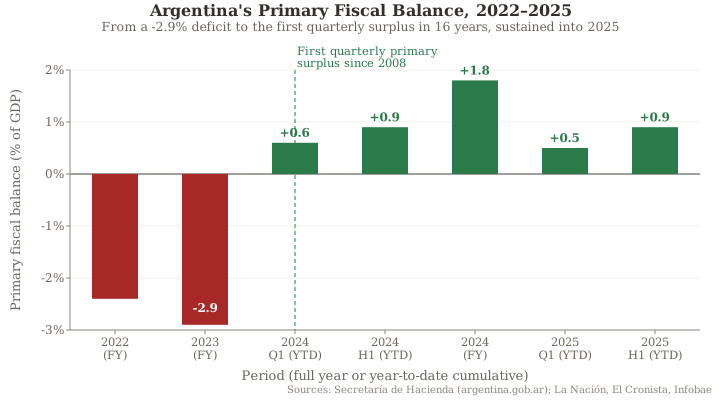
- January–April 2024. Monthly inflation falls in steps: 20.6%, 13.2%, 11.0%, 8.8%. In the first quarter Argentina records its first quarterly fiscal surplus since 2008. Real wages drop sharply; the measured poverty rate spikes above 50% before retreating.
- Mid-2024. Monthly inflation reaches single digits. Activity contracts, then begins to recover; the informal sector absorbs much of the pain. The predicted social explosion does not arrive.
- End-2024 / early-2025. Monthly inflation hovers near 2%. The capital controls known as the cepo are lifted in stages; central-bank reserves recover; country risk falls from roughly 2,000 basis points toward 600. The same reader who watched Venezuela’s hyperinflation grind on for a decade is entitled to ask why Argentina’s did not.
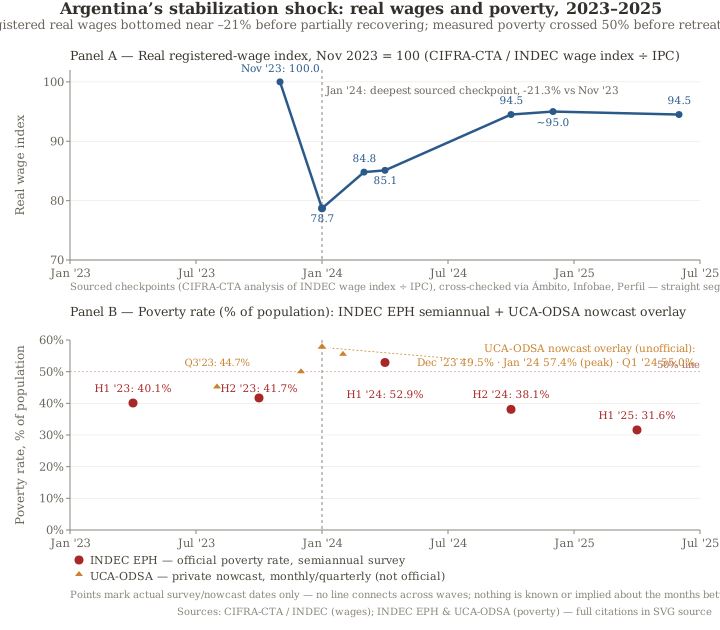
“Mr Milei’s shock therapy risks a backlash that could sink his presidency within months. Argentines have toppled governments for less; austerity this severe, imposed this fast, rarely survives contact with the street.”
— representative mainstream-press assessment, December 2023–March 2024 (archetypal of Financial Times / Economist / Foreign Affairs commentary)
“The chainsaw will destroy Argentina”
The confident December-2023 prediction across the mainstream press: shock therapy this severe would trigger a social explosion and collapse the program within months. It is worth taking seriously, austerity does fail this way, often. So why didn’t it here?
What happened, before any theory
The chainsaw was real; the program did not collapse; inflation came down faster than the consensus expected; activity bottomed and recovered. The mainstream press predicted otherwise, and the prediction was reasonable on the base rate. Why the program did not collapse is the work of Stages 2 and 3, and the answer turns out to require apparatus that was sitting on the shelf the whole time, in the balance sheet of the institution Milei promised to abolish.
The chainsaw made the news. What made the alternative untenable was a central bank that was already broken, in a way you need a specific apparatus to see.
The case as a central-banker saw it
“Argentina has been spending more than it earns for over a decade. The central bank has paid for this with money creation. There is no way out except to stop.”
— after Luis Caputo, economy minister, program announcement, December 12, 2023
Caputo was not a revolutionary. He had been Macri’s finance minister in 2018, the year Argentina went to the IMF for its largest-ever program; he had watched the 2018 currency run and the 2020 sovereign default up close. The diagnosis he announced in December 2023 was the one Argentine central bankers and IMF technicians had been making for years. The 2018 IMF program and the 2020 default that frame this trajectory sit in Economic History Ch.19 (The 2008 crisis and after), which covers post-2008 emerging-market policy.
To see what Caputo saw, start with the one identity every central banker carries in their head: where the money to cover a deficit comes from. (The measurement machinery underneath — how inflation, real-versus-nominal values, and the balance of payments are actually counted — is in Economics Ch.7 §7.2.)
A government that spends $G$ and raises taxes $T$ must finance the gap $G - T$ either by issuing new debt or by creating new money:
$$G_t - T_t = \Delta B_t + \Delta M_t$$When the bond term $\Delta B_t$ is closed off — markets won’t lend, or domestic demand for the central bank’s own paper is exhausted — the residual lands entirely on $\Delta M_t$. Money creation in excess of money demand is inflation.
A government can pay for a deficit two ways: borrow it or print it. When no one will lend any more — and Argentina had run out of lenders, foreign and domestic — the only door left is the printing press. Push more money through that door than people want to hold, and the extra money loses value. That loss of value is the inflation.
Fiscal dominance. The condition where the central bank is forced to print because the fiscal side has left it no choice has a name, fiscal dominance, and a canonical statement: Sargent and Wallace’s 1981 “unpleasant monetarist arithmetic.” Their point: a central bank cannot durably control inflation if the fiscal authority runs deficits it will not fund. Tight money today, without a fiscal fix, just shifts the money-printing to tomorrow, sometimes at a higher price. The formal substrate, the government budget constraint and its Ricardian limits, lives in Economics Ch.16 §16.3. The intellectual lineage, Sargent and Wallace as the originators of the unpleasant-arithmetic diagnostic, descending through the rational-expectations counter-revolution, runs along the money lineage of the History of Economic Thought timeline.
The Argentine twist: the central bank’s own debt. Argentina’s mechanism had a wrinkle that makes it the textbook case. To soak up the pesos it kept printing, the central bank (BCRA) sold short-term peso paper, LEBACs, then LELIQs, then overnight pases, paying interest to banks to park money rather than spend it. But that interest is itself new money. The BCRA was borrowing pesos to mop up pesos, then printing more pesos to pay the interest on the borrowing: a quasi-fiscal deficit growing on the central bank’s own balance sheet, separate from the Treasury’s. By late 2023 this stock of remunerated central-bank debt had reached roughly 12% of GDP, at peso interest rates north of 100%. The printing press had been moved inside the central bank and relabeled as monetary policy.

The blue dollar as the sensor. Argentina ran multiple exchange rates at once — an official rate, the MEP and CCL financial rates, and the black-market “blue” rate — held apart by the cepo cambiario, the capital controls. The gap between the blue rate and the official rate is the apparatus-detectable signal that money demand is collapsing: when people will pay nearly triple the official price to get out of pesos, the official anchor is gone.

“The real bomb was never the fiscal deficit alone. It was the mountain of remunerated central-bank debt, LELIQs and pases, whose interest had become a second, hidden deficit that could only be paid by printing.”
— Sturzenegger / Werning lineage on the BCRA quasi-fiscal deficit
“The LEBACs were the bomb”
The diagnosis that named the central bank’s own balance sheet as the proximate engine of the inflation. It was on the table for two finance ministers before it was politically possible to act on it.
Is “fiscal dominance” the right diagnosis?
“The roots of Argentina’s high inflation are fiscal. Persistent deficits, financed by the central bank, are the proximate cause; durable disinflation requires fiscal consolidation, not merely tighter money.”
— after the IMF’s Argentina Article IV / program-review framing, 2024
This is the mainstream, and it is steelmanned by the data. The IMF’s reading — shared by Caputo, by most Argentine academic economists, and by the broad central-banking consensus — is that the inflation was fiscal-dominance in the Sargent-Wallace sense: a fiscal authority running deficits it could not fund, forcing the money creation. The implication was borne out: stabilize the fiscal accounts and the inflation falls, because you have removed the thing forcing the printing. The first fiscal surplus in 16 years arrived in the same quarter the disinflation began, exactly as the fiscal-dominance frame predicts.
“The problem was never simply fiscal. It was monetary mismanagement compounded by an exchange-rate regime that strangled the productive economy, the inflation was driven as much by distributional conflict and capital-control distortions as by the deficit.”
— composite Argentine-heterodox / Kicillof-era reading
The heterodox reading, associated with the Kicillof-era policy tradition, argues the fiscal-dominance frame is too narrow: inflation in Argentina is also a distributional struggle over relative prices, and the multiple-exchange-rate regime plus capital controls were defensive tools against a hostile global financial system. Relative-price conflict and inertial indexation are real features of Argentine inflation that a clean money-printing story understates. But the load-bearing claim, that the deficit was not the binding constraint, runs into the consolidated balance sheet. The quasi-fiscal deficit on the BCRA’s books was itself a fiscal flow; calling it “monetary mismanagement” relabels the mechanism without changing it. Once the deficit was closed, the inflation fell, distributional conflict and all. On this case, the split is largely semantic.
Where this leaves us
Fiscal dominance is the diagnosis. The BCRA’s quasi-fiscal deficit was the proximate mechanism; the multiple-exchange-rate regime was symptom-management; the blue rate was the sensor reading that the apparatus was already broken. Caputo’s December 2023 program was the diagnosis that had been on the table for two finance ministers before it became politically feasible to act on it. For the wider question of what a central bank can and cannot do against a fiscal authority that won’t cooperate, the companion walkthrough on whether central banks can control the economy carries the central-bank-power story in the abstract.
But this is only the first piece of the apparatus. The Sargent-Wallace diagnosis tells you the situation is unsustainable. It does not tell you how to fix it credibly, and it does not tell you whether dollarization is the load-bearing fix or whether fiscal discipline is enough. For that, we need the full apparatus, and we need to ask why Calvo, an Argentine-trained economist, spent forty years building it.
The apparatus class the case forces
“Inflations are sustained when fiscal policy is unsustained, and they end when fiscal policy credibly changes.”
— after Thomas Sargent, The Ends of Four Big Inflations, 1982

Sargent’s 1982 study of the 1920s European hyperinflations is the apparatus paper for Argentina 2023. His finding: the great inflations did not end gradually as money growth slowed. They stopped, almost overnight, when the fiscal regime visibly and credibly changed. The chainsaw, on this reading, is the visible commitment device, and the apparatus that follows is the class of theory that tells you when such a device works and what it costs.
Built up from this case, the apparatus has four pieces. Each says something specific about Caputo’s fiscal plan and Milei’s dollarization promise.
1. Sargent-Wallace, fully built. The fiscal-dominance trajectory has exactly two stable end-states. Either the government makes a credible fiscal correction that re-anchors expectations and pulls money demand back, the Sargent 1982 ending, or the currency collapses into hyperinflation, which resets the system by destroying the real value of the nominal stock. Which end-state you reach is determined not by the size of the deficit but by the credibility of the commitment to fix it.
Write the government’s solvency condition as a present-value identity: the real value of outstanding debt must equal the present value of future primary surpluses,
$$\frac{B_t}{P_t} = \sum_{s=0}^{\infty} \beta^s\, E_t\!\left[\text{surplus}_{t+s}\right]$$where $B_t$ is nominal debt, $P_t$ the price level, and $\beta$ the discount factor. Read left-to-right with the surplus path fixed, this pins down what debt is sustainable. Read right-to-left with debt fixed, the same equation says the price level must adjust to make it hold, which is where the next piece of the apparatus starts.
A government’s debt is only worth what the government can credibly promise to pay back out of future surpluses. Promise enough, believably, and the debt holds its value, the inflation stops. Fail to promise it, or promise it without being believed, and something has to give: the price level rises until the real debt shrinks to what the surpluses can actually cover.
2. FTPL, the rival interpretation. The Fiscal Theory of the Price Level — Cochrane, Leeper, Sims — reads that same present-value equation as a theory of the price level itself: when expected surpluses fall short of real debt, the price level rises to restore the identity, and it can do so without any contemporaneous money growth, driven purely by a shift in fiscal expectations. Think of government bonds as shares in the fiscal “firm,” repriced when the market revises its view of future surpluses. FTPL captures the 2021–2022 global inflation episode well. On Argentina’s way down through 2024, though, it adds little distinctive: given a credible surplus, FTPL and Sargent-Wallace predict the same disinflation, so the heavier machinery does not change the verdict here. The full treatment is in Economics Ch.16 §16.5; the FTPL-revival lineage through Cochrane and Sims runs along the modern end of the monetary-theory lineage of the History of Economic Thought timeline.
3. Calvo’s dollarization-as-credibility. Guillermo Calvo, the Argentine-trained economist who spent a career on exactly this, built the apparatus for credibility transfer. When a domestic commitment device (a fiscal rule, a central-bank-independence statute) is not credible because the institutional context cannot enforce it, an external device — dollarization, a currency board, a hard peg — can import credibility from a more disciplined jurisdiction. The price is steep: external commitment forecloses domestic monetary policy. No lender of last resort, no countercyclical response, no exchange rate to absorb a terms-of-trade shock. The whole bet is that the credibility gained exceeds the flexibility lost. That is the formal core of the dollarization argument, and the exchange-rate-regime taxonomy it sits in — fixed, floating, dollarized, currency-board, plus the trilemma — lives in Economics Ch.17 §17.3.
4. Hanke’s threshold. Steve Hanke defines hyperinflation precisely, a monthly inflation rate of at least 50% sustained for at least 30 days, and Argentina’s December 2023 print of 25.5% monthly came close to but did not cross that line. The threshold matters because Hanke is the most visible public advocate for dollarizing Argentina now, and locating his claim on the apparatus is what lets us argue with it. The Weimar hyperinflation of 1923 — the canonical fiscal-dominance episode, where the threshold was crossed catastrophically — sits in Economic History Ch.12 (Interwar monetary collapse).
Now read the case against the apparatus. Caputo’s plan, fiscal surplus first, rate normalization, gradual lifting of the cepo, closes the fiscal-dominance gap without an external commitment device: it bets that a credible domestic fiscal correction is enough. Milei’s dollarization promise would add the external device on top, trading away monetary flexibility for additional commitment. The apparatus does not tell you which bet is right. It tells you exactly what each bet is.
“Argentina has tried every flavor of domestic monetary rule for seventy years, and broken each one. The only discipline that has ever held is the discipline a country cannot un-vote: dollarization. Abolish the peso and you abolish the printing press.”
— Hanke / Cachanosky / early-Milei dollarization argument
“Only dollarization locks in discipline”
The case that Argentina’s seventy-year record of fiscal-promise-then-break means no internal rule can ever be credible, only an external anchor, one no future government can quietly abandon, will hold.
External anchor, or credible fiscal rule?
“A country that has defaulted on its own discipline as many times as Argentina cannot credibly promise to behave. It can only credibly remove its own ability to misbehave. Dollarization is that removal.”
— after Steve Hanke, dollarization commentary, 2023–2024
Hanke’s position inherits Calvo’s apparatus directly: where domestic commitment is structurally unenforceable, the credibility has to come from outside. He argues the seventy-year record is evidence about the institutions themselves: the same political economy that broke every previous rule will break the next one, so the only durable fix is one that future governments cannot reach. Steelmanned: the strongest form of the dollarization-yes case is that Argentina’s institutions cannot hold an internal rule, and an external one is the only kind that survives a political cycle.
“Once the fiscal accounts are credibly fixed, dollarization adds rigidity without adding solvency. You give up the lender of last resort and the ability to respond to shocks, and you get, in exchange, a commitment you could have made with a peso.”
— after Iván Werning, interviews and writing on Argentine stabilization, 2024
Werning’s position, shared by most IMF research staff and most non-activist Argentine academics, is that the credibility problem is solvable on the fiscal side and that dollarization mistakes the symptom for the cure. If the binding constraint is the deficit, fix the deficit; a credible fiscal surplus re-anchors expectations whether or not the currency is the peso or the dollar. What dollarization adds is rigidity precisely where Argentina’s shock structure — commodity-price swings, sudden stops — demands flexibility. Steelmanned, this is the claim that the institutional fix and the monetary regime are separable, and you should fix the institution rather than amputate the policy toolkit. The argument over money’s nominal anchor here connects to the broader question of what money even is.
Where this leaves us
Sargent-Wallace tells you Argentina was in fiscal dominance. The Caputo plan is the fiscal-discipline-only path; dollarization is the external-commitment path. Both are coherent answers to the apparatus question, and the apparatus refuses to pick between them in the abstract, the choice turns on whether you believe Argentina’s institutional context can sustain a fiscal rule without an external anchor. Which one is additionally required is the question Stage 4 takes up.
The abstract form of that contest — whether inflation is fundamentally a monetary or a fiscal phenomenon — is taken up directly in the companion reframe walkthrough Is inflation a monetary or a fiscal phenomenon?, and the wider regime substrate behind the apparatus — how money, and the theory of who controls its value, has shifted across eras — runs through Money: theory and regime across eras.
The apparatus says both paths can work. The data so far says the Caputo plan has done the work. The remaining bet is whether the fiscal surplus survives the next political cycle, and that is a question the apparatus alone cannot answer.
What the apparatus explains, what it doesn’t, what to watch
“For the first time in sixteen years, the Argentine state spent less than it took in. The hardest part of the program is done.”
— after Luis Caputo, on the first-quarter 2024 fiscal surplus (an achievement echoed in the IMF’s April 2024 program review)
In April 2024, Argentina ran a fiscal surplus for the first time in 16 years. The Caputo plan had delivered the primary precondition the apparatus said was necessary. The Milei dollarization promise, the reform the campaign was built on, had not been delivered. And the disinflation continued anyway. That gap, between what was promised and what did the work, is the data the apparatus now has to read.
The apparatus said credibility decides the end-state. The comparative record says where credibility has come from, and, mostly, it has not come from dollarization.
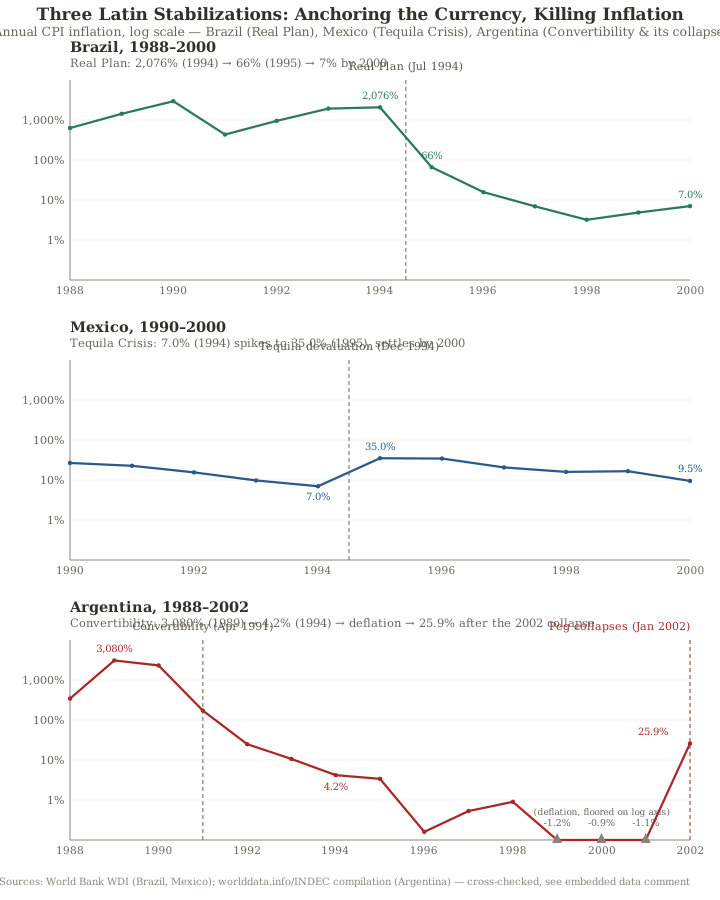
Brazil, 1994. The Real plan ended more than thirty years of Brazilian high inflation with no dollarization at all. It worked because the fiscal commitment was credible, the plan’s constitutional element was the 1994 Social Emergency Fund, an amendment that freed a share of federal revenue for the stabilization effort, and because the transitional URV indexed-unit mechanism re-anchored expectations without any external currency. Brazil’s Fiscal Responsibility Law, the statute that locked federal, state, and municipal spending into hard rules, followed in 2000. This is the central existence proof for the fiscal-only path: a large, institutionally-troubled Latin economy that stabilized durably on credibility alone. The 1980s Latin debt crises that set the stage, the previous round of IMF stabilization without dollarization, sit in Economic History Ch.16 (Stagflation and the neoliberal turn).
Mexico, 1995. The Tequila crisis triggered fiscal stabilization, a currency adjustment, and an IMF package; the recovery was rapid and durable, again without dollarization. Mexico is the strongest case that a floating peso plus a credible fiscal commitment outperforms the plausible dollarized alternative, even through a sharp shock. The flexibility the floating rate preserved was what let Mexico absorb the shock and recover.
Argentina’s own Convertibility, 1991–2001, the counter-evidence. The previous Argentine external-commitment device pegged the peso one-to-one to the dollar. It worked for a decade, and then collapsed catastrophically when the fiscal commitment failed at the end of the 1990s, taking the banking system and a presidency down with it. The lesson cuts against the simple dollarization case: external commitment is not a substitute for fiscal discipline. When the fiscal discipline fails, the external commitment fails with it, and fails harder, because there is no exchange rate left to give. The question dollarization raises is therefore whether it is a useful complement, insurance that pays off in the specific scenario where a future government would otherwise break a fiscal rule. The commitment-device framing under which that question lives is in Economics Ch.18 §18.2.
Ecuador 2000 and El Salvador 2001, weakly informative. Both dollarized after a crisis and both have functioned for around twenty-five years, but neither is structurally close enough to Argentina 2024 to decide the case: Ecuador had oil, El Salvador had remittance flows, and both had smaller, less politicized fiscal contexts. The empirical record on dollarization-as-additional-reform is thin.

The Caputo plan, by mid-2025: monthly inflation near 2%; the first 16-year fiscal surplus held; country risk down from roughly 2,000 basis points to 600; the cepo capital controls lifting in stages; central-bank reserves recovering. The dollarization-not-yet bet has, so far, been vindicated by the data, the fiscal-only path did the work. But the bet is about durability: does the fiscal surplus survive the next political cycle, the general election around 2027? If it does, the Caputo plan vindicates Werning. If it doesn’t, Hanke’s argument that only an external anchor survives a political cycle gains exactly the evidence it has been waiting for.
“The debate is over. Milei did it — surplus, disinflation, reserves rebuilding — and he did it without dollarizing. There is nothing left to reform; the only task now is to not undo it.”
— mid-2025 Milei-supportive commentary
“Argentina already won”
The mid-2025 victory lap: it worked, the data proves it, no further reform is needed. Half-right in a way that matters, and premature in a way the apparatus can name precisely.
Is the job done, or just begun?
“The fiscal anchor is the real anchor. We have it. Dollarization would now add cost and rigidity without adding anything the surplus does not already provide.”
— after Iván Werning, on why fiscal discipline is sufficient, 2024–2025
Werning’s case is that the evidence has already answered the question for practical purposes: the surplus re-anchored expectations, the disinflation followed, and dollarization would now buy a commitment Argentina has already demonstrated it can make, at the cost of the lender-of-last-resort and shock-absorption tools it will need the next time soy prices crash. Steelmanned, this is the claim that the credible fiscal surplus has done everything an external anchor would have done, with none of the rigidity, and that the burden of proof has shifted onto the dollarizers to show what additional insurance is worth its price.
“A surplus you can vote away is not a constraint. The question was never whether Milei could run a surplus, it was whether the next government can be stopped from spending it. Only an external anchor does that.”
— after Steve Hanke, on the missing commitment step, 2024–2025
Hanke’s case concedes the surplus and presses on the durability. A fiscal rule that depends on the governing party’s continued willingness is exactly the kind of internal commitment Argentina has broken before; the 2027 cycle is the first real test, and the entire point of an external anchor is to make the rule survive a government that would otherwise abandon it. At its strongest this is the claim that “worked so far” and “will hold” are different propositions, and that the discipline of the last seventy years says the second one needs more than a promise. The two of them are not really disagreeing about the data. They are disagreeing about whether Argentina’s institutions can hold a self-imposed rule, a frame-level question about commitment devices.
The honest answer
Three claims, and they do not all have the same shape. The diagnosis is settled: Argentina 2023 was fiscal dominance in the Sargent-Wallace sense, with the BCRA’s quasi-fiscal deficit as the proximate mechanism. The stabilization is working: the Caputo plan, fiscal surplus first, is broadly mainstream IMF orthodoxy, and by mid-2025 it has delivered measurable success without dollarization. On both, the mainstream verdict is consensus.
Whether dollarization is the additional right step is contested, and contested at the frame level. Werning and Hanke disagree about something prior: whether an external commitment device is categorically more credible than an internal fiscal rule in an institutional context like Argentina’s. The mainstream weight sits with Werning — fiscal discipline has proven sufficient so far, and dollarization’s flexibility cost is real — but the split is live.
What resolves it is a single, falsifiable parameter: does the post-2024 fiscal surplus survive a political cycle? If the discipline holds through the 2027 election and a change of government, dollarization was unnecessary insurance and Werning was right. If it doesn’t, dollarization was the missing commitment device the whole time and Hanke was right. The apparatus cannot answer that; only the next few years can. The deeper policy debate over dollarization itself, taking the apparatus as given and arguing the choice on its own terms, belongs to its own walkthrough Is dollarization good economics?; for the central-bank-power dimension of all this, the companion on whether central banks can control the economy carries that thread.
The sibling case that ran the other way, a hyperinflation that ground on instead of resolving, is Venezuela collapsed. Why?. The apparatus class diverges sharply there: Argentina 2023 is fiscal dominance in a still-functioning economy, while Venezuela is a multi-axis collapse — price distortion, sanctions, oil dependence, rent extraction — in which only Hanke’s hyperinflation threshold overlaps.
Where this leaves us
- The case as news. A 211% inflation year, a chainsaw campaign, a 54% devaluation, and a disinflation that arrived faster than the consensus predicted, the program survived the shock the mainstream press bet it could not.
- The diagnosis the central-bankers had. Fiscal dominance, a deficit the government could not fund, financed through the central bank’s own balance sheet, with the LELIQ overhang as the proximate engine and the blue-dollar gap as the sensor.
- The apparatus the case demanded. Sargent-Wallace unpleasant arithmetic, FTPL as its rival reading, Calvo’s dollarization-as-credibility, and Hanke’s threshold, the class that turns “chainsaw libertarian” into a precise question about commitment devices.
- The live wager that remains. Fiscal discipline did the work without dollarization; whether the discipline survives a political cycle is the one parameter that settles whether the external anchor was ever needed.
The case forced an apparatus the chainsaw imagery hid. Read naively, Argentina 2023 is a libertarian doing shock therapy; read through the apparatus, it is a textbook fiscal-dominance episode resolved by a credible fiscal correction, the Sargent 1982 ending, in which inflations stop when the fiscal regime visibly and credibly changes. The chainsaw was the commitment device; the surplus was the substance; the disinflation was the apparatus’s central prediction coming true.
What the apparatus cannot close is the bet. The resolving parameter is concrete and dated: whether the post-2024 fiscal surplus survives the next political cycle around 2027. That is a falsifiable claim with a clock on it, which is the most an apparatus is allowed to promise about a case that is still resolving in the news.