Is MMT crank or serious?
A bestseller says the government can’t run out of money. The most famous economists alive call it voodoo. Both are overstating.
The deficit myth
“The federal government can always afford to spend more. The question is never ‘how will we pay for it?’ The question is ‘will it cause inflation?’”
— after Stephanie Kelton, The Deficit Myth, 2020
Kelton’s book was a New York Times bestseller, and the slogan it popularized, the government can’t run out of its own money, reached tens of millions. The reflex is to file it under “print money, deficits don’t matter” and dismiss it. Do that and you have argued with a cartoon. The serious version is a claim about what kind of constraint a currency issuer faces. Start there.
The whole school turns on one distinction: currency issuer versus currency user. You and I are users. A household, a business, a city, a gold-standard treasury, a euro-member government, all users. A user must get money before it can spend: earn it, tax it, borrow it. It can run out. It can be forced to default on debts denominated in a currency it does not create.
A government that issues its own free-floating fiat currency is on the other side of that line. It spends the currency into existence and collects it back as tax; the sequence runs the opposite direction from a household’s. It cannot be forced into involuntary default on obligations denominated in money it alone creates. The constraint that binds it is a different one, and the rest of the argument tests that hinge. Its formal home, inside the government budget constraint, arrives in Stage 2.
“They’re not like us. The federal government is the issuer of the currency. We’re just the users.”
— after Stephanie Kelton, The Deficit Myth, 2020
Can a government that prints its own money go broke?
The viral version is “deficits don’t matter, just print.” That version is a caricature MMT itself rejects. Here is the version Kelton actually defends, the one you have to beat.
The claim and its cartoon
“There’s no such thing as running out of money for a country that issues its own currency. There are real limits — the availability of real resources, and the risk of inflation — but the federal government is not like a household.”
— after Stephanie Kelton, The Deficit Myth, 2020
Kelton’s reframe is precise, and worth reading in her own words before anyone reaches for a rebuttal. The federal government is the issuer; you are a user; the two face different constraints. The slogan that the deficit is a measure of how much trouble we are in gets the sign backwards; the government’s deficit is the rest of the economy’s surplus. Whether or not the program she builds on this holds, the starting move is a distinction the textbooks already contain.
“If you think the government can just print money to pay for everything with no consequences, look at Weimar Germany, look at Zimbabwe.”
— the popular dismissal, in its most common form
This is the reflex MMT meets most often, and it misses. The hyperinflation cases — Weimar in 1923, Zimbabwe in 2008 — are economies that monetized spending far past the point where real capacity could absorb it, with the inflation constraint screaming and ignored. That is the failure the sophisticated MMT account warns about: the constraint is inflation, and these are what happens when you blow through it. The serious mainstream reservation waits for Stage 3, aimed at the policy itself.
Where this leaves us
The deficit-myth reframe marks a real distinction between a currency issuer and a currency user, and the mainstream actually accepts it. So “crank” is already looking too cheap. But accepting it only sharpens the two questions that decide whether MMT is intellectually serious: is the reframe new, or did the discipline already have it? And does the policy MMT builds on top of the diagnosis survive contact with how politics actually works?
If a currency issuer really can’t be forced to default, if the constraint really is inflation, then either MMT discovered something the textbooks missed, or the textbooks already knew it and MMT gave it a louder microphone. Which is it?
What MMT gets right
2020: “A currency issuer can never run out of its own money.”, 1943: “Government fiscal policy… should be undertaken with an eye only to the results… and not to any established traditional doctrine about what is sound or unsound.”
— the modern MMT slogan, set against Abba Lerner, “Functional Finance and the Federal Debt,” 1943
The most surprising thing about MMT’s headline claim is how old it is. Grant the school its central point. Is it true? And if it’s true, is it new? Two different questions, with two different answers.
The diagnostic has a formal home, and it is an orthodox one. Write down the government budget constraint, the identity every intermediate macro course teaches. Spending in excess of taxes has to be financed, and there are exactly two margins: issue bonds, or create money. Consolidate the treasury and the central bank into a single balance sheet (analytically, the two are arms of the same sovereign), and the money-creation margin is always available to a government whose debts are denominated in the money it issues. That margin is what removes the involuntary-default floor. The constraint changes character. What binds is the supply of real resources, and excess nominal spending against fixed real capacity is inflation.
The consolidated government budget constraint, in a single period:
$$G - T = \Delta B + \Delta M$$where $G - T$ is the primary deficit, $\Delta B$ is new bond issuance, and $\Delta M$ is money creation. For an issuer of its own free-floating fiat currency, $\Delta M$ is unbounded in nominal terms, so the constraint that bites is the inflation that excess spending produces when nominal demand outruns real capacity.
A household has to earn or borrow dollars before it can spend them. The issuer of dollars spends them into existence first and collects them back as tax afterward; the sequence runs the other way. That is the whole asymmetry. It doesn’t make spending free; it means the thing that can stop a currency issuer is a shortage of real stuff to buy, which shows up as rising prices.
The formal apparatus — the consolidated constraint, the financing margins, and where the inflation constraint enters — is Economics Ch.16 §16.3 (The Government Budget Constraint).
“A sovereign government that issues its own non-convertible currency, with a floating exchange rate, can never become insolvent in that currency.”
— after L. Randall Wray, Modern Money Theory, 2012
“A currency issuer can’t go broke”
On this one, MMT mostly wins. The claim is correct, precondition-bounded, and the surprise is that it’s eighty years old.
A discovery, or a restatement?
“Taxes for revenue are obsolete. The federal government’s spending and taxing should be judged by their effects on the economy, not by their effect on the government’s budget position.”
— after Beardsley Ruml, “Taxes for Revenue Are Obsolete,” 1946
MMT’s own theorists name the ancestry openly. Kelton, Wray, and Warren Mosler build directly on Abba Lerner’s functional finance (1943): judge fiscal measures by their effects on output and inflation. Lerner is a Keynesian-revolution figure, and the move sits squarely in what that revolution produced, the policy-theory branch that made demand management the right frame for fiscal policy. The lineage runs deeper still, back through Knapp’s chartalism to money-as-state-liability. MMT’s diagnostic is Lerner’s, sharpened and amplified.
Lerner’s functional finance belongs to the Keynesian revolution, the demand-management turn in fiscal thought that History of Economic Thought Ch.8 (The Keynesian revolution) sets out. For the longer chartalist→Lerner→MMT thread across eras, money as a creature of the state, see “Money theory and monetary regime, across eras”.
“The valid part of MMT is not new, and the new part of MMT is not valid… the analysis of fiscal space and the consolidated balance sheet is standard.”
— the mainstream “placement” reading, as commonly summarized (echoing Blanchard, Mankiw, and standard intermediate macro)
Olivier Blanchard and Greg Mankiw both accept the diagnostic. A fiat issuer faces a resource constraint; it falls out of the same consolidated budget constraint they teach. The objection is a placement: this is already in the textbook, so the novel contribution is the framing and the political salience. The diagnosis is right, and it is old.
Where this leaves us
MMT is right that a sovereign currency issuer faces an inflation constraint, and it is right loudly and usefully. The reframe cleared away a genuinely confused public discourse about affording things. But it is right about something the discipline already knew. This is Lerner’s functional finance, restated. The action is in what MMT proposes to do with the diagnosis.
So the diagnosis is sound, and old. What decides whether MMT is serious as a program is whether the policy it builds on top of the diagnosis holds up. MMT says: spend to full employment, and just watch inflation. That little word “just” is carrying enormous weight.
Where MMT is contested
“Modern Monetary Theory… is fallacious at multiple levels… its proponents have a flawed model of how the monetary system actually works.”
— Lawrence H. Summers, The Washington Post, March 2019
When the discipline’s most prominent voices called MMT dangerous, they granted the diagnostic. The charge was about the prescription, and specifically about whether “just watch inflation” is a policy a real political system can actually execute.
Grant everything in Stage 2. Three distinctive MMT prescriptions sit on top of the granted diagnostic, and each is where the contest is.
1. “Watch inflation” as operationally sufficient. The diagnostic says the real constraint is inflation. The prescription says to spend up to that constraint, and to pull back — raise taxes, cut spending — when inflation appears. The trouble is the pull-back. Raising taxes or cutting programs mid-cycle to cool an overheating economy is exactly what legislatures are worst at. Stabilization was delegated to an independent central bank with a rule because the fiscal authority could not be trusted to contract on time.
2. The job guarantee as the inflation anchor. MMT’s signature proposal is a federal job guarantee, a standing offer of employment at a fixed wage, functioning as a buffer stock of labor. In a downturn the pool fills (automatic stimulus); in a boom workers are bid out of it into private jobs (automatic restraint); and the fixed guarantee wage is meant to anchor the price of low-wage labor the way a commodity buffer stock anchors a price. The inflation-anchoring property is the contestable one: it is a strong empirical claim about Phillips-curve and buffer-stock dynamics, defensible in theory, untested at national scale, and doing far more unproven work than its advocates concede. The relevant inflation-dynamics apparatus, the Phillips curve and the natural rate, is Economics Ch.15 §15.3 (The New Keynesian Phillips Curve).
3. Treasury–central-bank consolidation. MMT analyzes the government as a single consolidated entity, treasury and central bank as one, which is what makes the currency-issuer point crisp. But the independent central bank, the treasury that “funds” itself through the bond market, and the rule that the central bank doesn’t simply credit the treasury’s account on demand are deliberate institutional choices that change behavior. Treating the separation as something to see through understates how much it disciplines fiscal policy in practice.
“Spend until inflation, not until some arbitrary debt number. When inflation threatens, pull back.”
— the MMT operational rule, as commonly stated
Can a government run fiscal policy as an inflation thermostat?
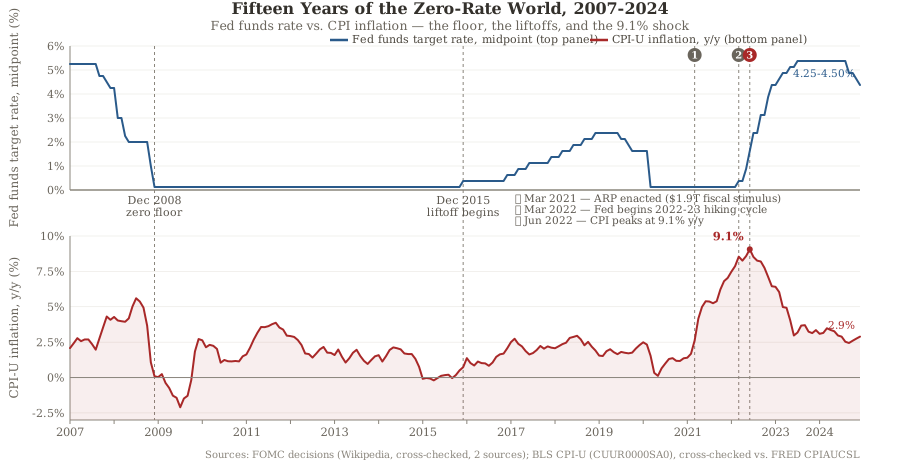
“Just watch inflation” sounds disciplined. The word doing the work is “pull back.” And 2021–22 is the closest thing we have to a live test of whether the system actually can.
Can the thermostat be trusted?
“The job guarantee is a powerful automatic stabilizer. It expands and contracts with the business cycle without anyone having to legislate it, and the fixed wage anchors the broader price level.”
— the Kelton–Wray case for the buffer-stock mechanism
The strongest defense builds the adjustment into standing institutions. A job guarantee adjusts automatically, absorbing labor in slumps and releasing it in booms with no vote required, and the guarantee wage gives the price system a floor that doesn’t drift. On the 2021–22 record, the defenders’ reading is that the inflation was overwhelmingly a supply shock — ports, chips, energy — so what it stresses is pandemic logistics. The buffer-stock idea is clever, and the supply-shock point is partly right.
“The MMT approach assumes a degree of fine-tuning ability that we don’t have. By the time you see the inflation, the political process to pull back is far too slow.”
— the Summers–Rogoff–Krugman line on responsiveness
The critics here engage the sophisticated MMT. They grant the diagnostic; they grant that automatic stabilizers help. The objection is targeted: a never-yet-built national job guarantee is being asked to do the inflation-anchoring work, and we have no evidence it can; meanwhile the discretionary part of the prescription depends on a fiscal contraction that 2021–22 showed up as politically absent. Paul Krugman’s 2019 exchange with Kelton turned on exactly this question, whether fiscal policy can be operated as a real-time stabilizer without an interest-rate lever in independent hands. The stress test that counts is the 2021–22 US episode, high inflation well short of hyperinflation and without uncontrolled monetization. Weimar and Zimbabwe answer only the strawman.
Where this leaves us
Granting the diagnostic, the distinctive prescriptions are where MMT gets weaker. “Just watch inflation” assumes a real-time fiscal responsiveness the political system has rarely shown, and 2021–22, the closest thing to a live test, ran the way the critics predicted: a big fiscal expansion, four-decade-high inflation, and a system that left the tightening to the Fed. The job guarantee is a serious proposal whose inflation-anchoring claim is untested at national scale. The consolidation framing clarifies the diagnostic but understates what the institutional separation does. The diagnostic still holds; the program built on top of it carries assumptions the record doesn’t support.
MMT also shows up inside two adjacent questions, from different angles. For MMT and FTPL as the two live fiscal-theoretic edges of whether spending helps, see “Does government spending help the economy?” (Stage 4). For the monetary-vs-fiscal reading of the 2021–22 price level, the active/passive regime apparatus, see “Is inflation monetary or fiscal?”.
So where does that leave the school? Its critics call it trivially true or dangerously wrong. Its advocates call it a paradigm shift. Both can’t be right, and neither is.
Where the walkthrough lands
One camp: “MMT is either trivially true or dangerously wrong.” The other: “This is the most important shift in macroeconomic thinking in a generation.”
— the two camp verdicts on MMT, paraphrased and set side by side
The public debate offers two answers, crank or revolution. Both are overstated, and the calibrated middle is what holds.
MMT is often filed next to the fiscal theory of the price level (FTPL), both are post-2008 fiscal-side frames, but they answer different questions. FTPL is a theory of what determines the price level: it makes the price level depend on the present value of fiscal surpluses. MMT makes a claim about constraints and operations, what binds a currency issuer, and how to run fiscal policy given that. The price-level apparatus, and the active/passive regime flip that goes with it, is the subject of a companion walkthrough. The formal FTPL home is Economics Ch.16 §16.5 (Fiscal Theory of the Price Level).
Placed in the longer view, MMT is one of several post-2008 challenger frames — alongside Piketty on inequality, the fiscal theory of the price level, the Minsky revival on financial instability, and complexity macro — that pushed at a New Keynesian consensus the crisis had shaken. That is where the history-of-thought account puts it: History of Economic Thought Ch.17 (Modern pluralism) §17.5 (The expanding frontier), which names MMT as one challenger among several.
“MMT is either trivially true or dangerously wrong.”
— the standard mainstream dismissal
Trivially true, or dangerously wrong?
The dismissal is a clever trap: whatever’s right in MMT is old, whatever’s new is reckless. The trouble is that the trap is itself too strong.
The verdict
MMT is a serious diagnostic with a contestable prescription. Its core claim, that a currency issuer faces an inflation constraint, is correct, accepted, and old. It is Lerner’s functional finance with a louder microphone. Its distinctive prescriptions, that “watch inflation” is operationally sufficient, that the job guarantee anchors inflation, that we should read government as a consolidated entity, are weaker, and the 2021–22 inflation surge exposed the political-responsiveness assumption the operational story rests on.
So: neither crank nor revolutionary. The diagnosis is right and respectable, and the “trivially true or dangerously wrong” dismissal is itself too strong, because the reframe was useful and the danger is specific to one assumption in the prescription. The diagnosis is also old, and the program is shakier than its advocates claim. The honest verdict is the calibrated middle. And the residual disagreement, whether the distinctive prescriptions deserve more credit than the mainstream majority gives them, is a live argument inside economics, between a discretionary-thermostat model and a rules-plus-independent-central-bank one. It is not a question of whether the school is intellectually serious. It is.
Where this leaves us
We started with a bestseller telling tens of millions that the government can’t run out of money, and the most famous economists alive calling it voodoo. The verdict splits along a single seam. MMT’s diagnostic, that a sovereign issuer of its own floating-rate fiat currency faces an inflation constraint, is correct, accepted by the mainstream, and old. It is Abba Lerner’s functional finance from 1943, reframed and amplified. Its distinctive prescriptions, that “just watch inflation” is operationally sufficient, that a federal job guarantee anchors inflation, that treasury and central bank should be read as one consolidated entity, are weaker, and 2021–22 stressed exactly the assumption the operational story needs: that the political system can run fiscal policy as a real-time inflation thermostat. It did not; the Fed tightened conventionally. The calibrated middle is the answer.
MMT touches several adjacent questions, each from a different angle. For MMT and FTPL as the two fiscal-theoretic edges of whether spending helps, see “Does government spending help the economy?” For MMT’s print-money claim inside the question of what money even is, see “What is money, actually?” For the monetary-vs-fiscal reading of the price level, see “Is inflation monetary or fiscal?”; and for the across-eras chartalist→Lerner→MMT lineage, see “Money theory and monetary regime, across eras”.