Are stock buybacks bad for the economy?
Two senators, a tax cut, and a Harvard Business Review cover story all say yes. A 1961 theorem says they’re aiming at the wrong target. Both are partly right, once you stop fusing three complaints into one.
The case against buybacks
“When a corporation uses its profits for stock buybacks, it’s deciding that returning capital to shareholders is a better use of that money than investing in its products or workers. We have a different vision for corporate America.”
— after Bernie Sanders & Chuck Schumer, “Limit Corporate Stock Buybacks,” The New York Times, February 3, 2019
A democratic socialist and the Senate Democratic leader rarely co-write op-eds. In 2019 they did, to argue that buybacks are corporate self-dealing that starves the economy. Four years later the grievance became law: the Inflation Reduction Act put a 1% excise tax on buybacks. The question is whether that intuition survives contact with how a buyback works.
Start with the mechanics, because the critique lives or dies on them. A share repurchase, a buyback, is a firm using its cash to buy its own shares on the open market. Those shares are retired, so shares outstanding fall. Earnings are now divided across fewer shares, so earnings per share (EPS) mechanically rises even if the firm earned not one extra dollar, and, all else equal, the share price ticks up. “Buyback” and “share repurchase” are the same thing; “payout” is the umbrella term for buybacks and dividends.
This wasn’t always normal, and that is what makes the political critique land. For most of the twentieth century, large open-market repurchases carried legal risk, they looked like a firm manipulating its own stock price. That changed in 1982, when the SEC adopted Rule 10b-18, a safe harbor that told firms how to buy back stock without manipulation liability. Buybacks went from rare and legally fraught to routine. The instrument the critics attack is a creature of an institutional turn, the same post-1982 deregulation and shareholder-value reorientation traced in Economic History Ch.16 (Stagflation and the neoliberal turn).
The mechanism (cash out, fewer shares, EPS up) and the institutional fact (Rule 10b-18 normalized it) are enough to take the critique seriously. The heavy finance theory, whether a buyback is different from a dividend, arrives in Stage 2. The deeper governance framing — what it means to treat the firm as a bundle of contracts between owners and managers, and why that lens decides the self-dealing charge — lives in Economics Ch.18 §18.1 (Transaction Cost Economics).
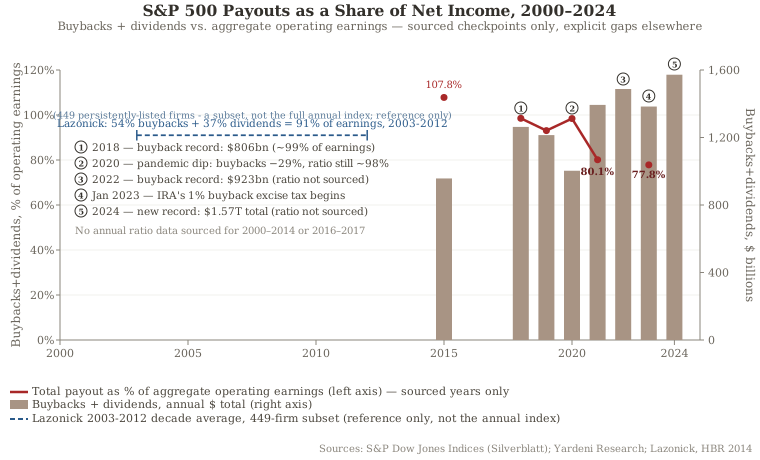
“Trillions of dollars that could have gone to higher wages, more research, or new plants went instead to propping up share prices. Corporate America chose to downsize and distribute rather than retain and reinvest.”
— after William Lazonick, “Profits Without Prosperity,” Harvard Business Review, 2014
“Buybacks divert money from workers and investment”
S&P 500 firms spent roughly 4 to 5 trillion dollars on buybacks over the 2010s. For many of the largest, buybacks plus dividends exceeded net income. The charge: that money built share prices instead of factories, products, and paychecks.
An instrument on trial, and an answer held in reserve
“Trillions of dollars that could have been spent on innovation and job creation in the U.S. economy over the past three decades have instead been used to buy back shares for what is effectively stock-price manipulation.”
— William Lazonick, Harvard Business Review, 2014
Lazonick is not a populist with a slogan; he is an economic historian making a serious claim about what corporations changed into. His “downsize and distribute” thesis sits inside the post-2008 financialization critique, the argument that finance reshaped corporate purpose toward extraction, whose intellectual home is History of Economic Thought Ch.17 (Modern pluralism), alongside the stakeholder-capitalism revival and the inequality-and-financialization turn. Argued at this strength, the case is hard to dismiss: it points at real money, a real institutional change, and a real divergence between profits and wages.
“The case against buybacks rests on an accounting illusion and a missing piece of finance theory. Both are fixable, but not here.”
— the corporate-finance rebuttal, taken up in Stage 2
The corporate-finance answer, voiced by economists like Clifford Asness and Jesse Fried, is that a buyback is not what it looks like, and that the cash it returns does not leave the economy. That answer is real, it is decisive on the macro question, and it is coming. One clarification belongs here, though. “Are buybacks bad?” is a question about one payout instrument. “Should the corporation be run for shareholders at all?” is a question about the firm’s objective, taken up by the companion walkthrough on shareholder primacy. One can hold shareholder primacy as the right goal and still think buybacks are mostly fine; one can reject shareholder primacy and still concede a buyback is just a dividend. Don’t let the two collapse into each other.
Where this leaves us
The critique is real, it is bipartisan, and it is now law, the Inflation Reduction Act’s 1% excise tax on buybacks took effect in 2023. Buybacks did scale into the trillions, the institutional change that enabled them is documented, and the divergence between payouts and wages is not invented. But “it feels like cheating” is an intuition. To know whether buybacks harm the economy, you have to answer a question that sounds absurd until you sit with it: is there any real difference between a company buying back its stock and a company paying a dividend?
Because if there isn’t, if a buyback is just a dividend wearing a different hat, then more than half a century of finance theory says the macro critique is aimed at the wrong target.
The corporate-finance defense
“The conventional wisdom that buybacks are bleeding firms of the cash they need to invest is simply wrong. Once you account for the equity firms issue, net shareholder payouts are far smaller than the gross-buyback headlines suggest.”
— after Jesse Fried & Charles Wang, “Are Buybacks Really Shortchanging Investment?” Harvard Business Review, 2018
In 1961, two economists proved something that should settle most of the buyback debate, and mostly does. Franco Modigliani and Merton Miller showed that, in a world without taxes and frictions, a shareholder is exactly indifferent between receiving a dividend and a buyback. The two transactions feel different, and they are economically identical.
Move one: Modigliani-Miller payout irrelevance. Picture a firm worth a fixed amount that decides to hand one dollar of cash per share back to its owners. If it pays a dividend, you receive that dollar and the share price falls by exactly one dollar, the firm is worth less by exactly the cash it paid out. If it does a buyback instead, the firm uses the same cash to buy shares; the price per remaining share rises, and whoever sells gets the cash. A shareholder who wants a dividend but is given a buyback can manufacture one by selling a sliver of stock; a shareholder who wants to reinvest a dividend can manufacture a buyback by buying more. The total value of the firm falls by the cash paid out either way. Only the form differs.
Let the firm hold value $V$ across $N$ shares, with $C$ in cash to distribute. Pay it as a dividend: each share drops to $(V - C)/N$ and the holder pockets $C/N$ — total per share $= V/N$. Repurchase instead at price $V/N$: the firm retires $n = C / (V/N)$ shares, leaving $N - n$ shares to split the remaining value $V - C$. The new price is
$$\frac{V - C}{N - n} = \frac{V - C}{N - \frac{C}{V/N}} = \frac{V}{N}$$The per-share value of a non-selling holder is unchanged at $V/N$, and a selling holder receives $V/N$ in cash, identical wealth to the dividend case. The form of the payout, absent frictions, carries no economic content.
A buyback and a dividend are the same transaction in different clothes. Cash leaves the firm and goes to shareholders; the only question is whether you receive it as a check (a dividend) or as a higher price on the shares you still hold (a buyback). Your total wealth is the same. If you’d rather have had the check, sell a slice and you do. The difference everyone fights about is mostly cosmetic.
Move two: the tax wrinkle, the friction that tips buybacks from equal to preferred. In the real world the two are taxed differently. A dividend is taxed the moment you receive it. A buyback hands you nothing to be taxed on unless you choose to sell, and if you don’t sell, the gain compounds untaxed. Deferral is valuable, so on tax grounds shareholders generally prefer buybacks to dividends. That preference is much of why firms shifted toward repurchases after 1982. The same tax apparatus — how the law treats dividends versus capital gains, and what a tax like the IRA buyback excise does — is developed in Economics Ch.16 §16.7 (Ramsey Optimal Taxation).
Move three: capital reallocation, the refutation of “starves investment.” When Apple returns a dollar to a shareholder, that dollar does not disappear from the economy. The shareholder now holds cash and reinvests it, into a startup, a bond, another firm’s shares, often a firm that does have a profitable project to fund. The aggregate capital stock is not depleted by a penny. Capital is reallocated, from a firm that has run out of good internal projects to firms and assets that haven’t. That is not waste; in a market that clears, it is the efficient outcome, the general-equilibrium logic of how returned capital finds its highest use is the scaffolding in Economics Ch.11 §11.5 (Walrasian general equilibrium).
The dollar doesn’t vanish when it leaves Apple. It shows up in someone else’s hands, and that someone puts it where it can earn more than Apple could earn with it. “Buybacks starve the economy of investment” quietly assumes the money is destroyed. It isn’t. It moves.
Move four: free cash flow, why returning the cash is the disciplined choice. The standard rule for a firm is to fund every project that earns more than its cost of capital, every positive-NPV project, and return whatever cash is left. A firm that buys back stock is usually one that has already funded its good ideas and is now sitting on cash it can’t profitably deploy. The alternative to returning it is not magically higher investment; it is hoarding, or empire-building into bad acquisitions, the classic “agency cost of free cash flow” Michael Jensen named in 1986. Forcing managers to disgorge surplus cash is the point. The investment-decision rule that underwrites this — fund positive-NPV projects, return the rest — is the firm’s profit-maximization problem in Economics Ch.5 §5.7 (Profit Maximization).
The firms buying back stock are usually the ones that have already funded every good idea they have. “Why didn’t they invest it instead?” assumes there was a better investment waiting. Often there wasn’t, and a manager who spends surplus cash chasing growth for its own sake is the problem the buyback solves.
Those four moves — equivalence, tax preference, reallocation, free-cash-flow discipline — are the orthodoxy. They have a doctrinal home: the shareholder-value program that made “return cash to owners” the governing norm of the corporation. Milton Friedman’s 1970 argument that a firm’s responsibility is to increase its profits, and the Jensen-Meckling 1976 agency theory that recast the firm as a contract between owners and managers, are its lineage, the counter-revolution turn traced in History of Economic Thought Ch.10 (The counter-revolution).
“A buyback is just a dividend you can choose to receive. The firm hands cash to shareholders either way; the only difference is the wrapper, and the tax.”
— the Modigliani-Miller orthodoxy, restated
“A buyback is just a tax-efficient dividend”
If a buyback and a dividend are economically the same transaction, then the “buybacks starve investment” complaint is misdirected, it’s a complaint about returning cash to shareholders at all. Is that all it is?
The defense, now at full strength, and the pattern it still has to explain
“Buybacks don’t reduce aggregate investment. The cash gets reinvested elsewhere; net of issuance, payouts are far smaller than the headlines; and firms returning cash are typically those without better uses for it. The case against buybacks is mostly a case against arithmetic.”
— the Asness–Fried corporate-finance rebuttal
This is the finance-theory defense, the answer Stage 1 held in reserve. It sits in the shareholder-value / agency-theory tradition — Friedman 1970, Jensen-Meckling 1976 — whose lineage runs through History of Economic Thought Ch.10 (The counter-revolution). On the macro question it is decisive: returned capital reallocates, net payouts are smaller than gross, and returning surplus cash is the disciplined choice. The “buybacks starve the economy” claim does not survive it.
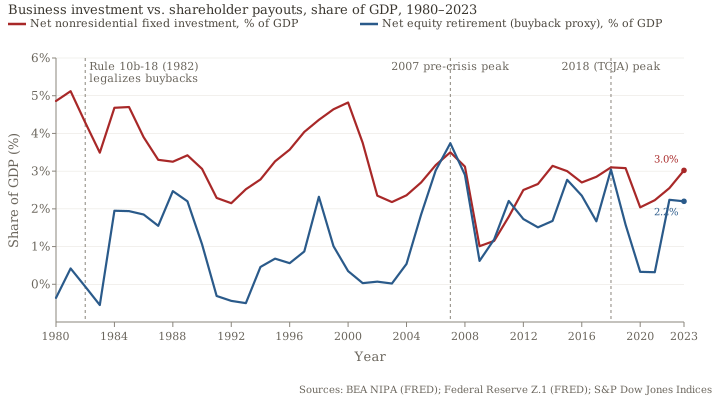
“Yes, but look at the data: business investment as a share of GDP drifted down over the same decades buybacks soared. Something has to explain that, and ‘the cash reallocates’ is a story, not a measurement.”
— the empirical objection the defense has to answer
This is the critique that survives, and it names a real pattern. Investment-to-GDP did soften while payouts rose; debt-funded buybacks did happen in the cheap-money 2010s. The better reading is that the marginal investment project didn’t clear the hurdle rate — where a positive-NPV project existed, debt was cheap enough to fund both the project and the buyback. Which direction the causation runs is what Stage 3 settles: do firms buy back because they lack projects, or do they fail to invest because they’re buying back?
Where this leaves us
On the economics, the corporate-finance answer is decisive. A buyback is a dividend in different clothes; it is tax-preferred for understandable reasons; and the cash it returns gets reinvested by someone, usually someone with better projects than the firm returning it. The “buybacks starve the economy of investment” claim mostly fails. The dollar doesn’t disappear; it moves. But “mostly” is doing real work in that sentence, and the part it’s hiding is the part the critics are right about.
Because there’s one place the finance theory’s clean answer breaks down, at the level of one executive, one quarter, and one bonus target.
The legitimate concern
“Managers use repurchases to meet analyst EPS forecasts. Firms that would have just missed the consensus buy back shares to clear it, and they do so by cutting investment and employment.”
— after Heitor Almeida, Vyacheslav Fos & Mathias Kronlund, “The Real Effects of Share Repurchases,” Journal of Financial Economics, 2016
Researchers found a tell. Firms whose earnings per share would land just below the number Wall Street expected bought back exactly enough stock to clear it, and they paid for it by cutting investment and jobs. This is where the finance theory’s clean answer stops working, and where the critics are right.
The mechanism is a principal-agent problem. Executive pay is routinely tied to EPS or to the stock price. A buyback mechanically raises EPS even with flat earnings, because it shrinks the denominator. So the moment a manager’s bonus depends on EPS, the buyback decision is no longer a clean capital-allocation choice, it is contaminated by the manager’s own payoff. The harm is the interaction between buyback authority and EPS-linked compensation.
Earnings per share is
$$EPS = \frac{\text{Net Income}}{\text{Shares Outstanding}}$$There are two ways to lift it: raise the numerator (earn more) or shrink the denominator (retire shares). A repurchase does the second with no change in net income, so a manager paid on EPS can hit the target without creating a dollar of value. Almeida, Fos and Kronlund identify the gaming at the margin: among firms whose pre-repurchase EPS would land just below the analyst consensus, repurchase activity jumps discontinuously, and those firms cut R&D and employment to fund it.
You can hit an EPS target two ways: earn more, or shrink the number of shares the earnings are divided across. The buyback shrinks the denominator, and it’s a lot faster than building a better business. When the CEO’s bonus rides on EPS, the temptation is obvious, and the bill gets paid out of the investment budget.
This is a corporate-governance failure, and it has a long lineage. The worry that managers run firms for themselves rather than for the owners goes back to Adolf Berle and Gardiner Means’s 1932 account of the separation of ownership and control, the founding text of the managerialism the EPS-gaming concern descends from, in the institutionalist tradition traced in History of Economic Thought Ch.15 (The institutionalist tradition). The formal agency apparatus — how contract design shapes whether managers act in owners’ interest, and why compensation contracts can be written to be gamed — is developed in Economics Ch.18 §18.1 (Transaction Cost Economics).
Two further concerns belong here. First, short-termism: the targeted EPS-gaming result is well-identified and robust, the bunching of repurchases right at the analyst threshold is hard to explain any other way. The broader claim that buybacks cause secular underinvestment across the economy is much weaker, and Stage 2 already showed why it mostly fails. The discipline is to keep those apart: the narrow gaming is real; the aggregate story isn’t. Second, market timing: firms tend to repurchase pro-cyclically, buying heavily near market peaks (2007, 2018–2019) and pulling back in troughs (2009), the opposite of value-maximizing. That destroys per-share value relative to a steadier policy. But notice who it harms: shareholders. It is a managerial-skill flaw, conceded, not a structural indictment of the instrument. The 2020 airline episode — carriers that spent the bulk of their free cash flow on buybacks through the 2010s, then sought federal bailouts when the pandemic hit — is the most viscerally damning exhibit, but it is a case for bailout conditionality and capital buffers.
“CEOs buy back stock to hit their bonus targets.”
— the EPS-gaming charge, made concrete by Almeida, Fos & Kronlund (2016)
“Executives buy back stock to hit their pay targets”
This is the version of the critique that survives the finance-theory defense intact. The evidence is clean, the mechanism is precise, and the verdict concedes it: the critics are right about the boardroom.
The conceded critique, and where to aim the fix
“Firms that would have missed the EPS forecast had they not repurchased shares show economically and statistically large increases in repurchases, and they reduce employment and investment to do it.”
— after Almeida, Fos & Kronlund, Journal of Financial Economics, 2016
This is the critique at its strongest, because it is correct. Combined with Lazonick’s account of managerial self-dealing, it establishes that buyback authority, in the hands of executives paid on EPS, gets used to hit numbers at a real cost to investment and jobs. No finance-theory move dissolves this. The self-dealing charge from Stage 1, dismissible as a motive, returns here as a measured mechanism, and it lands.
“This is a governance problem, not a payout problem. Fix the contract, not the tool. Ban the buyback and the incentive to game EPS simply finds another channel.”
— the corporate-governance response
The counter here is a calibration. It grants the evidence and asks where the fix belongs. If the harm comes from EPS-linked pay meeting a fast lever, the cure is to change the pay or neutralize the lever (adjust the metric for repurchases, lengthen vesting, disclose). A ban treats the symptom and misses the disease, the same logic that returns, at larger scale, in the final stage.
Where this leaves us
Here the critics are right about the boardroom. When the person deciding to buy back stock gets paid more if EPS clears a threshold, the buyback stops being a clean capital-allocation decision and becomes a tool for hitting a number. The evidence is clear and it is costly. But a problem with executive compensation. The fix is to stop paying CEOs for moving a ratio they can move without creating any value.
So we have a benign mechanism with a real governance bug. That should be the whole story. Except the loudest version of the critique was never about EPS gaming or capital allocation at all. It was about who the economy is working for, and there the buyback is a symbol.
The verdict: symptom, not cause
“The 2017 tax cut was sold as a raise for workers. It bought back stock instead. In 2018, S&P 500 firms repurchased a record sum, well over 800 billion dollars, while wage growth barely moved.”
— the “tax cut went to buybacks, not wages” indictment, 2018–2019
Strip away the false version of the critique (buybacks starve investment) and the technical version (EPS gaming, true but narrow). What’s left is the political version, and it is the loudest: buybacks are the face of an economy that rewards capital over labor. The 2017 Tax Cuts and Jobs Act was the test case. Is that critique right, and if so, are buybacks the cause or merely the symbol?
Begin with the policy lever, because it shows how little the buyback is doing. The Inflation Reduction Act’s 1% excise tax on buybacks is real, but its effects are modest by design: it raises a little revenue and tilts firms marginally back toward dividends. What it does not do, cannot do, is redirect that cash to wages. A firm with no profitable project to fund will return surplus cash regardless of the wrapper; tax the buyback and it pays a dividend instead. The tax apparatus behind this, what a payout tax changes, is the same one developed in Economics Ch.16 §16.7 (Ramsey Optimal Taxation).
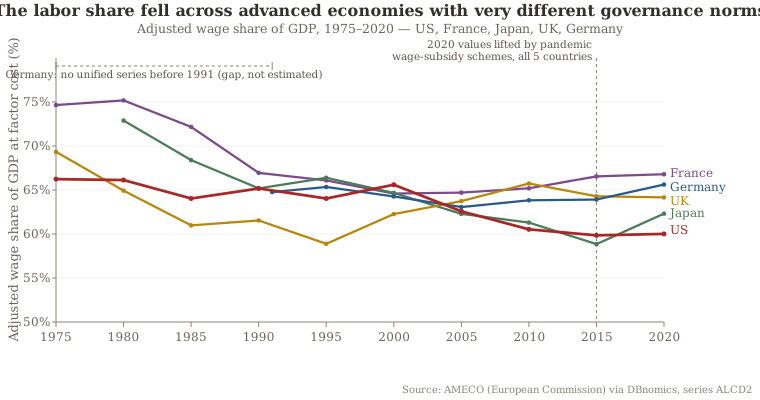
Now the move the argument turns on: symptom versus cause. The political grievance points at something real. The capital share of income rose over the buyback era; the labor share fell; the gains visibly went to shareholders. But buybacks did not drive that shift, they express it. Buybacks rose because fewer high-return investment projects were clearing: declining investment opportunities, the shift toward intangible capital that needs less cash to scale, and rising market concentration that generates excess free cash flow with nowhere productive to go. In that environment, firms return more cash, and the buyback is how they do it. The excess cash is itself a story about market power and concentration, the territory of the companion walkthrough on big-tech antitrust. Banning buybacks would convert repurchases into dividends, and leave wages untouched. The era in which buybacks became the dominant payout channel, the 1990s–2000s globalization and great-moderation decades, is narrated in Economic History Ch.18 (Globalization and the great moderation); the financialization and stakeholder-capitalism critique that frames the grievance lives in History of Economic Thought Ch.17 (Modern pluralism).
“They told us the corporate tax cut would raise wages. Instead it bought back stock. That tells you everything about who this economy serves.”
— the 2018 distributional critique of the Tax Cuts and Jobs Act
“The 2017 tax cut proved buybacks come at workers’ expense”
The grievance has a factual core: the cut did fund buybacks, and wages did not surge. But the episode proves something subtler than the slogan, and the difference is the whole verdict.
Financialization-as-cause vs. secular forces, the one live split
“Shareholder-value ideology restructured the purpose of the corporation. Buybacks are not incidental to the rise in inequality, they are the operating mechanism of an extractive turn in American capitalism.”
— the financialization reading (Lazonick and the Sanders–Schumer line)
The claim is that the shareholder-value norm caused the shift it describes, that making payout the goal of the firm reorganized corporate behavior toward extracting value rather than building it. Its intellectual home is the post-2008 financialization and stakeholder-capitalism critique in History of Economic Thought Ch.17 (Modern pluralism). Argued at strength, it is a serious thesis about institutional change.
“The labor-share decline shows up across countries with very different corporate-governance norms. That points to common secular forces — technology, trade, concentration, intangibles — not to a buyback culture unique to American capitalism.”
— the secular-forces reading
The counter grants that the distribution shifted and disputes the engine. If the labor share fell in economies that never developed a buyback culture, then the shift has causes deeper than financialization, and buybacks express those causes. How much weight to assign financialization and shareholder-value norms versus secular forces is the live disagreement, a dispute about magnitude inside a settled frame. The frame is not contested by serious finance economists: buybacks as a payout mechanism, not the cause of underinvestment. The weight on financialization-as-cause is. That split is real, and it stays open; it is the split the companion walkthroughs on shareholder primacy (the objective-of-the-firm question) and stakeholder capitalism (the “invest in workers instead” alternative) take further.
Where this leaves us
The public debate fuses three complaints into one yes-or-no question, and that fusion is the error. Un-fused, the answer is precise: the macro “starves investment” claim is false, the EPS-gaming claim is true but narrow, and the distributional grievance is real but displaced. Banning buybacks would address the symbol while leaving the disease, whatever it is, untouched.
The verdict
“Are stock buybacks bad?” is three questions, and the public debate’s mistake is collapsing them into a single verdict. Pull them apart and each gets a clean answer:
- Do buybacks starve the economy of investment? No. A buyback is a dividend in different clothes (Modigliani-Miller), and the cash it returns does not vanish, it reallocates to investors who redeploy it, usually toward firms with better projects than the one returning it. The macro critique aimed at the buyback form fails.
- Do executives game buybacks to hit pay targets? Yes, but narrowly. Firms that would just miss an EPS forecast repurchase to clear it, cutting investment and jobs to do so (Almeida-Fos-Kronlund). This is real and costly, but it is a compensation-contract failure, fixable by governance and disclosure.
- Are buybacks the face of an economy that favors capital over labor? Yes, as its symbol. The capital-versus-labor shift is real, and buybacks express it. Banning them would convert repurchases to dividends, and change nothing about wages.
So the verdict, held in one line: mostly benign mechanism, real governance-gaming concern, displaced distributional grievance. On the mechanism, corporate finance has a consensus, no serious finance economist holds that buybacks deplete the aggregate capital stock. On the gaming, the literature agrees it is real and costly; the argument is about magnitude. And on the distribution, the live disagreement, how much of the labor-share decline is financialization and how much is secular forces buybacks merely express, is named and left open.
The next time someone tells you buybacks are killing the economy, or that they’re obviously harmless and the critics just don’t understand finance, you have the tools to do what neither slogan does: separate the three claims, concede the one that’s true, refute the one that’s false, and point the real grievance at the target it’s about.