Banking: Italian innovations to shadow banking.
A Florentine merchant in 1340 and a money-market fund in 2008 are running the same machine: take in money people can demand back at any moment, lend it out long, and pocket the spread. The machine is too useful to ban and too dangerous to leave alone, so for seven hundred years the story repeats, someone invents a cleverer version of it, the cleverer version escapes the rules built for the last one, it gets run like a bank because it is a bank, and the rules chase it down again. This walkthrough follows the one machine through four of its escapes.
The Italians build the machine
“Pay by this first bill of exchange… the sum of five hundred florins, which I have here received from… and charge it to my account.”
— Standard form of a Florentine lettera di cambio, 14th century
A merchant in Florence pays a supplier in Bruges without a single coin leaving Italy. The Bardi and the Peruzzi, the two largest banking houses in Europe, lend the equivalent of a kingdom’s revenue to Edward III of England. Deposit banking is roughly seven hundred years old, it was a technological revolution, and it shipped with a flaw that every later version of banking inherits. (The Bardi-Peruzzi collapse of the 1340s appears here as a banking institution, an early deposit-and-merchant bank whose business model is the thread’s whole subject; as a crisis episode, the sovereign default that took the house down is walked in the companion thread on crises, Bardi-Peruzzi through 2008.)
Three Italian inventions, each a working mechanism. The bill of exchange moved value across borders without shipping coin, bundled a loan and a currency trade into one instrument, and slipped around the Church’s usury prohibition by hiding the interest inside the exchange rate. Double-entry bookkeeping let you see, on the page, whether a multi-branch house was good for its debts. And deposit banking: the house takes in deposits and lends them out. That last one contains the seed of everything that follows, because the moment a bank lends out money it has promised to return on demand, it has promised the same coin to two people. The medieval Italian commercial revolution that produced these houses is the spine of Economic History Ch.2 (Post-classical world systems) and Ch.3 (The high medieval economy and the 14th-century rupture).
The seed germinates with the goldsmiths. A goldsmith holds your gold for safekeeping and hands you a receipt, a note. He notices that depositors almost never all come back for their gold at once, so he lends out most of it and keeps only a fraction in reserve. This is fractional reserve, and it does two things at once. It creates money: the notes circulate as currency while the gold backing them is also out working as loans, so the same gold now does double duty. And it makes the note runnable: the promise to redeem on demand is only good as long as not everyone demands at once. The goldsmith’s ledger and the modern bank’s balance sheet have the same load-bearing line. The money-creation apparatus — why holding money has an opportunity cost, how the monetary base expands — is the formal home of this; peek it below or read it in full at Economics Ch.16 §16.1 (Why Hold Money?). The goldsmiths and the founding of the Bank of England sit in Economic History Ch.5 (Early modern globalization).
Hold reserve ratio $r$ against deposits and lend the rest, and a unit of base money supports deposits up to the money multiplier:
$$\text{deposits} = \frac{1}{r}\times\text{base money}$$A reserve ratio of one-tenth turns a hundred coins of gold into a thousand coins of spendable claims. The efficiency gain is enormous; so is the gap between claims outstanding and coin on hand.
The goldsmith promised to give your gold back any time you ask, then lent most of it out. While everyone trusts the promise, it works beautifully. The notes spend like gold and the gold itself is also out earning interest. If everyone shows up for their gold at once, the promise breaks, because the gold is not in the vault. It is in someone’s field, financing next year’s harvest.
The runnable bank needs a backstop, and the first version of one is the Bank of England (1694): a chartered bank that lends to the government and, in doing so, ends up holding the system’s reserves. It is the prototype of the central bank, the institution that stands behind the banks that can be run. The function is still immature here (it matures into doctrine in Stage 2), but the structural move has been made: someone has to be the reserve behind the reserves. The trade routes the merchant-banking houses grew out of, the long-distance Mediterranean and Silk Road commerce that made bills of exchange worth inventing, are mapped in the trade explorer.
One more mechanism: why a run feeds on itself. A bank run is a coordination failure. The bank cannot pay everyone at once, so if you believe other depositors will rush to withdraw, the right move is to rush too, not because the bank is bad, but because the last in line gets nothing. Your belief about everyone else’s behavior makes the panic real. The same logic that turns information-insensitive claims information-sensitive in a panic sits in the market-failure apparatus; peek it above or read Economics Ch.4 §4.6 (Information Asymmetry).
There are two equilibria. If nobody runs, the bank meets its few daily withdrawals from reserves, stays solvent, and everyone is repaid in full. The “wait” equilibrium pays more than the “run” equilibrium. But if enough others run, the bank must dump illiquid assets at fire-sale prices to raise cash, the losses make withdrawing-now strictly better than waiting, and the “run” equilibrium becomes self-fulfilling. Both are equilibria of the same healthy bank; which one obtains depends only on what each depositor expects the others to do.
If everyone else runs, you should run too, even if the bank is perfectly healthy. That single sentence is the engine of every crisis that follows.
The view fractional reserve overturned is the safe model. On the warehouse view, a deposit is a bailment, money you store is money kept, like a coat handed to a cloakroom. The goldsmith who runs a hundred-percent reserve never lends out what he has promised to return, so his note is always good and his warehouse cannot be run. There is no coordination failure to trigger, because there is nothing to coordinate around: the gold is in the vault, all of it, all the time. The warehouse view is the position that makes the depositor whole, and the entire seven-hundred-year history of banking panics is the bill for abandoning it.
Idle gold becomes working capital; the money supply expands to match the volume of trade; credit reaches the merchant, the farmer, the shipbuilder who could not otherwise raise it. The economy with fractional-reserve banks grows faster and finances more than the economy of warehouses ever could. But fractional reserve bought that productivity by accepting the run, the precise vulnerability the warehouse never had. The trade is efficiency in exchange for runnability. Every later rung tries to keep the efficiency while managing the run, and discovers that the run does not stay managed.
Fractional-reserve deposit banking won, and it deserved to. It is the foundation of every banking system since, because the efficiency gain over the warehouse is too large to refuse. But the same move that delivered the gain created the runnable bank, and the containment problem starts here. That is the first turn of the pattern: an innovation (fractional reserve) buys efficiency and ships a new vulnerability (the run). The vulnerability is the price of the function, and the function is too valuable to give up.
The goldsmith’s bank could be run, and it was. For two centuries the standard answer to a run was to let the bank fail and let the panic burn itself out. Then the 19th-century banking crises got bad enough that a journalist-banker sat down and wrote the book that taught central banks what to do when a panic starts, and to land it, he had to defeat the reigning orthodoxy about whether they should do anything at all.
Bagehot, the Fed, and the perimeter
“The holders of the cash reserve must be ready not only to keep it for their own liabilities, but to advance it most freely for the liabilities of others. They must lend to merchants, to minor bankers, to ‘this man and that man,’ whenever the security is good.”
— Walter Bagehot, Lombard Street: A Description of the Money Market, 1873
Bagehot wrote the rulebook for stopping a panic in one sentence: in a crisis, the central bank should lend freely, at a high rate, on good collateral. It is still the formula central banks reached for in 2008. To get there Bagehot had to argue down an orthodoxy that said the central bank should do the opposite, hoard its reserve and let reckless banks fail.
Bagehot’s lender-of-last-resort doctrine is the backstop the runnable bank needed, stated as a procedure. In a panic, lend freely, so the run has no reason to continue, because everyone can see cash is available. Lend against good collateral, so the central bank is protected and only saves banks that are solvent. Lend at a penalty rate, so banks don’t treat the backstop as a cheap line of credit in normal times. The concept doing the work underneath is the illiquid-versus-insolvent distinction. A run can kill a solvent bank through the coordination failure from Stage 1, everyone withdraws because everyone fears everyone will withdraw, and the central bank exists to break that fear before a liquidity problem becomes a solvency problem. The historical Bagehot, the 19th-century crises, and the founding of the Federal Reserve sit in Economic History Ch.11 (The gold-standard era); the central-bank apparatus is in Economics Ch.16 §16.1.
The Stage-1 two-equilibrium structure is what the lender of last resort manipulates. The run equilibrium exists only because each depositor’s best response to “others run” is to run. A credible promise to lend freely against good collateral removes the payoff to running first: if the bank can always meet withdrawals, waiting weakly dominates running, the run equilibrium is selected away, and the promise rarely has to be used, because announcing it changes the equilibrium. The central bank does not need infinite reserves; it needs to be believed.
A healthy bank can be killed by a run for no reason except that everyone fears everyone else will run first. The central bank breaks that fear by promising to lend. Once depositors believe the promise, there is no reason to run, so the bank survives, and the promise mostly never has to be kept.
The doctrine became an institution, the Federal Reserve (1913), a permanent lender of last resort, and then, after the institution failed, it became a perimeter. In the early 1930s the Fed did roughly what the old orthodoxy prescribed and let runs cascade; thousands of banks failed and a recession became the Great Depression. Milton Friedman and Anna Schwartz’s monetarist verdict was blunt: the Fed should have lent far more, and the contraction of the money supply turned a downturn into a catastrophe. That diagnosis, Friedman’s reading of the bank runs, lives in the counter-revolution lineage at History of Economic Thought Ch.10 (The counter-revolution). The response in 1933 was a perimeter: federal deposit insurance, which removes the depositor’s reason to run by guaranteeing the deposit, and the Glass-Steagall firewall, which separated deposit-taking commercial banks from securities-trading investment banks so the insured deposit base could not be exposed to market risk. The Depression bank runs, deposit insurance, and Glass-Steagall are walked in Economic History Ch.12 (The interwar monetary collapse). The sequence is doctrine, then institution, then perimeter, each layer added because the previous one failed.
Bagehot belongs to the classical political-economy tradition, the nearest doctrinal home is History of Economic Thought Ch.3 (Classical political economy), but he sits awkwardly there, because the lender-of-last-resort doctrine is a banking-institution idea more than a value-or-distribution idea. And one boundary: what the central bank can do for the macroeconomy — whether it can steer growth and inflation, the limits of monetary policy at the zero lower bound, “whatever it takes” — is a different question, walked in the walkthrough on whether central banks can control the economy. Here the central bank is one rung of the banking-institutions thread: the backstop for runnable banks.
The orthodoxy Bagehot had to defeat is the direct ancestor of every modern “no bailouts” argument and it has a genuine point. The Currency-School position held that the central bank should keep its reserve rigidly and not rescue reckless banks: a central bank that always rescues teaches banks to take more risk. If you know you will be saved, you lend more aggressively, hold thinner reserves, and chase higher returns, because the downside has been socialized. Bail out the reckless and you breed recklessness, and you also debase the currency by expanding credit to prop up institutions that should be allowed to die. This is moral hazard, named and feared a century before the word was common.
What Bagehot added was a distinction the orthodoxy could not make. It treated all failing banks alike, but there are two kinds. An insolvent bank is bust, its assets are worth less than its debts, and letting it fail is correct. An illiquid bank is solvent but caught in a run: its assets are good, but it cannot turn them into cash fast enough to meet a panicked rush. Let the illiquid-but-solvent bank fail and you do not impose discipline; you convert a containable panic into a system-wide depression, because the run spreads to healthy banks and the fire sales destroy real value. That is what happened in the early 1930s when the Fed followed something close to the orthodoxy. Moral hazard is real, which is why Bagehot insists on the penalty rate and the good collateral, and the lender of last resort is necessary, because letting solvent banks die in a coordination failure helps no one.
Bagehot’s doctrine is durable. Lend freely, against good collateral, at a penalty rate is still the formula central banks reach for in a panic, it is what the Fed did in 2008, and the illiquid-versus-insolvent distinction still organizes crisis management. The perimeter built on top of it worked: deposit insurance plus the Glass-Steagall firewall gave the post-1933 decades remarkably few banking crises. But the perimeter had a cost. The insured, firewalled, regulated bank is safe, and it is also less profitable and less flexible than a bank that could do more with its balance sheet. That cost is what the next generation of financial innovators was built to escape. The second turn of the pattern: the vulnerability (the run) provokes regulation (the lender of last resort, then the insured perimeter), and the regulation creates a cost that invites the next escape.
For forty years after 1933, American banking was boring and safe, “3-6-3 banking,” the joke went: borrow at 3 percent, lend at 6 percent, be on the golf course by 3pm. Boring and safe is also expensive and constrained. By the 1980s a generation of financial innovators had worked out how to do everything a bank does — take in short-term money, lend it out long — without being a bank at all, and therefore without the perimeter’s costs. They were about to rebuild the runnable bank in a place the safety net could not reach.
The escape from the perimeter
“These increasingly complex financial instruments have contributed to the development of a far more flexible, efficient, and hence resilient financial system than the one that existed just a quarter-century ago.”
— Alan Greenspan, remarks before the National Italian American Foundation, October 12, 2005
By 2007 the repo market and the shadow-banking sector rivaled or exceeded the traditional banking system in size. The chairman of the Federal Reserve was telling the country that financial innovation had made the system more resilient. He was describing real benefits, and missing that the system had quietly rebuilt the one machine the whole perimeter was designed to contain.
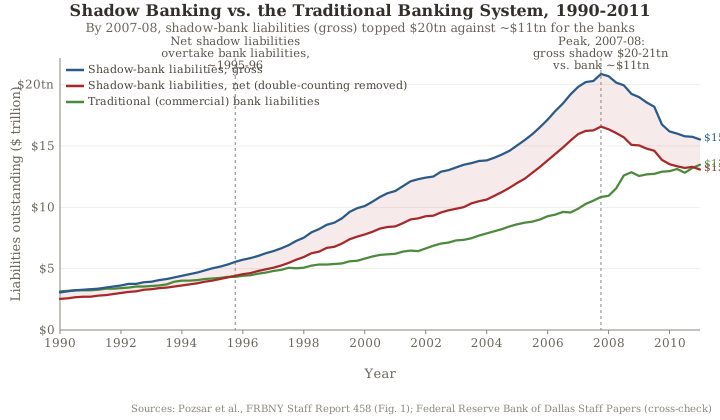
Maturity transformation outside the perimeter is borrowing short and runnable to fund long and illiquid, but doing it in institutions the safety net was never built to cover. It arrives in three innovations, each a benefit and each, structurally, a rebuilt runnable bank. Securitization pools loans, mortgages above all, and sells tranches of the cash flow to investors. It moves credit off the bank’s balance sheet, spreads the risk across many holders, and lowers the cost of capital; more credit reaches more borrowers, more cheaply. Repo, the repurchase agreement, is short-term collateralized borrowing: an institution funds long-term assets with money it borrows overnight and rolls over each morning. That is maturity transformation, borrow-short-lend-long, but with no deposit insurance and no central-bank window. And the repo lender can refuse to roll over — demand more collateral, or simply walk away — which is a run. Money-market funds offer a dollar-stable, redeem-on-demand claim that behaves like a deposit, while investing in short-term paper that can lose value; the promise of “a dollar whenever you want it” is a runnable claim sitting outside the insured perimeter. The deregulation arc that opened the space, Garn-St. Germain through Gramm-Leach-Bliley, and the rise of this whole system are in Economic History Ch.18 (Globalization and the great moderation).
All three are the same machine. Each takes in short-term, redeemable funding and holds long-term, illiquid assets, and each does it outside the deposit-insured, lender-of-last-resort perimeter. The Stage-1 run condition transfers without modification: the repo lender who refuses to roll over and the money-market depositor who redeems en masse are running on the same coordination failure that hit the goldsmith. The fire-sale and adverse-selection machinery that makes a run feed on itself, safe debt turning information-sensitive the moment doubt appears, is the market-failure apparatus; peek it below or read Economics Ch.4 §4.6 (Information Asymmetry). The valuation theory that priced the derivatives layered on top of these instruments, the Black-Scholes road to 2008, is traced from the other side in the companion finance-theory thread, Fisher to behavioral.
A money-market fund that promises you a dollar any time you want it, but invests that dollar in things that can fall in value, is a bank. It just is not called one, and nobody insured it. The doctrinal frame for why this kind of fragility is endemic to finance — Minsky’s financial-instability hypothesis, that stability itself breeds the leverage that produces the next crisis — lives at History of Economic Thought Ch.17 (Modern pluralism).
First, the predecessor the innovators were leaving behind: the regulated, insured, firewalled bank of the Glass-Steagall era was stable, and the record proves it. The post-Depression decades had remarkably few banking crises; the insured deposit base was protected from market risk; the firewall kept the boring business of taking deposits separate from the risky business of trading securities. That stability is the standard against which the escape has to be judged.
Second, the innovators’ case was real, in its own terms, argued by serious people who were mostly right about the benefits. The regulated bank was expensive and constrained: it left credit unextended, capital underused, and borrowers underserved because the perimeter’s costs sat between savers and the projects that needed funding. Securitization lowered the cost of a mortgage and let a saver in one country fund a homebuyer in another. Repo created deep, liquid funding markets that made the whole system more efficient. Money-market funds gave ordinary savers a higher return than a checking account while keeping their money available. Risk really was spread across more holders rather than concentrated on one bank’s balance sheet, and to a generation that remembered the single-bank-failure cascades of the 1930s, that diversification looked like progress. The deregulators were responding to a real cost of the perimeter with innovations that had real benefits.
“The repeal of Glass-Steagall… was the worst decision of the past century. It set the stage for the financial crisis.”
— A common post-crisis indictment of the 1999 Gramm-Leach-Bliley Act
“Repealing Glass-Steagall caused the 2008 crisis.”
The most popular post-crisis indictment: tear down the 1933 firewall in 1999, and eight years later the system collapses. The story has a real grain of truth and the wrong mechanism, and the difference is the thread’s pattern.
The shadow-banking system rebuilt the runnable bank outside the perimeter, and it did so rationally. The perimeter’s costs were real and the innovations’ benefits were real; nobody set out to recreate a vulnerability. But maturity transformation funded by claims that can run is the exact vulnerability Stages 1 and 2 spent a millennium learning to contain, now rebuilt in a place where the containment did not reach. This verdict stops short of “and therefore it crashed”, that is the next stage, but it names the recreated vulnerability without crediting it to greed or stupidity. The third turn of the pattern: regulation (the insured perimeter) creates a cost; innovation escapes the cost; and the escape rebuilds the runnable bank where the safety net was never strung.
The shadow-banking system had rebuilt the runnable bank at enormous scale, outside the safety net. Everyone knew banks could be run. Almost no one was watching for a run on a money-market fund. On the morning of September 16, 2008, one of the oldest money-market funds in America fell below a dollar, and the run the thread had been predicting for seven hundred years arrived in a form the safety net had never been built to catch.
2008, and why the cycle recurs
“The financial crisis of 2007–2008 was a banking panic. A banking panic is an event whereby holders of short-term debt… suddenly demand cash in exchange for their claims. The 2007 panic was in this sense like the panics of the 19th century.”
— after Gary Gorton, Slapped by the Invisible Hand: The Panic of 2007, 2010
On September 16, 2008, the Reserve Primary Fund, a money-market fund holding Lehman Brothers commercial paper, fell below a dollar a share. The phrase was “breaking the buck.” It triggered a run on prime money-market funds and a freeze in the repo market within days. The run that took down the financial system in 2008 was a run on funds and repo, on institutions almost no one called banks. The question is whether that was a new kind of crisis or the oldest one in the thread wearing new clothes.
It was the oldest one. The repo run — lenders demanding more collateral or refusing to roll over, forcing fire sales — and the money-market-fund run — depositors redeeming en masse after the buck broke — were coordination-failure runs on maturity-transforming institutions outside the perimeter, the same two-equilibrium structure from Stage 1 applied to repo and funds. The mechanism running since the goldsmith predicted this: maturity transformation plus runnable claims plus no backstop equals a run waiting for a trigger. The lender-of-last-resort response was pure Bagehot, the Fed lent freely against collateral, but the Fed had to invent new facilities (the Term Auction Facility, the Primary Dealer Credit Facility, a money-market-fund backstop, the AIG rescue) to reach institutions outside its traditional perimeter, because the perimeter had not kept up with where the maturity transformation had migrated. The 2008 run, the breaking of the buck, and the response are walked in Economic History Ch.19 (The global financial crisis and after); the Minsky-revival and Gorton frames that read it as endemic fragility are at History of Economic Thought Ch.17 (Modern pluralism).
Then the regulation chased the escape. Dodd-Frank (2010) and Basel III extended the perimeter to capture much of what 2008 revealed had slipped outside it: designating systemically important institutions for tougher supervision, the Volcker rule echoing Glass-Steagall’s firewall, money-market-fund reform, higher capital and liquidity requirements, central clearing of derivatives, and macroprudential supervision watching the system as a whole rather than one bank at a time. The fourth turn of the pattern: the run came, the regulation chased it, and the perimeter was redrawn around where the maturity transformation had moved. The minute-by-minute mechanics of the failure are handled by the event-level walkthroughs, 2008 from below and the Lehman weekend, and the complex-systems and cultural reading of the disaster goes to risk across disciplines.
The pre-2008 conviction was that the new system was safer than traditional banking. Serious people held it — regulators, the innovators, much of the academic literature — and the case was not stupid. The “originate-to-distribute” model spread risk to those best able to bear it instead of concentrating it on a single bank’s balance sheet, which sounds, and was argued to be, more resilient than the 1930s world of single-bank-failure cascades. The deep, liquid repo and money-market markets made funding cheaper and more available than the old deposit-based system. And the Great Moderation seemed to confirm it from the data: two decades of low volatility and few crises, a financial system that appeared to have engineered away the old instability. If you had been asked in 2006 whether spreading mortgage risk across thousands of diversified holders was safer than piling it on one bank, the answer that diversification reduces risk was the textbook answer.
What 2008 refuted was the specific way the belief was wrong. Diversification does not help when the correlation goes to one in a panic, when every mortgage-backed asset falls together because the thing that moves them is the same nationwide housing bust. “Risk spread to those best able to bear it” turned out to mean “risk spread to those who did not understand it and could not absorb it.” And the system had mistaken one kind of risk for another. It had diversified credit risk, the risk that a given borrower defaults, and then assumed it had thereby reduced run risk. But run risk is not credit risk. Run risk is the coordination failure from Stage 1, and it does not care how well the underlying credit is diversified; it cares only whether the funding can be pulled on demand. The system had rebuilt maturity transformation funded by runnable claims, outside the safety net, and then convinced itself that diversifying the assets had made the structure safe. The “safer” belief failed not because its proponents were reckless but because they were measuring the wrong risk.
The thread’s verdict has four parts, and three of them are consensus. The pattern recurs (consensus): the innovation-crisis-regulation cycle is structural, because maturity transformation is too valuable to suppress and too dangerous to leave unbackstopped, and every backstop creates a cost the next innovation is built to escape. The apparatus is durable (consensus): maturity transformation, the run as a coordination failure, the lender of last resort, and the regulatory perimeter explain the whole thread, goldsmiths to 2008, with a single mechanism. 2008 was a bank run (consensus): the shadow-banking run was the classic bank run recreated outside the perimeter, as Gorton argued, and the thread’s apparatus predicted it once you see repo and money-market funds as maturity transformation without a safety net. These three are where the mainstream economic-history and financial-economics literature has settled.
The fourth part is a split: how much the post-2008 re-regulation actually reduced systemic run-risk, and where the next escape is. The frame is settled, the cycle is structural and will recur, but inside that locked frame the magnitude is live. The optimist reading: macroprudential regulation raised the cost of the next escape, and Dodd-Frank and Basel III closed much of the gap 2008 exposed. The skeptic reading: regulation always lags, the perimeter is already leaking, and maturity transformation is migrating into crypto and stablecoins where the safety net once again does not reach.
The payoff is the ability to see the pattern. The next time you read about a financial innovation that lets institutions take in runnable short-term money to fund illiquid long-term assets, outside the regulated perimeter, you are looking at the next turn of a seven-hundred-year-old cycle, and you know what comes next, even if you cannot say when.
“Stablecoins are just unregulated banks waiting to run.”
The frontier claim right now, and the place the thread’s payoff lands. The pattern gives you a precise question to ask: which crypto instruments do maturity transformation outside the perimeter?
The same machine, four times
First, the Italians built the machine — bills of exchange, double-entry bookkeeping, deposit banking, then the goldsmith’s fractional reserve and the Bank of England — and the machine shipped with the run. Second, the run provoked the rules: Bagehot’s lender-of-last-resort doctrine, then the Federal Reserve, then, after the Fed failed in the 1930s, the perimeter of deposit insurance and the Glass-Steagall firewall. Third, the perimeter’s cost provoked the escape: securitization, repo, and money-market funds rebuilt maturity transformation outside the safety net, rationally and with real benefits. Fourth, the escape ran, the 2008 repo and money-market runs were the classic bank run in new clothes, and Dodd-Frank and Basel III chased the perimeter out to where the maturity transformation had gone.
Four parts of the verdict, three of them consensus: the pattern recurs, the apparatus is durable, and 2008 was a bank run. The fourth — how much the re-regulation closed the gap, and where the next escape is — is a live disagreement inside a settled frame. Maturity transformation funded by claims that can run is too valuable to suppress and too dangerous to leave unbackstopped, so the function survives, the backstop chases it, the cost of the backstop invites the next escape, and the run comes back in whatever the era’s newest instrument is wearing.
When the next instrument lets institutions take in money people can demand back at any moment and lend it out long, outside the regulated perimeter, you are watching the fifth turn begin, and the only thing the thread cannot tell you is the date.