Editorial · First Edition A knowledge journey — currently focused on economics, with more to come. May 2026
i. — What this site does A reel · then four panels you can click through

There's no shortage of good learning material. The bottleneck is purpose.

We want answers to the big questions in fields we care about. Are high interest rates good for the economy? Do trade wars help us? Did Keynes mean what the textbook says? To take these seriously you dig past the headline — sometimes through an interactive chapter, sometimes through a traced lineage of each side, sometimes through an empirical atlas. The panels below show all three, on one example.

ii.

Big Questions

One in full · more on offer
Big Question · 03 · Labor markets
A federal $15 minimum wage will cost American jobs.
— a recent claim, paraphrased
Behind the take —
Do minimum wages cause unemployment?
The textbook says yes. The data says maybe not. A 30-year war between theory and evidence.
An interactive chapter

An apparatus you can move.

Here, a labor supply-and-demand chart — the model both sides of the debate are arguing inside. Drag the floor and watch the prediction respond.

The labor-market model

Drag the floor. Switch the market structure. Watch the prediction flip.

Floor $15.00
0 50 100 $0 $10 $20 D S Competitive eq Wage floor: $15.00

The floor sits at the market-clearing wage of $15. The standard model predicts no change in employment.

A traced lineage · Position A

A position has a lineage.

Here, the standard view: "in a competitive labor market, raising the wage above equilibrium reduces hiring." Stigler · Friedman · Neumark.

Position A · the disemployment lineage

Where the standard view comes from.

1946 Stigler "The Economics of Minimum Wage Legislation" — first explicit framing of the disemployment prediction.
1962 Friedman Capitalism & Freedom — minimum wage as "anti-Negro law" via reduced employment of low-skill workers.
2008 Neumark & Wascher Minimum Wages — the canonical synthesis of the disemployment-elasticity literature.
today contemporary literature Argument is now over magnitude of disemployment, not its existence.
A traced lineage · Position B

There is usually more than one.

Here, the monopsony view: "real labor markets aren't competitive. A binding floor can pull wages closer to marginal product." Robinson · Card & Krueger · Dube.

Position B · the monopsony lineage

Where the corrective view comes from.

1933 Robinson The Economics of Imperfect Competition — the foundational monopsony model.
1994 Card & Krueger New Jersey vs. Pennsylvania natural experiment — the empirical turn that the standard view never fully absorbed.
2010s Dube · Cengiz · Azar Direct measurement of monopsony power; bunching estimators; concentration-based identification.
today contemporary literature A floor in the corrective range can increase employment toward the competitive level.
An empirical atlas

The empirical territory the dispute lives in.

Here, state-by-state minimum wages and employment effects. Card & Krueger ran their natural experiment on the NJ–PA border; the empirical fight is conducted on this map.

State-level wage floors, 2000 — 2024

Vermillion intensity = state minimum wage above federal. Click states for detail.

STATE FLOOR ABOVE FEDERAL · 2024 Darker = larger differential. Federal floor still $7.25. Highest: WA $16.66 · CA $16.00 · NY $15.00.

This is the empirical territory the debate is conducted over. Card-Krueger ran the original natural experiment on the NJ–PA border (top right of the map). Dube and others use the same border-jurisdiction strategy at scale.

0 of 4 pieces explored
Read Big Question #3 in full →

More on offer — same shape, different question.

— or write your own —

Browse all 10 Big Questions →

iii.

Topics

Vol. I in depth · II–V in the works

Each topic is a container — textbook, Big Questions, atlases, history-of-thought timeline — sharing one editorial spine. Click a side cover to rotate; click the centered cover to open.

iv.

Interactive atlases

If you like exploring through visuals

An atlas here is an interactive view you can poke at — a time-scrubbed map, a network you can pivot, a layered chart with toggles. Each one lets you find the same period or place across multiple lenses.

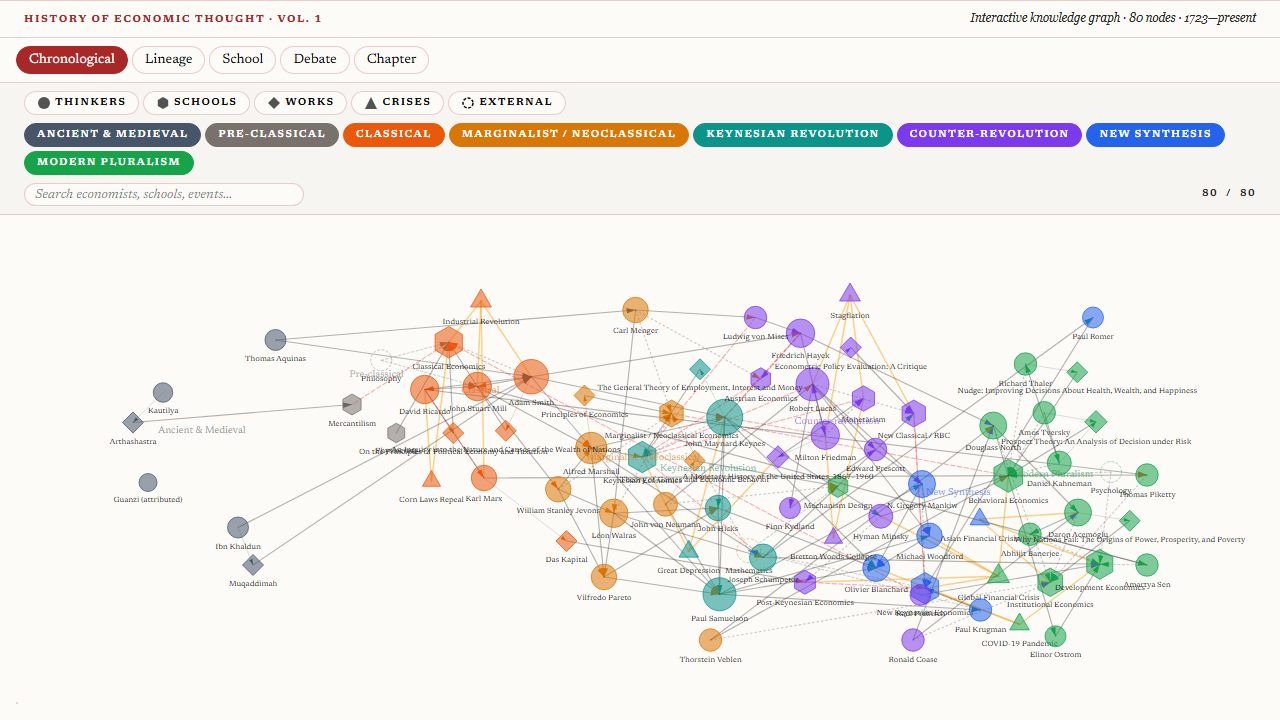
Knowledge graph Knowledge graph of economic thinkers, schools, works, and crises — clusters coloured by era from Ancient & Medieval through Modern Pluralism

History of Economic Thought

Who influenced whom — Aquinas through Acemoglu

80 thinkers 1700 — present Lineage · School · Debate
Pulled from by: the Keynesian revolution, the marginalist turn.
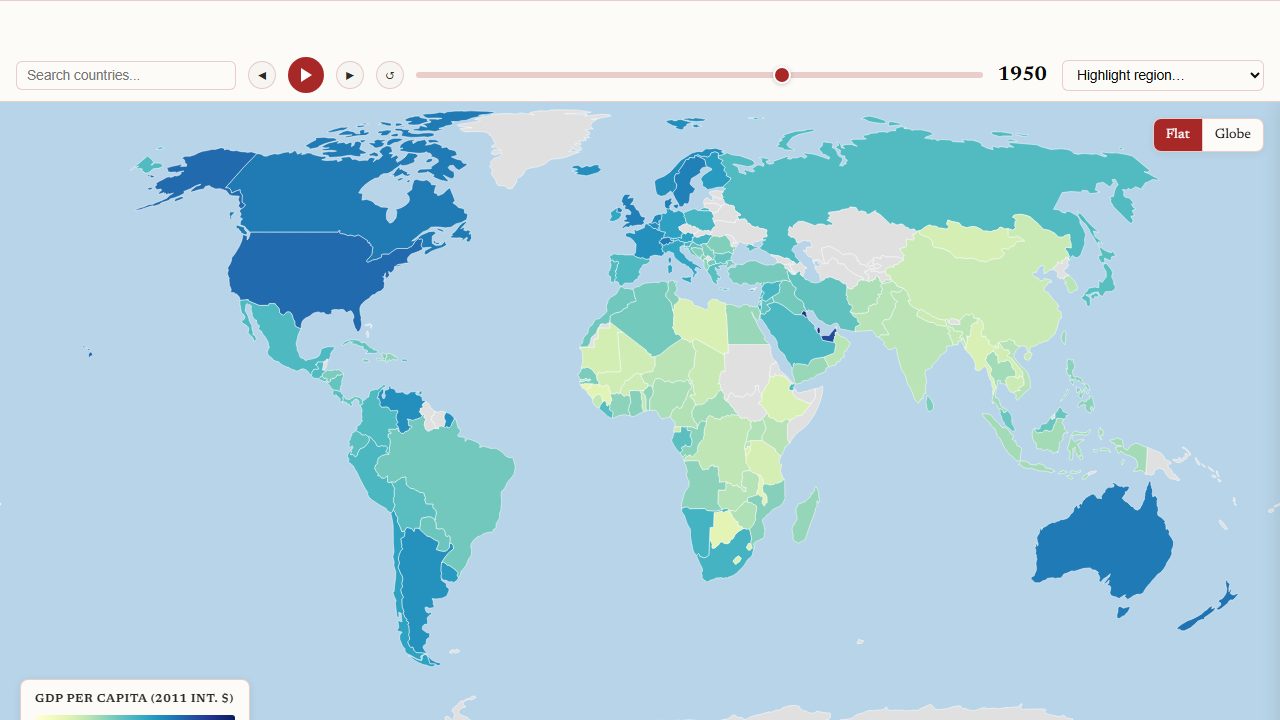
Choropleth World choropleth of GDP per capita in 1950, with year scrubber, region highlighter, and a flat/globe toggle

GDP per Capita Through History

A choropleth you can scrub from 1820 to today — flat or globe

200 years ~190 countries Year slider · Globe toggle
Pulled from by: why some countries are rich, the great divergence.

Browse all 5 atlases →

v.

Takes

If you want a quick reaction to something current

Short, sharp pieces on a current claim or news event — engaged head-on, then taken apart with citations to the chapters and Big Questions that bear on it. The provisional layer; where ideas go before they earn a Big Question.

May 02 5 min read On a current claim

"AI productivity gains will fall to wages, eventually" — and why "eventually" might be a lifetime

The standard response to the AI-displacement worry runs through the Solow paradox: new technology, by raising productivity, eventually raises real wages — that's the textbook conclusion, sketched in any introductory growth model. The empirical record from 1980 forward is harder to read that way. Median wages decoupled from productivity for thirty years inside the same economy that produced the Solow result.

If your time horizon is a generation, "eventually" is a defensible answer. If your time horizon is a working life, it isn't — and most of the people doing the worrying are working their working life. The model and the lived experience aren't disagreeing about the mechanism; they're disagreeing about what counts as "soon enough."

Read the take →
© 2026 Uniflection · All rights reserved Privacy