Should we tax wealth instead of income?
A nurse pays a quarter of her paycheck. A billionaire pays single digits on a fortune that grows by the year. The fix sounds obvious, tax the wealth. Europe tried that, and mostly gave up.
The billionaire who paid 3%

“The 25 richest Americans paid a ‘true tax rate’ of just 3.4% on a collective \$401 billion of wealth growth between 2014 and 2018. Jeff Bezos paid zero federal income tax in 2007 and 2011.”
— ProPublica, “The Secret IRS Files”, June 2021
Read that number next to your own paycheck and the outrage writes itself. A registered nurse earning \$80,000 hands over roughly a quarter of it in federal tax. The richest people in the country pay a rate a fraction of that. And nothing illegal happened. The tax code, working exactly as written, produced the outcome. “Tax wealth instead of income” stops sounding like a policy and starts sounding like simple justice.
The gap that outrages everyone hides a distinction between two rates. There is the statutory rate — the number in the tax brackets, topping out near 37% on ordinary income — and there is the effective rate, the share actually paid once you account for what counts as taxable. For most workers the two are close: your salary is income, the income tax fires. For the very wealthiest they diverge to the point of absurdity.
The income tax taxes a flow, what you earn in a year. Wealth is a stock, what you have already accumulated and continue to hold. For a salaried worker the flow and the stock track each other: you earn, you spend, the income tax catches the flow on its way in. For a billionaire whose fortune is a pile of appreciating shares, the stock can grow by tens of billions while the taxable flow stays near zero. The income tax cannot reach wealth that never turns into income.
The incidence machinery behind “who actually bears a tax” — statutory versus economic burden, why a tax on a thing is not the same as a tax on a person — is worked formally in the elasticity-and-welfare apparatus. For the optimal-income-tax result that fixes where the top rate sits in the first place, see the inequality walkthrough, Stage 3, which carries the Mirrlees–Diamond–Saez machinery in full.
“Elon Musk paid zero federal income tax in 2018. In 2015, he paid \$68,000. During a period when his wealth grew by \$13.9 billion, his total true tax rate was 3.27%.”
— ProPublica, “The Secret IRS Files”, 2021
Is the “3.4% true tax rate” the right thing to be outraged about?
The number is real and the design is the point. But “the rich pay a low rate on wealth growth” is a diagnosis. Does it actually imply we should tax the stock?
The gap is real, but what does it imply?
“Your first \$50 million is free and clear. But your fifty-millionth and first dollar, you’ve got to pitch in two cents, and two cents on every dollar after that.”
— Elizabeth Warren, campaign rally, 2020
Warren’s “two-cent” framing is the populist face of a serious academic case. The ultra-wealthy, Saez and Zucman argue, live in a different tax universe, legally, because their fortunes compound as untaxed appreciation, outside the reach of an income tax built to catch wages and salaries. If the income tax structurally cannot see that growth, the direct fix is to stop relying on it for the very top and levy a small annual charge on the stock itself. The rate is deliberately low; the base is what makes it bite.
“The fundamental problem is that the very rich have most of their wealth tied up in businesses and other assets that don’t generate the cash to pay a wealth tax, and that are extraordinarily hard to value. A ‘true tax rate’ computed against unrealized gains has no counterpart in any tax base any country administers.”
— the public-finance skeptics’ framing, after Lawrence Summers & Natasha Sarin
The skeptic grants the gap and denies that it points where the slogan claims. A rate computed against wealth growth that has never been realized is a rhetorical construction, and by the base the system actually uses, the rich are its heaviest payers. The diagnosis (the income tax misses unrealized appreciation) is correct but underdetermines the cure: you could tax that appreciation when it accrues, or when it transfers at death, without ever building the machinery for an annual levy on every painting and private company in the country.
Where this leaves us
The effective-rate gap is real and the outrage is earned. A system whose top statutory rate is 37% but whose effective rate for the wealthiest is single digits has progressivity on paper and not in practice, and “the design produced this” is the damning part, no one had to break a rule. The gap is decisive evidence that the income tax fails to reach unrealized appreciation at the top. It is not evidence that an annual tax on the stock of wealth is the right way to fix that, because the same diagnosis admits at least three different cures. To earn the conclusion, the wealth-tax case has to be made on its own terms, and it can be.
So the gap is real. The wealth-tax movement says the fix is obvious: stop taxing the income they don’t report and start taxing the wealth they can’t hide. Two economists wrote the book, literally, on how to do it. Here is their case at its strongest.
The case for taxing the stock
“The income tax was created in a world where income and wealth went together. For the very rich today, they have come apart. You cannot tax what you cannot see, and the income tax can no longer see the fortunes at the top. So tax the wealth itself.”
— Emmanuel Saez & Gabriel Zucman, The Triumph of Injustice, 2019 (paraphrased)
This is the considered argument of two of the economists who built the data on top wealth shares in the first place. The proposal deserves to be met at its strongest before anyone reaches for objections.
How a fortune grows untaxed: buy, borrow, die. Step one, buy and hold appreciating assets, founder shares, real estate, a private company. Unrealized gains are not income, so the income tax never fires on the growth. Step two, borrow against those assets to fund a lavish life; a loan is not income either, and interest rates for the very wealthy are trivial against double-digit asset returns. Step three, die: under the step-up in basis, your heirs inherit the assets at current market value, and the lifetime of accrued gains is erased for tax purposes forever. Three legal steps, and a fortune compounds across a lifetime and across generations while the income tax collects almost nothing. If the income tax structurally cannot reach the stock, tax the stock directly.
Why the stock grows faster than the flow: $r > g$. Thomas Piketty’s argument gives the proponents their justification. When the return on capital persistently exceeds the growth rate of the economy, accumulated wealth pulls ahead of wages and national income as a matter of arithmetic. A tax on the stock targets the accumulation dynamic at its source.
Let $W$ be a fortune earning return $r$, with the owner consuming a fraction $c$ of it. Wealth accumulates as
$$\frac{dW}{dt} = (r - c)\,W$$If $(r - c) > g$, where $g$ is the growth rate of national income, the wealth-to-income ratio rises without bound: the stock outpaces the flow indefinitely. A small annual tax $\tau$ on $W$ shaves the accumulation rate to $(r - c - \tau)$, directly slowing the divergence the income tax cannot touch.
If your investments grow at 5% a year while the whole economy grows at 2%, your slice of the pie gets bigger every single year, because compounding does the work for you. Wages can’t keep up with that by definition. A wealth tax is a small annual brake on the compounding itself, applied directly to the pile.
The full $r > g$ argument and the two-century intellectual lineage it sits in, Ricardo’s “principal problem” of distribution through to Piketty’s tax-records data, are carried elsewhere. For the apparatus, see the inequality walkthrough, Stage 3; for the lineage from classical political economy forward, the proponent tradition is one of the named threads in the History of Economic Thought chapter on modern pluralism, and the older “tax the unearned stock, not the productive flow” idea runs back to Henry George and the classical land-rent debate in the chapter on classical political economy. For the full theory lineage, see the Ricardo-to-Piketty distribution thread.
What it would raise. Saez and Zucman cost the Warren design — 2% a year on net wealth above \$50 million, 3% above \$1 billion — at roughly \$2.75 trillion over ten years on their estimates, reaching only the wealthiest tenth of one percent of households. They argue the base is enormous because wealth concentration has surged: the top 0.1% share of US wealth has roughly tripled since the late 1970s. The design aims at the lowest-elasticity, most-concentrated base the optimal-tax framework would point you toward, and that is the apparatus argument for it.
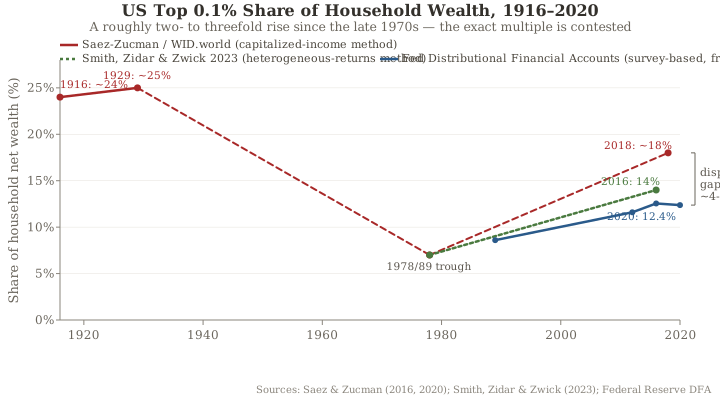
“Two cents on every dollar above \$50 million, projected at roughly \$2.75 trillion over ten years, from the wealthiest one-tenth of one percent.”
— the Warren / Saez–Zucman ultra-millionaire tax design, 2019
Is a well-designed annual wealth tax actually administrable?
The affirmative case at full strength: a low rate, a broad base, third-party valuation, an exit tax against flight. Saez and Zucman say it raises real money and reaches the stock the income tax can’t.
Tax the stock, or don’t tax saving at all?
“A progressive wealth tax is the most direct policy tool to curb the rise of wealth concentration. It targets the stock of wealth, not the flow of income that the very rich can choose not to realize.”
— Emmanuel Saez & Gabriel Zucman, The Triumph of Injustice, 2019 (paraphrased)
Saez and Zucman make the affirmative case as a matter of plumbing. The income tax is built around realization; the very rich control whether and when they realize; therefore the income tax is structurally unable to reach the largest fortunes. The wealth tax bypasses realization entirely by taxing the holding. It is motivated by $r > g$, the accumulation dynamic that concentrates wealth automatically, and aimed at it directly. They claim only that it is the most direct instrument that hits the target, and that the design problems are solvable with tools the tax system already deploys.
“The most basic result in the theory of optimal taxation is that you should not tax the normal return to saving. A wealth tax does exactly that, every year, to capital that was already taxed once as income, and it falls hardest on the assets that fund investment.”
— the efficiency critique, after Atkinson–Stiglitz and N. Gregory Mankiw
The efficiency objection is distinct from the administrability worries that come next. The argument is theoretical and serious: optimal-tax theory says the right bases are consumption and labor income, because taxing saving distorts the intertemporal choice and shrinks the capital stock everyone’s wages ultimately depend on. A 2% annual wealth tax, against a 4–5% real return, is an effective tax of 40–50% on that return, punishingly high by the standards of capital-income taxation, and levied on a base that was already taxed once when the income was earned. On this view the wealth tax is taxing the wrong thing.
Where this leaves us
The affirmative case earns its place. The income tax genuinely cannot reach unrealized appreciation at the top; $r > g$ is a real dynamic; the stock is where the accumulated economic power sits, and a tax on it aims straight there. The double-taxation charge is half-answered — taxing the return to wealth is ordinary, even if annual taxation of the stock itself is not — and the efficiency charge, while theoretically weighty, presumes the capital flight the proponents insist good design can prevent. The case holds up in the abstract. But a tax is an administrative machine that has to run in the real world, against people with every incentive to defeat it. The remaining question is whether it can actually be done.
The theory says tax the stock. So why did almost every country that tried it give up? In 1990, twelve OECD countries had a wealth tax. By 2020, about three did. That collapse is not an accident, and it is the skeptics’ single best argument.
The implementation problem
“In 1990, twelve OECD countries levied an annual net-wealth tax. By 2020, only about three still did. The repeals were driven by difficulties in administration, capital flight, and disappointing revenue relative to the cost of collection.”
— OECD, The Role and Design of Net Wealth Taxes in the OECD, 2018 (paraphrased; tally as commonly updated through 2020)
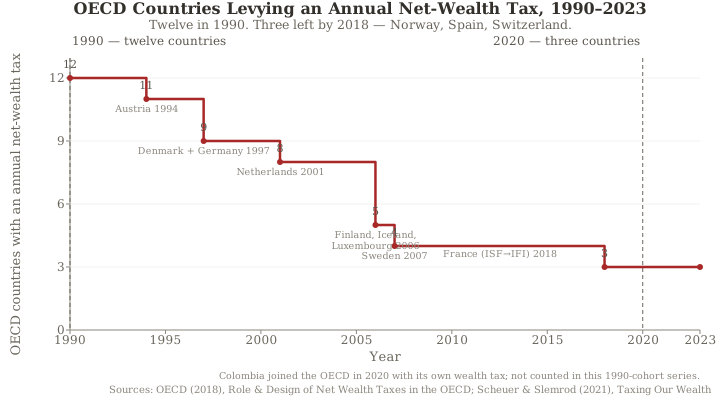
This is the hardest fact for the wealth-tax case, a near-clean sweep. France ran its ISF from 1982 until 2017, then gutted it to a real-estate-only tax under Macron after decades of capital and millionaire flight. Germany’s wealth tax was suspended on constitutional grounds in 1997 and never revived. Sweden repealed its tax in 2007. The direction of travel across rich democracies was almost uniformly one way: out.
Why the wealth-tax base runs away from you. Every tax raises less than the rate times the base would suggest, because the base responds to being taxed: the more elastic the base, the more revenue leaks away. Three channels make the wealth-tax base unusually elastic. Capital flight: both money and people are mobile, and an annual levy gives them a recurring reason to move. France is estimated to have lost tens of thousands of millionaires over the ISF’s life. Valuation: illiquid assets — private companies, art, farmland, complex partnerships — have no market price, so the state must appraise them every single year, which is administratively heavy and invites systematic lowballing. Avoidance: wealth reclassifies into whatever the law exempts, and the European bases were riddled with exemptions for exactly the assets the rich hold. Each channel shrinks the real base below the paper base, and net of collection costs the European yields were modest.
Revenue is not rate times nominal base. Net of behavior and enforcement, it is closer to
$$R = \tau \cdot B \cdot (1 - a) - C$$where $\tau$ is the rate, $B$ the nominal base, $a$ the avoidance-and-flight share, and $C$ the administration cost. The European record is a record of $a$ large and $C$ high, the realized $R$ came in a fraction of the headline $\tau \cdot B$, which is exactly the gap between the Saez–Zucman projections and the skeptics’ estimates.
Picture a tax you can leave the country to escape, levied on assets nobody can put a clean price on, collected by an agency that has to re-appraise every private business and every painting once a year, forever. The headline revenue assumes none of the wealth moves, none of it hides, and the appraisals are honest. The European experience is what happens when all three assumptions fail at once.
The valuation problem is an information problem: the government cannot observe true wealth, only what taxpayers report, and a tax on something only the taxpayer can measure invites them to measure it conveniently. That is the binding constraint, and it is the same information asymmetry that sits at the heart of mechanism design. The surrounding neoliberal-turn and financialization context in which these taxes were debated and repealed — falling top rates, capital-account liberalization — runs through the economic-history chapters on the stagflation and the neoliberal turn and globalization and financialization.
“Twelve OECD countries had net-wealth taxes in 1990. By 2020, about three remained. France converted its ISF to a real-estate-only tax after sustained capital flight.”
— OECD, The Role and Design of Net Wealth Taxes in the OECD, 2018 (paraphrased; tally as commonly updated through 2020)
Does the European repeal record prove a wealth tax can’t work?
The skeptic’s central exhibit: 12 wealth taxes became 3, and the repeals followed flight, valuation, and revenue problems. Is it proof of impossibility, or a record of bad design?
Wrong tool, or just a badly built one?
“A wealth tax is a poor way to raise revenue. The amount it would actually collect is a small fraction of the headline estimates, and there are far better tools for taxing the rich, tax their capital gains as they accrue, end the step-up in basis at death, and strengthen the estate tax.”
— Lawrence Summers & Natasha Sarin, 2019 (paraphrased)
Summers and Sarin make the skeptic case constructive, a “do it differently.” The revenue critique comes first: once you net out avoidance, flight, and the cost of annual valuation, the projections collapse to a fraction of the Saez–Zucman figure, because those figures assume a base that does not move. Then the positive program, which targets the very same effective-rate gap from Stage 1 by taxing a flow instead of a stock. Mark-to-market taxation of the very wealthy taxes unrealized gains as they accrue, so “buy and hold” no longer defers tax forever. Ending step-up in basis at death closes the “die” step of buy-borrow-die, the single largest leak. Higher capital-gains rates closer to ordinary-income rates close the “borrow” incentive. A robust estate tax reaches the stock once, at transfer, when it has to be valued anyway. Each taxes a flow that is realized or transferred at a moment, easier to value and harder to flee than an annual stock levy, and the administrative machinery for all of it already exists.
“The European wealth taxes failed because they were badly designed, high rates, narrow bases full of loopholes, weak enforcement, no exit tax. A well-designed wealth tax defeats these problems, and Switzerland has run one for a century.”
— after Emmanuel Saez & Gabriel Zucman, responding to the revenue critique
The proponents reinterpret the European record. The repeals, they argue, indict specific bad designs. Every failure mode the skeptics cite has a design answer: a low rate removes the fire-sale pressure, a broad base with almost no exemptions removes the reclassification game, third-party valuation removes the self-appraisal problem, and an exit tax removes the flight option by treating departure as a realization event. And Switzerland is the existence proof, a century of broad-based cantonal wealth taxation with high compliance and no flight crisis, precisely because it embodies those design choices. As for the alternatives, the proponents say mark-to-market and a beefed-up estate tax are welcome but insufficient: mark-to-market on illiquid assets faces the same valuation problem as a wealth tax, and the estate tax already exists and already leaks. The cleanest instrument, on their view, is still the direct one.
Where this leaves us
The European repeal record is the fact everything turns on, and it cuts deep without quite closing the case. The skeptics read a dozen abandonments as a verdict on the instrument; the proponents read them as a verdict on a dozen bad designs, and Switzerland gives that rebuttal teeth. Both readings are honest. A single well-functioning Swiss example, embedded in a federal low-rate third-party-valuation system the big economies have not built, is real evidence the tax can work, but it does not overturn the modal outcome of repeal under flight, valuation, and revenue pressure. On administrability, the balance tips to the skeptics. And their alternative does real work: taxing accrued gains, ending step-up in basis, and strengthening the estate tax are a genuinely better-engineered path to the same destination, hitting the effective-rate gap by taxing flows that are valued at a moment and harder to flee.
One caveat sits outside the economics. In the United States specifically, a federal wealth tax faces a constitutional question the economics cannot settle: the apportionment clause and the unrealized-income doctrine of Eisner v. Macomber (1920), revisited but not resolved in Moore v. United States (2024), leave it genuinely unclear whether Congress could levy a direct tax on wealth without apportioning it among the states by population. This walkthrough leaves that legal obstacle unadjudicated, but it matters a great deal for the American version of “should we,” and it weighs on the side of instruments whose constitutionality is settled.
So the goal is right and the tool is contested. The mainstream’s answer is not “do nothing”, it is “do it differently.” Here is where the economics actually lands, and what reasonable people still argue about.
The verdict, right goal, wrong instrument?
“Billionaires today pay a smaller share of their income in taxes than other social groups. A coordinated minimum standard ensuring that individuals with more than \$1 billion in wealth pay at least 2% of their wealth in tax each year would raise \$200–250 billion globally from about 3,000 individuals.”
— Gabriel Zucman, A Blueprint for a Coordinated Minimum Effective Taxation Standard for Ultra-High-Net-Worth Individuals, G20 report, 2024 (paraphrased)
Commissioned by the Brazilian G20 presidency, Zucman’s 2024 report takes the wealth-tax argument international, reframing it as a coordinated minimum tax that blunts the capital-flight objection by leaving fewer places to flee to. The professional disagreement between Saez–Zucman and Summers–Sarin is live at the policy frontier.
The design principle that organizes the verdict is one line: tax the base with the lowest elasticity and the lowest administration cost that still hits the target. Stage 2 fixed the target: the accumulated economic power that compounds untaxed at the top. Stage 3 showed the annual stock of wealth to be a high-elasticity, high-cost base, mobile, hard to value, expensive to collect. The principle therefore points away from an annual levy on the stock and toward the flows that carry the same economic power past the tax system at lower elasticity: realized or accrued capital gains, and transfers at death, which have to be valued at a moment in any case and cannot relocate to Geneva the way a portfolio can. For the optimal-tax framing behind “lowest-elasticity base,” see the inequality walkthrough, Stage 3.
“Tax their capital gains as they accrue, end the step-up in basis at death, and strengthen the estate tax. Same goal, more workable instruments.”
— the capital-income-reform position, after Summers, Sarin & Auerbach
Is “fix capital-income taxation instead” the right answer?
The mainstream position: keep the equity goal, change the instrument. But the wealth-tax case deserves one more hearing at its strongest before the verdict goes against it.
The verdict
The equity goal is right. The effective-rate gap is real, $r > g$ is real, and wealth concentration has risen sharply since 1980, a tax system that lets the largest fortunes compound at single-digit effective rates is failing at what it claims to do, and some fix is warranted. But a pure annual net-wealth tax faces hard, documented problems the European experience recorded in a near-clean sweep: capital flight, annual valuation of illiquid assets, administration cost against low net revenue, and the double-taxation objection. Twelve OECD countries levied such a tax in 1990; about three did by 2020, and the repeals followed those problems. The mainstream view, and this walkthrough’s, is that the same equity goal is better served by taxing capital income and inheritance: mark-to-market accrual taxation of the very wealthy, ending step-up in basis at death, higher capital-gains rates, and a robust estate tax. These reach the same accumulated power by taxing flows that are valued at a moment and harder to flee, on infrastructure that already exists.
At the goal layer there is near-consensus: the gap warrants a fix. At the instrument layer there is a real, named split, whether good design defeats the documented annual-wealth-tax problems. Saez and Zucman say yes, and Switzerland is their evidence; Summers, Sarin, and most of the public-finance mainstream say no, and the European repeals are theirs. That disagreement is partly about magnitudes (how much revenue survives flight and avoidance, how much the base actually moves) and partly about feasibility (whether an exit tax and honest third-party valuation can actually be administered at the scale of the US economy). This walkthrough’s lean is explicit: the equity goal is right; the workability balance favors capital-income and inheritance instruments over a standalone annual wealth tax; and Saez and Zucman’s design optimism is a real minority position that the European record weighs against but does not conclusively refute. A backstop wealth tax alongside capital-income reform is more defensible than a wealth tax instead of it, and that is the strongest pro-wealth-tax stance the record supports.
For whether the resulting distribution is just, Rawls and after, see justice and economic thought. For whether the redistribution question is even the right framing, see is poverty about distribution. The revenue this debate is about funds the welfare state a companion walkthrough anatomizes. And a wealth tax is one proposed funding source for the UBI another one evaluates.
Where this leaves us
The gap is real: the wealthiest legally pay single-digit effective rates on fortunes that grow untaxed, and that is a genuine failure of a system that calls itself progressive. The tax-the-stock case is strong: the income tax structurally cannot reach unrealized appreciation, $r > g$ concentrates wealth automatically, and taxing the stock directly is the most targeted instrument anyone has proposed. Administrability is the hard problem: a dozen OECD wealth taxes became three, undone by flight, valuation, and revenue that came in a fraction of the headline, contested by the proponents as a design failure, with Switzerland as their counter-exhibit, but a heavy fact. So fix capital-income taxation instead: taxing accrued gains and inheritance reaches the same accumulated power, and it survives the flight-and-valuation problem that undid the wealth taxes.
The lean is toward capital-income and inheritance instruments over a standalone annual wealth tax, with a narrow backstop wealth tax more defensible than a substitute, and the residual disagreement is named, because honest pluralism on the instrument is the position. The next time someone tells you “just tax their wealth” or “a wealth tax can never work,” you have the tools to push past both slogans to the question that actually decides it: which instrument makes them pay.