2008 from below: what apparatus did the crisis demand?
Start where the news-reader started, a French bank halting redemptions on three funds, a commercial-paper market freezing, an investment bank failing over a single weekend. Walk the sixteen-month cascade as it was experienced, not as a model later organized it. Then watch the discipline build, in the decade after, the class of apparatus those events demanded and the pre-2008 workhorse did not contain.
Als Debattengraph anzeigenThe case as the news-reader saw it
“The complete evaporation of liquidity in certain market segments of the U.S. securitisation market has made it impossible to value certain assets fairly regardless of their quality or credit rating.”
— BNP Paribas, press release suspending redemptions on three investment funds, August 9, 2007
Historians would later flag this paragraph as the start of the global financial crisis. On the morning of August 9, 2007, it read as a French bank announcing a problem with three of its funds. The crisis was already running. The news-reader was just starting to notice.
The story did not start at BNP Paribas. It started two months earlier, inside Bear Stearns. On June 22, 2007, Bear committed a \$1.6 billion credit line to its High-Grade Structured Credit Strategies Fund as investors rushed to pull their money out. On July 17 the bank told clients the fund and its more leveraged sibling had lost essentially all of their value. On July 31 both funds, the two run by Ralph Cioffi and Matthew Tannin, filed for bankruptcy. They had been earning their returns by holding bonds built out of subprime mortgages and borrowing short-term to hold more of them. When subprime borrowers began missing payments in early 2007, the market for those bonds thinned out, and "thinned out" became "no buyer at any price" faster than the funds' own models said it could. The Bear hedge funds were the first event in the crisis.
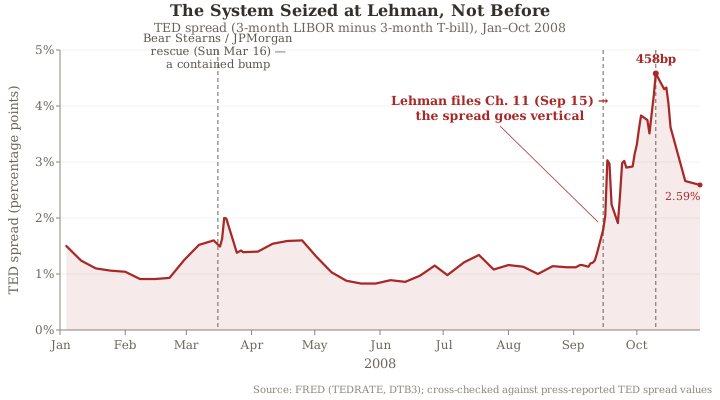
Then came August. The BNP Paribas statement on the 9th was the first time a large, ordinary bank said in public that it could not price its own holdings. Within hours the European Central Bank injected €95 billion into the banking system to keep overnight lending from seizing; the Federal Reserve followed on August 17 with a discount-rate cut and longer-term loans to banks. The market for asset-backed commercial paper, the short-term IOUs that funded vast pools of mortgage securities, shrank from roughly \$1.18 trillion to about \$0.95 trillion over the following weeks as lenders refused to roll the paper over. The TED spread, the gap between what banks charge each other and what the U.S. government pays, blew out from about 40 basis points in early July to 240 by late August. A reader following the wires through that month watched losses in one specific corner of the mortgage market spread into one specific funding market, watched that funding market stop working, and watched central banks step in to supply the cash the market would normally have supplied itself.
For the deeper chronology — the build-up of subprime origination, the securitization chain, and the summer-2007 funding stress as a connected sequence — the canonical account is Economic History Ch.19 §19.1 (The Crisis: September 2008 and the Global Financial Collapse), with the asset-backed-commercial-paper funding-market detail in the same section’s institutional-run passage.
The moment liquidity stopped being an abstraction
One sentence from a French bank told the world that securities with credit ratings and apparent buyers had no price at all. It did not yet say the cascade would reach Bear Stearns within seven months and Lehman within thirteen. But the thing the sentence named, assets you cannot value because no one will fund holding them, was the mechanism that drove everything that followed.
Read in sequence, the summer of 2007 is one connected movement. A specific kind of mortgage bond lost value faster than the funds holding it could absorb; the funds had borrowed short-term to hold those bonds, and their short-term lenders pulled out; the funding market that had supplied them froze; central banks stepped in because the funding markets that normally supply liquidity to one another had stopped doing so. Each step was reported as its own news story — a fund failure here, a discount-rate cut there — and the institutions living through it did not yet know how the connection ran or where it would land. These are events as they were experienced, named, dated, and priced, before anyone had the language to say what kind of thing was happening.
Where this leaves us
The summer of 2007 was a cascade caught in motion: specific corners of the credit market losing value, funding markets freezing, institutions absorbing losses. The cascade was visibly transmitting, and what it would reach next was not yet legible to anyone inside it. The concepts that would later organize it — the vocabulary of runs, counterparties, and systemic risk — enter next, as the words the policymakers themselves reached for when the cascade arrived at their door.
Eight months later, Bear Stearns itself, the bank that had rescued its own hedge funds the previous summer, would need a Federal Reserve backstop to be sold to JPMorgan over a single weekend. The cascade had reached the institutions that thought they were rescuing the funds caught in it.
The case as the Fed and Treasury saw it
“Lehman Brothers Holdings Inc. … Chapter 11 … total assets of \$639 billion and total debts of \$613 billion.”
— drawn from the voluntary petition and accompanying filings, U.S. Bankruptcy Court, Southern District of New York, filed 1:45 AM, September 15, 2008, the largest bankruptcy in U.S. history
The filing came after a weekend at the New York Federal Reserve in which Treasury Secretary Henry Paulson and Fed Chair Ben Bernanke concluded that no Fed facility could rescue Lehman without a private buyer, and no private buyer would commit without a Fed guarantee on the bad assets. Six months earlier, the same two officials had found a way to rescue Bear Stearns. Why Lehman went bankrupt when Bear got rescued is the question that pulls apparatus into this story.
The spring ran on rescues. On March 16, 2008, the Fed engineered the sale of Bear Stearns to JPMorgan — at \$2 a share initially, later raised to \$10 — and backstopped \$29 billion of Bear's worst assets through a special vehicle named Maiden Lane. On July 11, regulators seized IndyMac, a \$32 billion thrift, in the largest such failure to that point. On September 7, the Treasury took Fannie Mae and Freddie Mac into conservatorship, eventually drawing \$187.5 billion on the lines of credit it extended them. Running through every one of these decisions was a phrase the policymakers used out loud in testimony and press conferences: too big to fail. They meant that some institutions were so wired into the rest of the system that letting them collapse would take the system down with them, and that this concern justified the public money.
Then came the weekend of September 12–15. At the New York Fed, a Barclays bid for Lehman foundered on a Fed guarantee Paulson and Bernanke would not provide; a Bank of America bid pivoted to Merrill Lynch instead; Lehman filed at 1:45 AM Monday. The next morning the Reserve Primary Money Fund disclosed \$785 million of now-worthless Lehman commercial paper, and its share price fell to \$0.97, "breaking the buck," the first time in decades that a money-market fund, the vehicle ordinary Americans treated as indistinguishable from cash, had lost principal. The run that had started in one funding market in 2007 had now reached the safest non-Treasury short-term investment in the country. The policymakers reached for two more phrases. Counterparty exposure: Paulson's later account in On the Brink turns the Lehman decision on whether the contagion would run worse with a Fed-funded rescue, which would set a moral-hazard precedent, or without it, which is what happened. And the run on the shadow-banking system: Timothy Geithner's framing for the emergency money-market guarantee announced September 19, in which the Treasury stood its \$50 billion Exchange Stabilization Fund behind every dollar of every money-market fund to stop the run that had started that Tuesday.
This walkthrough keeps the Lehman weekend at chronology-paragraph depth; for the hour-by-hour account of the negotiations at the New York Fed and the systemic-risk apparatus they demanded, the deeper treatment is the sibling walkthrough The Lehman weekend.
The response stage came fast. On September 16 the Fed extended AIG an \$85 billion credit line, eventually \$182 billion, because AIG had written credit-default-swap protection on hundreds of billions of dollars of securities held by major banks across the world, so letting AIG fail would have pushed losses straight into that web of counterparties. On October 3 the Troubled Asset Relief Program was signed: \$700 billion in authority, of which \$245 billion went to banks through the Capital Purchase Program by year-end and \$79.7 billion went to the automakers. On December 19 the Bush administration extended \$13.4 billion to General Motors and Chrysler to keep them out of immediate bankruptcy. The phrase behind the AIG rescue was systemic interconnection, Bernanke's account in The Courage to Act turns the decision on AIG's exposure to the whole investment-banking complex. The information-economics literature these concepts lean on, adverse selection when buyers cannot tell good assets from bad, and the fire-sale externality where one firm's forced selling lowers the price every other holder marks against, runs through Stiglitz-Weiss and Shleifer-Vishny; the textbook home is Economics Ch.4 §4.6 (Information Asymmetry). But in September 2008 these were concepts the policymakers invoked without any model that could run them.
The full event chronology — Bear and IndyMac and the GSEs, the Lehman–AIG–Reserve Primary week, and the TARP-and-automakers response — is the spine of Economic History Ch.19 §19.1 (The Crisis: September 2008 and the Global Financial Collapse), whose coordinated-response passage walks the emergency facilities and rescues in turn.
“We had no choice but to let Lehman go … we had no buyer and no authority to inject capital. With Bear, we had a buyer. With Lehman, we did not.”
— Henry Paulson, paraphrasing the Lehman-weekend decision in On the Brink (2010); compare Bernanke on the AIG decision the next day in The Courage to Act (2015)
Why Lehman went bankrupt when Bear got rescued
Same officials. Same Fed toolkit. Six months apart, opposite outcomes, Bear sold with a federal backstop, Lehman left to fail, AIG rescued the very next day. The contrast is a window onto what the discipline could and could not do in real time, because the people making the call had to reason about systemic risk with no model that could measure it.
Read the autumn from inside the room, and the four phrases line up as one improvised framework. Too big to fail drove the Bear rescue and the GSE seizure: certain institutions could not be allowed to go down because of what they were connected to. Counterparty exposure framed the Lehman decision: would the contagion run worse with a rescue that set a precedent, or without one? Systemic interconnection drove the AIG rescue the next day: AIG's failure would have hit every major bank through the CDS web at once. And the run on the shadow-banking system named what the money-market guarantee was trying to stop. Each phrase was a real-time read of a specific decision, reached for under deadline by people who could see the cascade moving but could not measure where it would go.
What the policymakers lacked was a way to operationalize any of it. They could say "systemic risk" and "counterparty cascade" and "funding run," but there was no workhorse model on the Fed's shelves that represented banks, leverage, or the funding markets whose freezing was the whole event. The standard macroeconomic apparatus of 2008 treated the financial sector as a frictionless pass-through, saving flowed to investment, and the plumbing in between had no dynamics of its own. So the officials reasoned in prose, weighed precedents and contagion by judgment, and made the largest interventions in the history of the Federal Reserve on the strength of concepts they could name but not compute. Whether they read the Lehman counterfactual correctly is still argued. The answer turned on apparatus the discipline did not yet have, and these events are what told the discipline what to build.
Where this leaves us
In real time, the Fed and Treasury read the cascade through too big to fail, counterparty exposure, the run on the shadow-banking system, and systemic interconnection, concepts the policymakers themselves invoked but had no formal apparatus to operationalize at the scale the crisis demanded. The Lehman-versus-Bear contrast exposed the limits of what the discipline could do with the tools it had. The next stage takes up the class of apparatus the discipline built in the decade that followed, in direct response to what the events of these two stages revealed.
Eight years after the Lehman weekend, Janet Yellen stood at a Boston Fed conference and set out a research agenda. The apparatus the events demanded was already being built.
The case demands apparatus
“We argue that fluctuations in the riskiness of return on investment, risk shocks, are an important driver of business cycles … transmitted to the macroeconomy through their effect on the cost of external finance.”
— after Lawrence Christiano, Roberto Motto & Massimo Rostagno, “Risk Shocks,” American Economic Review 104(1), 2014
By 2014 the financial-frictions program had moved from the peripheral research literature it had lived in since the late 1990s to a top-journal workhorse. The class of model that could represent banks, leverage, and funding markets, the variables September 2008 was happening inside, did not exist in usable form on the day Lehman filed. It was built between then and now, and the events of the first two stages are what told the builders what to build.
The pre-2008 workhorse had a financial sector that did nothing: saving flowed to investment through a frictionless conduit, and balance sheets had no effects of their own. The apparatus the events demanded had to put four specific dynamics, each one visible in Stages 1 and 2, inside the model. Four research families did that, and each maps onto a cascade-dynamic the crisis exhibited.
- The financial accelerator (Bernanke-Gertler-Gilchrist 1999, extended by Christiano-Motto-Rostagno 2014). A contracting friction between borrowers and lenders generates an external-finance premium that rises as net worth falls, so an adverse shock weakens balance sheets, which raises the cost of borrowing, which weakens balance sheets further. This formalizes the Bear → Lehman → AIG counterparty cascade of Stage 2, the loop in which losses propagate through interconnected balance sheets.
- Banking with leverage constraints (Gertler-Karadi 2011, Journal of Monetary Economics). Financial intermediaries face a balance-sheet constraint that binds when their net worth deteriorates, and central-bank asset purchases substitute for the lending impaired intermediaries can no longer do. This formalizes the September 2008 emergency-facility arc of Stage 2, the alphabet soup of Fed lending programs and the AIG credit line, all of them stepping in where impaired intermediaries had stopped supplying credit and conventional rate cuts could not reach.
- Liquidity-funding spirals (Brunnermeier-Pedersen 2009, Review of Financial Studies). Market liquidity (the cost of trading an asset) and funding liquidity (the cost of borrowing to hold it) feed back through margins, producing reinforcing loss spirals and margin spirals that can collapse a market with no change in fundamentals. This formalizes the funding-market freezes of both earlier stages — the August 2007 commercial-paper freeze, the March 2008 run on Bear's repo funding, and the September 2008 money-market-fund run — as the same mechanism running at three different scales.
- Intermediary asset pricing (He-Krishnamurthy 2013, American Economic Review). When the intermediary sector's capital is impaired, risk premiums on the assets intermediaries hold jump, because the sector's capacity to bear risk, not the representative consumer's appetite for it, is what is constrained. This formalizes the late-2008 spread blowouts — credit, mortgage, and swap spreads all widening together — that the standard consumption-based asset-pricing model could not explain at all.
At the core of the program sits one idea: the cost of borrowing carries a premium that depends on the borrower's balance sheet.
In the simplest financial-accelerator specification, the external finance premium $s$ depends on net worth $N$ relative to the capital $K$ being financed:
$$s_t = s\!\left(\frac{N_t}{K_t}\right), \qquad s' < 0$$As net worth falls relative to the project being funded, the premium rises, and because higher borrowing costs further erode net worth, the premium and the balance sheet move against each other. That single sign, $s' < 0$, is the accelerator.
When a borrower's balance sheet weakens, lenders charge more to lend, which weakens the balance sheet further, which makes lenders charge more again. A small shock to net worth gets amplified into a large swing in the cost of credit. The pre-2008 workhorse had nothing that could do this; its financial sector was a pipe, which is why the events of 2007–2008 looked, from inside that model, like they came from nowhere.
The unmodified base these extensions retrofit onto is the canonical New Keynesian core; the toolkit for reaching the point where conventional policy runs out and the unconventional tools begin lives alongside it. The chapters that build these models formally are below.
For how this financial-friction program sits inside the New Keynesian tradition it patched — what the canonical synthesis model missed, and how the discipline bolted the missing structure on — the intellectual-history account is History of Economic Thought Ch.12 §12.7 (The reckoning: what 2008 exposed and what survived).
The financial-frictions program is one of four repair threads a broader synthesis traces across the whole discipline; for that wider accounting — financial frictions alongside HANK, occasionally-binding constraints, and narrative methods — see the sibling walkthrough Did 2008 break macroeconomics?
“A model of unconventional monetary policy … in which intermediary balance sheets matter for the supply of credit.”
— after Mark Gertler & Peter Karadi, “A Model of Unconventional Monetary Policy,” Journal of Monetary Economics, 2011
The apparatus the events demanded
Four research families, each formalizing one cascade-dynamic the crisis exhibited: balance-sheet propagation, impaired-intermediary lending, funding spirals, and intermediary-capital pricing. Together they are a coherent program, and none of it was in the pre-2008 workhorse. The mapping runs from event to apparatus: the discipline did not retrofit a story onto the crisis; the crisis told it what was missing.
Named separately, the four families look like four papers; they are one program. They share a single claim, that financial-sector dynamics are first-order for the macroeconomy and require formal apparatus the pre-2008 workhorse did not contain, and they divide the labor of building it: balance-sheet propagation, impaired-intermediary credit supply, liquidity-funding spirals, and intermediary-capital asset pricing. Each was a structured response to something the events of 2007–2008 had shown the old model could not see. Read as a class, post-2008 financial-frictions macroeconomics is the discipline's consensus methodological answer to the gap the crisis exposed.
At its strongest, the program is predictive and operational. It generates specific conditions under which cascade dynamics ignite, net-worth thresholds in the accelerator, leverage-constraint binding in the banking models, margin-spiral initiation in the liquidity models, intermediary-capital impairment in the pricing models, and those conditions are written into the policy-analysis models that the Federal Reserve, the European Central Bank, and the Bank of England now run for forecasting and policy design. The macro-finance integration this required is reviewed in Tobias Adrian, Nina Boyarchenko, and Hyun Song Shin's 2014 survey in the Annual Review of Financial Economics, which traces how intermediary balance sheets moved from a research curiosity to a standard channel. The intellectual-history situating of all this, the post-2008 absorption of financial frictions as one of the named structural shifts in the modern landscape, alongside the Minsky revival it provoked, is History of Economic Thought Ch.17 §17.2 (Vindication and falsification: the Great Moderation to 2008).
Only the financial-frictions apparatus is built up here, as the mainstream's answer to what the events demanded. There is a second reading of the same crisis, that it was at root a monetary-disequilibrium event, and that apparatus-comparison is the work of the sibling walkthrough 2008: financial or monetary?, which inhabits both framings side by side.
Where this leaves us
The four-family financial-frictions program is the apparatus class the events of 2007–2008 demanded. Each family formalizes a specific cascade-dynamic the events exhibited; together they constitute the discipline's consensus methodological response to what the workhorse had been missing, and the class is now technically standard inside the post-2008 toolkit. The same absorption looks different from the causation angle: the sibling walkthrough Did economics cause 2008? reads this build-out as the discipline conceding, through its own senior insiders, that the methodological charge had substance. Read here, it is the apparatus the events demanded.
The four-family class is in the workhorse. Whether the workhorse is now adequate, and what specifically remains unbuilt, is what the closing stage asks.
What the apparatus explains, and what remains
“The financial sector has been incorporated more fully into macroeconomic models, and the analysis of unconventional monetary policy tools has been extended.”
— after Janet Yellen, “Macroeconomic Research After the Crisis,” Federal Reserve Bank of Boston conference, October 2016
Eight years after Lehman, the Fed Chair's speech was an inventory of what was being built into the framework next. Most of what is in the workhorse a decade later is the program Yellen flagged that day. The closing question is what that build-out has explained, what remains unbuilt, and what is open.
Start with what the apparatus now explains. The shadow-banking-system fragility of all three earlier funding-market freezes — the August 2007 commercial-paper freeze, the March 2008 run on Bear's repo funding, the September 2008 money-market-fund run — fits the liquidity-funding-spiral framework as a single mechanism at three scales. The counterparty-cascade transmission of Bear → Lehman → AIG fits the balance-sheet propagation of the accelerator and banking models. And the policy architecture that followed reads as the apparatus operationalized: macroprudential regulation as margin-and-leverage-constraint policy; lender-of-last-resort capacity as intermediary-balance-sheet support; the Fed's emergency-liquidity facilities — the TAF, the PDCF, eventually a standing repo facility — treated as a permanent part of the playbook. Dodd-Frank (July 2010) and Basel III (December 2010) built the regulatory frame the apparatus informed; the 2009-onward Fed stress-test program, institutionalized as the Comprehensive Capital Analysis and Review, made the lender-of-last-resort posture routine. That policy-response arc is the regulatory-aftermath stretch of Economic History Ch.19 §19.1 (the Dodd-Frank and stress-testing aftermath).
Now the gaps. The macro-finance integration is uneven: the financial-friction blocks are bolted onto standard New Keynesian skeletons, so the integration is technically genuine but conceptually layered. The endogenous-instability accounts in the Minsky tradition are not yet workhorse: the apparatus formalizes the back end of a financial cycle — the fire sales, the accelerator, the spread amplification once trouble starts — but not the front end, the way a long calm itself manufactures the leverage that later destabilizes the system. The interaction between household heterogeneity and financial frictions, where heterogeneous-agent New Keynesian models meet intermediary balance sheets, is still a live research frontier. And the predictive-adequacy question is open: whether this apparatus would have flagged 2008 had it existed before the crisis is a counterfactual the literature cannot settle, and whether it can flag the next crisis is the live policy question.
Substantial build-out, or load-bearing gaps?
“By 2015 the DSGE models major central banks ran for policy evaluation had financial-sector blocks; the canonical model the synthesis had defended in 2007 was no longer the model the synthesis was running.”
— the post-2008 reckoning, as narrated in History of Economic Thought Ch.17 §17.2
The build-out is done and in use. The four-family apparatus is technically standard inside the post-2008 toolkit, the financial-friction blocks are in the Fed, ECB, and Bank of England policy models, macroprudential regulation operationalizes the apparatus's policy implications, and the central-bank emergency-liquidity playbook now treats the 2008 facility design space as permanent. Bernanke's own insider account in The Courage to Act reads as the memoir of a discipline that absorbed the charge and rebuilt accordingly. On every concrete measure — what is taught, what is published, what central banks run — the discipline did the work the events demanded.
“Prolonged stability itself produces instability: borrowers who survive a stable period accumulate confidence and leverage … without any agent making an obviously irrational choice.”
— after Hyman Minsky’s financial-instability hypothesis (1986), in its post-2008 revival; see History of Economic Thought Ch.17 §17.2
The gaps that remain are the ones that matter. The apparatus models the cascade once it begins but not how the calm breeds the fragility, the endogenous-instability front end Minsky insisted was the whole story, and which the discipline has rehabilitated rhetorically far more than methodologically. The Bank for International Settlements financial-cycle work of Claudio Borio and colleagues, and the post-Keynesian instability literature, argue that a framework which treats the crisis trigger as an exogenous shock to an otherwise stable system has not represented the thing that makes financial systems dangerous. Add the bolted-on integration, the heterogeneity-and-frictions frontier still outside the workhorse, and the unsettled predictive-adequacy counterfactual, and the honest verdict is that the build-out, however substantial, stops short of the mechanism that generated the event in the first place.
Would the apparatus have predicted 2008?
The question the apparatus class cannot answer about itself. The models built after 2008 fit 2008, they were built to. Whether they would have seen it coming had they existed beforehand, or would see the next one coming now, is a counterfactual no internal feature of the apparatus can settle.
Where this leaves us
The four-family financial-frictions program is the mainstream's answer to what the events of 2007–2008 demanded, and the discipline has substantially built it out: financial-friction blocks sit in the policy models central banks run, macroprudential regulation operationalizes the apparatus's implications, and the lender-of-last-resort playbook is now permanent. The build-out is also incomplete in specific, load-bearing ways: the macro-finance integration is uneven, the endogenous-instability front end is not yet workhorse, the heterogeneity-and-frictions frontier is still research literature, and the predictive-adequacy question is open. That calibration — substantial build-out, uneven integration, predictive adequacy unsettled — is the position. The frame is settled (the events demanded a financial-frictions class, and the discipline built one); the live disagreement is about how complete the build is.
The 2026 posture holds two things at once. Against the claim that nothing changed, the apparatus is in the workhorse, the policy architecture is in place, and the emergency playbook is permanent; the discipline did not shrug off the charge. Against the claim that the apparatus is now adequate, the integration is layered, the instability-generating mechanism is still unmodeled, and no one can certify the class against the next crisis. And the path traced here — from events, to the concepts policymakers reached for, to the formal models, to the question of how complete those models are — is one of several legitimate readings of the same evidence. Did economics cause 2008? reads the same build-out as senior insiders conceding the charge that the discipline helped cause the crisis; 2008: financial or monetary? reads the same events through both a financial and a monetary lens, surfacing an alternative this single-apparatus account does not. The question here was narrower and answerable: what apparatus did the events demand, and how far has the discipline built it? The answer is the financial-frictions class, built substantially, integrated unevenly, with its predictive reach still an open bet.
The frame-level question, whether the toolkit was broken or merely extended, is the sibling verdict of Did 2008 break macroeconomics?, which sits alongside the parameter-magnitude calibration reached here.
The arc, from below
- The case as the news-reader saw it. Summer 2007 — the Bear hedge funds, the BNP Paribas redemption halt, the commercial-paper freeze — in sequence, as a cascade caught in motion, with no apparatus brought in.
- The case as the Fed and Treasury saw it. March to December 2008 — Bear, the GSEs, Lehman, AIG, Reserve Primary, TARP, the automakers — read through the four phrases the policymakers reached for in real time without a model to compute them.
- The case demands apparatus. The four-family financial-frictions program — accelerator, banking, liquidity spirals, intermediary asset pricing — each formalizing a cascade-dynamic the events exhibited.
- What the apparatus explains, and what remains. A substantial build-out now in the workhorse, with an uneven integration, an unbuilt instability front end, and an open predictive-adequacy question.
The discipline reads the events of 2007–2008 as a demand for a class of apparatus the pre-2008 workhorse did not contain, counterparty cascades, intermediary-capital constraints, liquidity-funding spirals, and the shadow-banking fragility that pre-2008 macroeconomics did not represent at all. The four-family financial-frictions program is the mainstream's answer to that demand, and the build-out across 2009–2020 has been substantial: it is in graduate macro syllabi, in the policy models major central banks run, and in the design of macroprudential regulation.
The thing that is no longer in doubt is that the events demanded this class of apparatus; what is still argued is how complete the build is. The apparatus is the response to what the events revealed; whether the discipline's failure to have it earlier helped cause the crisis belongs to a different walkthrough, and whether the toolkit was broken or merely extended belongs to another still. Read from below, the case demanded an apparatus, the discipline built most of it, and the part that remains unbuilt, the mechanism by which stability manufactures its own collapse, is the part that would tell us whether any of it will see the next one coming.