Les marchés allouent-ils les ressources efficacement ?
From \$4 trillion healthcare to climate catastrophe: when the invisible hand drops the ball
Voir comme graphe de débatThe first welfare theorem
"The United States spends about twice as much on health as the average wealthy country but has the lowest life expectancy and highest rate of avoidable deaths."
— after The Commonwealth Fund, U.S. Health Care from a Global Perspective, 2023
Americans spend over \$4 trillion a year on healthcare (\$12,500 per person), yet rank last among wealthy nations on life expectancy, infant mortality, and preventable deaths. If markets allocate efficiently, how do you explain this?
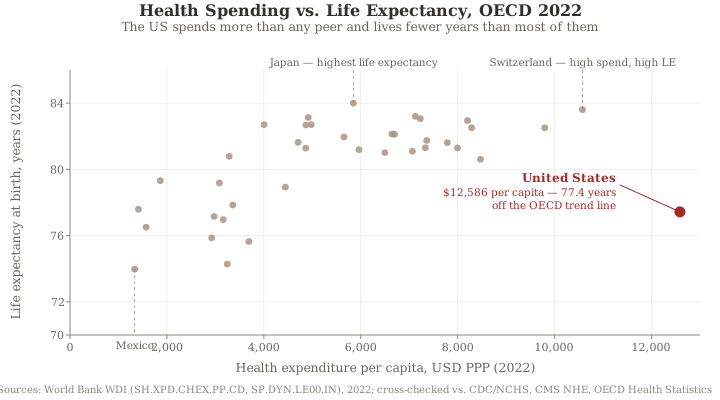
Behind that \$4 trillion indictment sits the benchmark economists use to claim markets should work. That benchmark is total surplus.
Consumer surplus and producer surplus. When you buy a coffee for \$4 but would have paid \$6, you capture \$2 of value, consumer surplus (CS). When the coffee shop sells it for \$4 but could have profitably sold it at \$2.50, it earns \$1.50 of producer surplus (PS). Add them up across every transaction in a market:
At the competitive equilibrium quantity $Q^*$, every unit produced has a buyer who values it more than it costs to produce. Total surplus is maximized. This is allocative efficiency. The price system coordinates millions of decisions into an allocation no planner could improve upon.
At the right price, every trade that should happen does happen. Every buyer who values the good more than it costs to make gets one. No value is left on the table. That's the economist's definition of efficiency.
Deadweight loss. Anything that pushes the market away from $Q^*$ destroys value. A tax, a price ceiling, or a monopolist restricting output all reduce the quantity traded below the efficient level. The lost surplus is called deadweight loss (DWL). A transfer moves surplus from one party to another; deadweight loss simply disappears.
Why this matters for healthcare. The surplus framework gives markets a powerful default endorsement. Left alone, competitive markets maximize total value. But that endorsement is conditional. The supply curve must capture all production costs. The demand curve must capture all consumption benefits. There are no costs imposed on third parties, no benefits spilling to non-buyers, no seller dominating the market, and no information that one side has and the other doesn't.
Healthcare violates every one of these assumptions. Kenneth Arrow showed in 1963 that the healthcare market differs from commodity markets. Patients can't evaluate the quality of care they're buying, insurance creates moral hazard, and the consequences of bad purchases are irreversible. The \$4 trillion paradox is a market operating in conditions where the efficiency theorem never applied.
Three terms to fix before going further. They recur across the rest of this walkthrough. Information asymmetry: one side of the transaction knows materially more than the other. The doctor knows what treatment is needed; the patient does not. Moral hazard: once insurance covers the cost, the insured patient demands more care and the insured provider has weaker reasons to control it; the act of insuring changes behavior. Adverse selection: when buyers can self-select, the healthy opt out of insurance pools and the sick stay in, driving premiums up until the pool collapses unless coverage is mandated. These are specific structural conditions under which the welfare theorem stops applying.
"Should healthcare be a market?"
The US runs the largest experiment in market-based healthcare on Earth. It has produced the most expensive system in the developed world, with outcomes that trail single-payer systems by nearly every measure. Arrow saw this coming sixty years ago.
The efficiency benchmark
"Virtually all the special features of this industry stem from the prevalence of uncertainty in the incidence of disease and in the efficacy of treatment... The uncertainty of the object of transaction in the medical-care market makes it differ fundamentally from the usual commodity of economics textbooks."
— after Kenneth Arrow, American Economic Review, 1963
Arrow's paper launched the field of health economics. The conditions that make markets efficient (good information, predictable demand, many competitors) fail systematically in healthcare. Patients can't evaluate treatment quality. Demand is unpredictable and catastrophic. And the seller (the doctor) advises the buyer on what to buy. This information asymmetry is intrinsic to the service. Six decades later, no one has refuted the core argument.
"Of course, if market transactions were costless, all that matters (questions of equity apart) is that the rights of the various parties should be well defined and the results of legal actions easy to forecast."
— Ronald Coase, Journal of Law and Economics, 1960
Coase's theorem offers the free-market response to every market failure. If property rights are clearly defined and transaction costs are low, private bargaining reaches the efficient outcome without government intervention. In healthcare, transaction costs are enormous. Patients can't comparison-shop during a heart attack, information is hopelessly asymmetric, and the "product" can't be returned. Coase himself treated zero transaction costs as a theoretical device. The theorem's contribution is diagnostic; it tells you to look at transaction costs before deciding whether markets or regulation will perform better.
Where this leaves us
The surplus framework says competitive markets maximize total value. But the conditions are demanding: all costs in the supply curve, all benefits in the demand curve, good information on both sides, many competing sellers. Healthcare fails on every count. The \$4 trillion paradox is what happens when you apply market logic to a domain where the efficiency conditions don't hold. The surplus benchmark is the right starting tool. But how many markets actually meet the conditions?
Healthcare is one market. But what if the biggest market failure isn't about one industry at all? What if it's about the entire planet?
The house on fire

"Our house is on fire." The climate crisis is the ultimate externality, a market failure so large it threatens civilization. Every ton of CO2 emitted imposes costs on people who never consented to the transaction, in countries that never burned the fuel, in generations that haven't been born yet.
Thunberg's rage is emotionally powerful. But the economics behind it is just as devastating. Climate change is the oldest market failure in the textbook, scaled to planetary dimensions. The concept is the externality.
Externalities: when prices lie. An externality exists when a transaction imposes costs or benefits on third parties who aren't part of the deal. A steel mill emitting sulfur dioxide imposes health costs on nearby residents, a negative externality. The mill's private cost of production is less than the social cost (private cost plus health damages). Because the mill ignores the damage, it produces more than is socially optimal.
Formally, the marginal social cost exceeds the marginal private cost: $MSC > MPC$. The market overproduces. The efficient quantity is where $MSC = \text{Marginal Benefit}$, but the market produces where $MPC = \text{Marginal Benefit}$. The gap is deadweight loss, real value destroyed by transactions that shouldn't have happened.
Every time a factory pollutes, it's getting a subsidy it never applied for, the right to dump costs on other people for free. The price of its product is too low because it doesn't include the damage. So consumers buy too much of it. The market "works" for the buyer and seller, but fails for everyone else.
Why climate is the ultimate externality. William Nordhaus, who won the 2018 Nobel for integrating climate change into economic analysis, calls it "the most important externality in the history of the human race." The social cost of carbon (the total damage inflicted by one additional ton of CO2) is estimated at \$50–\$200 per ton, depending on the discount rate. Global emissions are roughly 37 billion tons per year. That's \$1.8–\$7.4 trillion in annual damages that don't appear in any price. The market for fossil fuels is "efficient" only if you ignore that the planet is warming.
The standard fixes. Arthur Cecil Pigou proposed the solution a century ago, a tax equal to the marginal damage. A carbon tax of \$50 per ton forces emitters to internalize the social cost. Cap-and-trade systems create a market for the externality itself, letting the price emerge from trading among emitters. Both work in theory. In practice, the EU Emissions Trading System has reduced European emissions by roughly 35% since 2005.
Other categories — public goods, common resources, information asymmetry — sit alongside externalities in the standard market-failure catalog and are covered in Chapter 4. Externalities and the climate case stay the focus here.
"The problem with climate change is that the costs are imposed on people who are not part of the decision. The solution is to correct the externality by putting a price on carbon, and then letting markets do what markets do best."
— after William Nordhaus, Nobel Lecture, 2018
"Is a carbon tax the best climate policy?"
Economists have been saying "put a price on carbon" for thirty years. Pigou designed the tool a century ago. Nordhaus won the Nobel for the math. So why do we still not have a global carbon price, and are the alternatives actually worse?
The greatest market failure
"Climate change presents a unique challenge for economics: it is the greatest and widest-ranging market failure ever seen."
— Nicholas Stern, Stern Review on the Economics of Climate Change, 2006
Pigou identified the mechanism. Stern quantified the stakes. His 2006 review estimated that unmitigated climate change would reduce global GDP by 5–20% permanently, a deadweight loss dwarfing any market intervention in history. The review's most controversial move was using a near-zero discount rate, implying future generations' welfare counts almost as much as ours. Nordhaus disagreed on the discount rate (using a market-based 3–5%) but agreed on the diagnosis. The externality is real, enormous, and requires a price correction. The Pigou-Stern-Nordhaus line is the profession's consensus. Climate change is a market failure, and the fix is to make carbon expensive.
"The problem of social cost is ultimately about transaction costs. If it were costless to bargain, the assignment of rights would not affect the efficiency of resource allocation."
— after Ronald Coase, Journal of Law and Economics, 1960
Coase's framework asks: could private bargaining solve the externality without government intervention? For climate, the answer is no. The "transaction" involves 8 billion people across 195 countries, plus future generations who can't negotiate at all. Transaction costs are infinite for the parties most affected. Pigouvian intervention is unavoidable here. Even Coase would agree that when transaction costs are astronomical, the choice is between regulation and unpriced damage.
Where this leaves us
The market failure catalog (externalities, public goods, common resources, information asymmetry) describes most markets that matter for human welfare: healthcare, education, finance, energy, the environment. Climate change is the largest externality in human history, but it operates on the same mechanism as a factory polluting a river. The price doesn't capture the cost, the market overproduces, and surplus is destroyed. So how do we know precisely when market efficiency holds? A Nobel laureate has a blunt answer.
We've cataloged failures. But so far, the argument has been case-by-case, healthcare here, climate there. Is there a general theorem about when markets work and when they don't? There is.
The welfare theorems
"Whenever there are externalities or imperfect information — that is, essentially always — markets are not efficient."
— Joseph Stiglitz, Whither Socialism?, 1994
A Nobel laureate's verdict: the conditions for market efficiency essentially never hold. Stiglitz proved it mathematically. In any economy with incomplete markets or imperfect information, competitive equilibria are generically constrained-inefficient. Provably inefficient, even by a charitable standard.
Stiglitz's provocation sounds like ideology. It states the conclusion of theorems that tell you exactly when markets are efficient, and what breaks when the conditions fail.
The First Welfare Theorem. If a competitive equilibrium exists, and preferences are locally nonsatiated (consumers always want a little more of something), then the equilibrium is Pareto optimal: no one can be made better off without making someone else worse off.
The proof proceeds by contradiction. Suppose a Pareto improvement existed, an alternative allocation $x'$ where someone is better off and no one is worse off. Under local nonsatiation, if consumer $i$ prefers $x'_i$ to the equilibrium allocation $x^*_i$, then $x'_i$ must cost more than $x^*_i$ at equilibrium prices (otherwise $i$ would have chosen it). Summing across all consumers, the improving allocation costs more than total income. But total income equals the value of total endowments, and total demand can't exceed total supply. Contradiction.
The First Welfare Theorem says that if markets are competitive, if there's a market for everything, and if there are no externalities, then the outcome is as good as it gets. You can't reshuffle goods to help someone without hurting someone else.
The conditions. Complete markets (a market for every good, every state of the world, every date). Price-taking behavior (no market power). No externalities. That rules out healthcare's information asymmetry, the climate externality, monopolies, and missing insurance markets. Every item in the failure catalog from Stage 2 maps to a violation of one of these conditions.
The Second Welfare Theorem. Any Pareto optimal allocation can be achieved as a competitive equilibrium, provided you start with the right distribution of wealth, using lump-sum transfers. This sounds powerful. Markets can achieve any efficient outcome, including equitable ones. But lump-sum transfers (taxes that don't distort behavior) are a theoretical fiction. Every real redistribution tool (income taxes, wealth taxes, means-tested benefits) creates distortions. The theorem says you can have efficiency and equity through markets, but only with a tool that doesn't exist.
The Greenwald-Stiglitz theorem (1986). When markets are incomplete (when some risks can't be traded, or some goods don't have markets), competitive equilibria are generically constrained-inefficient. "Constrained-inefficient" means that even accounting for the informational limitations that prevent markets from being complete, there exist government interventions that make everyone better off.
Since markets are always incomplete (you can't buy insurance against most of the risks that matter: job loss, neighborhood decline, your child's health), competitive equilibria are almost always improvable by well-designed interventions. Stiglitz's "essentially always" is the theorem speaking.
"The laissez faire solution for medicine is intolerable. The very word 'patient' suggests dependence, vulnerability, and information asymmetry -- the opposite of the conditions under which competitive markets produce good outcomes."
— after Kenneth Arrow, "Uncertainty and the Welfare Economics of Medical Care", American Economic Review, 1963
"Should healthcare be a market?" (revisited)
In Stage 1, we saw healthcare as one broken market. Now the welfare theorems explain why it's broken, and why it can never be fixed by deregulation alone. Arrow's 1963 diagnosis maps precisely onto the conditions the First Welfare Theorem requires and healthcare violates.
Are the welfare theorems a vindication or an indictment of markets?
"Whenever there are 'externalities', where the actions of an individual have effects on others for which they neither pay nor are paid, the market equilibrium will not be efficient. Greenwald and Stiglitz (1986) showed that whenever markets are incomplete or information imperfect — that is, essentially always — competitive equilibria are constrained Pareto inefficient."
— Joseph Stiglitz, Whither Socialism?, 1994
Stiglitz's claim sounds extreme but is what the theorem proves. The conditions for the First Welfare Theorem (complete markets, perfect information, no externalities) never hold simultaneously in any real economy. Greenwald-Stiglitz showed that when they fail, there always exist tax-subsidy policies that make everyone better off, even respecting the same informational constraints. The result reversed the burden of proof; markets are inefficient unless you demonstrate that the specific conditions hold. Stiglitz is one node in a longer lineage — Akerlof on lemons, Spence on signaling, Mirrlees on hidden information — that turned imperfect information from a footnote into a research program; that lineage is traced in history of economic thought, Ch.11: Information economics and the game-theory revolution.
"The most significant fact about this system is the economy of knowledge with which it operates, or how little the individual participants need to know in order to be able to take the right action. ... We must look at the price system as such a mechanism for communicating information if we want to understand its real function."
— Friedrich Hayek, "The Use of Knowledge in Society", American Economic Review, 1945
Hayek's 1945 paper answers on Greenwald-Stiglitz's own terrain, information. The economic problem of society, Hayek argued, is not how to allocate "given" resources but how to use knowledge that is never available in concentrated form, the knowledge of particular circumstances of time and place, scattered across millions of minds and impossible to centralize. Prices, on this view, are the social institution that aggregates that dispersed knowledge into a signal each participant can act on without needing to understand why. A planner staring at a Stiglitz-style theorem sees an existence proof for a welfare-improving intervention; a planner inside Hayek's frame sees the problem the existence proof glosses over, who knows enough to design and run the intervention? Hayek's heirs in the Austrian tradition (see history of economic thought, Ch.6: Austrian tradition) push the point further: when comparative institutional analysis is honest about both market failure and knowledge failure on the government side, the burden-of-proof argument cuts both ways. A second tradition sharpens the same worry from the political side. Public choice — Buchanan, Tullock, Olson — models the planner as an interest-bearing agent inside a system of voters, bureaucrats, and lobbies, where the very intervention the theorem licenses becomes a prize for the best-organized group to capture. The government-failure case against the existence proof is traced in history of economic thought, Ch.14: The public choice tradition.
Where this leaves us
The welfare theorems identify exactly when and why markets fail. The First Welfare Theorem is a conditional claim with conditions that fail in healthcare, education, finance, labor markets, and the environment. Greenwald-Stiglitz closes the escape hatch. With incomplete markets and imperfect information (always), competitive equilibria are provably inefficient. The theorem shifts the question from "do markets work?" to "what institutional design works best in this specific setting?" And for some settings, the answer is radical: don't patch the market. Design something new.
The welfare theorems diagnose the disease. Can economics also prescribe the cure? What if, instead of regulating failed markets, we could engineer institutions that work better from first principles?
Market design in practice
"Marketplace design is a young enough field that many of its insights still have to fight their way into general acceptance and use... Economists have begun to understand the kinds of markets we observe as the products of intelligent design, even if the designers were often just struggling to understand the markets they were trying to make work better."
— after Alvin Roth, Who Gets What, and Why, 2015
If markets fail, can economists engineer better ones? The answer is yes. Kidney exchanges save thousands of lives in a domain where sales are illegal and waitlists are inefficient. Spectrum auctions have allocated hundreds of billions of dollars of radio spectrum. School choice algorithms match millions of students to schools. All of it is deployed infrastructure.
Alvin Roth calls it "economists as engineers." The field is mechanism design. Instead of asking "does this market work?", mechanism design asks "can we design rules that produce efficient outcomes even when the standard conditions fail?"
The starting point is a powerful simplification called the revelation principle. Any outcome achievable by any mechanism can also be achieved by a truthful direct mechanism, in which participants simply report their private information and the mechanism computes the outcome. Instead of searching over all possible institutions, you only need to search over truthful ones.
The flagship design is the Vickrey-Clarke-Groves (VCG) mechanism. Each participant reports their value. The mechanism allocates the good to whoever values it most. Each participant pays a tax equal to the externality they impose on others.
Formally, if participant $i$ wins, they pay:
$$p_i = \sum_{j \neq i} v_j(\text{allocation without } i) - \sum_{j \neq i} v_j(\text{allocation with } i)$$This payment structure makes truth-telling a dominant strategy; reporting your true value is optimal regardless of what anyone else does. Spectrum auctions, which have allocated hundreds of billions of dollars in radio spectrum across dozens of countries, are practical descendants of VCG.
Each person pays not based on what they bid, but based on the cost their participation imposes on everyone else. If you win an auction, you pay the amount by which your winning reduced everyone else's surplus. This eliminates any incentive to lie about your value.
Matching markets: where prices can't go. Some markets can't use prices at all. You can't legally sell kidneys, auction school places, or buy residency positions. Roth's answer was to design algorithms that produce stable matches, outcomes where no pair of participants would prefer to break their current match and pair with each other. The Gale-Shapley deferred acceptance algorithm does exactly this. It now runs the National Resident Matching Program (40,000+ doctors per year), kidney exchange chains (thousands of transplants), and school choice systems in New York, Boston, and dozens of other cities.
The limits: Myerson-Satterthwaite. The Myerson-Satterthwaite theorem (1983) proves that in bilateral trade with private information, no mechanism can simultaneously achieve efficiency, incentive compatibility, voluntary participation, and budget balance. The theorem bounds what any institution can achieve when information is private.
Market design also extends to preventing existing markets from being captured. The rise of digital platforms has revived antitrust economics. When Google, Amazon, or Apple control both the marketplace and compete within it, the conditions for the First Welfare Theorem fail through a new mechanism, platform monopoly power combined with information advantages that dwarf anything Akerlof imagined. The question is whether mechanism design can create competitive digital markets, or whether the economics of platforms makes monopoly the natural equilibrium. Lina Khan's FTC has been the most aggressive test of this question to date.
"The current framework in antitrust — specifically its pegging competition to 'consumer welfare,' defined as short-term price effects — is unequipped to capture the architecture of market power in the modern economy."
— Lina Khan, "Amazon's Antitrust Paradox", Yale Law Journal, 2017
"Are Big Tech companies monopolies?"
Google has 90% of search. Apple and Google duopolize mobile app distribution. Amazon is both the marketplace and its largest seller. Lina Khan's FTC argued these platforms wield monopoly power that the old antitrust tools can't reach. Market design asks whether we can design platforms that prevent monopoly from emerging.
Can designed mechanisms outperform markets?
"We are doing 'economic engineering,' using the tools of game theory and mechanism design to help fix markets that are broken, or to build new ones from scratch. Kidney exchange, spectrum auctions, school choice, these are markets that work because they were designed to work."
— Alvin Roth, Who Gets What, and Why, 2015
Roth's career embodies the shift from "economics as observatory science" to "economics as engineering." The National Resident Matching Program, kidney exchange chains, and school choice algorithms are running systems that allocate resources for millions of people. Kidney exchange alone has facilitated over 6,000 transplants in the US through non-directed donor chains that would have been impossible without algorithmic matching. When markets fail, you can sometimes build something better from first principles. The intellectual machinery Roth deploys — the revelation principle, incentive compatibility, the Hurwicz-Maskin-Myerson foundations recognized by the 2007 Nobel — grew out of the same information-economics turn; its lineage sits in history of economic thought, Ch.11: Information economics and the game-theory revolution.
"Amazon's current business practices — competing with the merchants who depend on its platform, leveraging data from third-party sellers to develop its own products — echo the anticompetitive tactics of the railroad monopolies that the original antitrust laws were designed to address."
— Lina Khan, Yale Law Journal, 2017
Khan's argument reframed antitrust for the platform era. The traditional test (consumer prices) shows Amazon as pro-consumer: low prices, fast delivery, vast selection. But Khan argued the relevant metric is market structure. When the platform is also the competitor, and when merchants have no alternative, the platform can extract value in ways that don't show up in consumer prices but reduce efficiency through diminished competition and innovation. The paper became the intellectual foundation of the Biden-era FTC's antitrust agenda and triggered the most significant rethinking of competition policy since the Chicago School revolution of the 1980s.
The verdict
Mechanism design opens a second path to efficient resource allocation. In specific settings, designed institutions are demonstrably better. Kidney exchanges save lives. Spectrum auctions allocate resources worth hundreds of billions. School choice algorithms replaced opaque, inequitable assignment systems. But mechanism design works best in structured environments with well-defined goods and participants. In messier domains (healthcare systems, digital platform regulation, labor markets) the design problem is too complex for elegant solutions. The trajectory runs from "markets are efficient" (Stage 1) through "markets fail" (Stages 2–3) to "we can sometimes engineer better institutions" (Stage 4).
Where this leaves us
We started with a \$4 trillion healthcare paradox and a teenager telling Davos the planet is on fire. Four stages later, four conclusions:
- The benchmark is real but demanding (Stage 1). In a competitive market with no distortions, total surplus is maximized at equilibrium. The invisible hand coordinates millions of decisions without central planning. But the conditions (all costs in the price, good information on both sides, many competing sellers) fail in the markets that matter most. Healthcare, the \$4 trillion case study, violates every one.
- The failures are pervasive (Stage 2). Externalities (climate), public goods (basic research), common resources (fisheries), and information asymmetry (insurance) describe healthcare, education, finance, energy, and the environment. Climate change alone represents trillions in annual unpriced damage.
- The theorems are precise and damning (Stage 3). The First Welfare Theorem proves efficiency under conditions that never hold simultaneously. Greenwald-Stiglitz proves that with incomplete markets and imperfect information (always), competitive equilibria are provably improvable. The burden of proof has shifted; markets are inefficient unless you demonstrate the specific conditions hold.
- We can sometimes build better (Stage 4). Mechanism design has produced kidney exchanges, spectrum auctions, and school choice algorithms that outperform both unregulated markets and blunt government intervention. But impossibility theorems set hard limits, and political constraints set softer ones.
The answer to "do markets allocate resources efficiently?" is: yes, when the conditions hold, and those conditions fail in most of the domains that matter most for human welfare. Markets are extraordinarily good at coordinating decentralized decisions for commodities, consumer goods, and standardized products. But for healthcare, climate, education, digital platforms, and the commons, the invisible hand needs visible help. Understanding when it does, and designing that help well, is what economics is about.