How did the 1970s break the Phillips curve?
For a decade, inflation and unemployment rose together, something the reigning theory said could not happen. This is the case that forced modern macroeconomics to rebuild its engine.
The decade as it happened
“I have directed Secretary Connally to suspend temporarily the convertibility of the dollar into gold or other reserve assets, except in amounts and conditions determined to be in the interest of monetary stability and in the best interests of the United States.”
— Richard Nixon, Address to the Nation Outlining a New Economic Policy, August 15, 1971
Three sentences inside a Sunday-night address moved the most important price in the international economy off the anchor it had held for twenty-seven years. Nobody watching knew it yet, but the postwar order had just started to come apart, and two years later the next blow would land from outside the country entirely.
Hold one idea in your head as the decade unfolds, because it is about to break. The Federal Reserve of 1971 operated on a simple, powerful claim about how the economy worked: inflation and unemployment trade off. Push unemployment down with cheap money and a hot economy, and you pay for it in a little more inflation. Cool the economy to fight inflation, and you pay for it in a little more unemployment. You could pick your spot along that menu. For fifteen years it looked like the menu was real, and a generation of policymakers built their reaction to the economy on it.
That menu has a name, the Phillips curve, and a full home in the macro apparatus, where it sits inside the aggregate-demand and aggregate-supply machinery. We will take it apart properly in Stage 2. This was the instrument the Fed had on hand, and it had no slot for what the decade was about to do.
Live through the decade the way a newspaper reader did, year by year, and the breakdown writes itself.
August 1971. Nixon does three things at once: he closes the gold window, freezes wages and prices for ninety days, and slaps a 10% surcharge on imports. The freeze is wildly popular. Finally, someone is doing something about prices. But the gold-window closure quietly ends the Bretton Woods system of fixed exchange rates that had governed world money since 1944, the regime whose rise and rules are the spine of History Ch.13 (The Bretton Woods order). The dollar is now floating. So is everyone else.
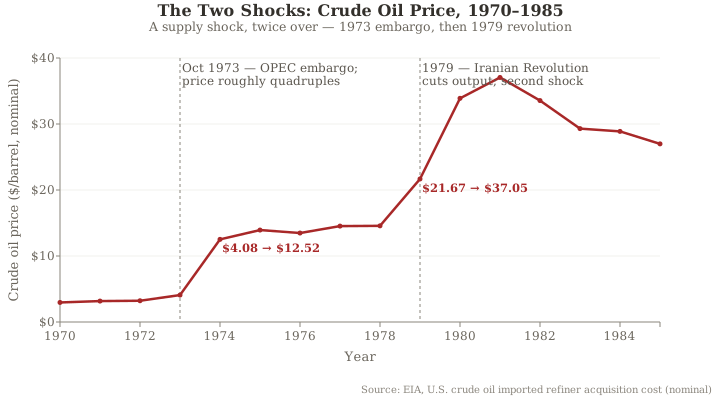
October 1973. Arab members of OPEC, retaliating for Western support of Israel in the Yom Kippur War, embargo oil shipments and cut production. The price of crude roughly quadruples over the next half year. Gas lines stretch around blocks; stations post flags, green for fuel, red for empty; the national speed limit drops to 55 to save gasoline. For the first time, Americans experience a price shock they cannot vote away or freeze away. The chronology, with the oil-price spike set against G7 output, is laid out in History Ch.16 §16.1 (The system breaks).
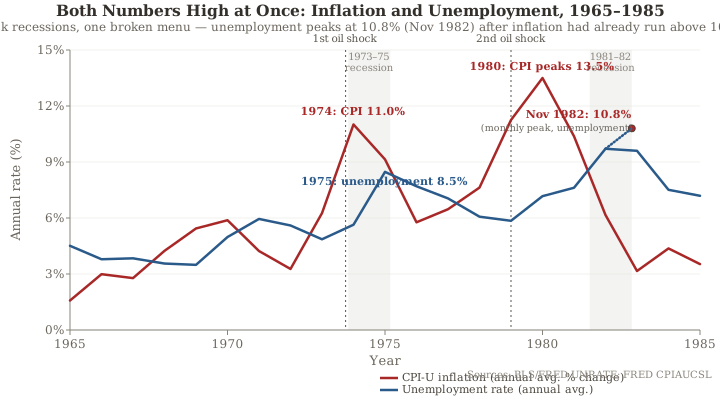
1974–75. The recession that follows is the deepest since the 1930s. Unemployment climbs past 8% while inflation runs above 10%. The Phillips menu said you choose one or the other; the economy was now serving both. The press needed a word for it and reached for a portmanteau: stagflation. Arthur Burns, running the Fed, is visibly torn between fighting the inflation and cushioning the unemployment, and ends up doing neither convincingly.
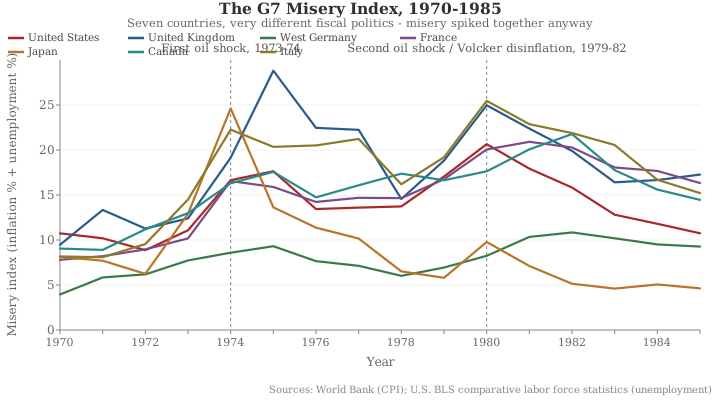
1979. The Iranian Revolution cuts oil output again; a second price shock hits an economy that never fully recovered from the first. In July, President Carter goes on television and tells the country it is suffering “a crisis of confidence,” describing a nation that had lost faith in its own future. The press renames it the “malaise” speech. Weeks later he hands the Federal Reserve to Paul Volcker. On Saturday, October 6, 1979, Volcker calls an unscheduled press conference and changes how the Fed operates.
“The threat is nearly invisible in ordinary ways. It is a crisis of confidence. It is a crisis that strikes at the very heart and soul and spirit of our national will.”
— Jimmy Carter, “Crisis of Confidence” address, July 15, 1979
1981–82. Volcker drives the federal funds rate to 19%. The economy goes into a double-dip recession; unemployment peaks at 10.8% in November 1982, the highest since the Great Depression. Farmers blockade the Fed building with tractors. And it works: inflation, which ran at 13.5% in 1980, falls to 3.2% by 1983 and stays down. The fever breaks, at a brutal price.
“The simultaneous existence of substantial unemployment and rapid inflation is the central economic problem of our time, and one for which the textbooks offered no remedy, because they said it could not occur.”
— the era’s own framing of stagflation, as recorded across the business press of the mid-1970s
Was stagflation really unprecedented?
The decade told itself a story: this had never happened before, the rules had simply stopped applying. That framing was half right in a way that matters, and half a flattering excuse for the people who had built the broken rules.
Where this leaves us
By the end of the decade nearly every assumption the postwar order rested on had been overturned. The gold anchor was gone. The Phillips trade-off the Fed had built its policy on had visibly stopped working. And the comfortable habit of treating supply shocks as footnotes to a demand story was finished. The oil shock was the story. The Volcker disinflation, when it finally came, worked exactly as if someone had a theory that said it would work. But that theory did not exist in any usable form when the decade began. So the question for the rest of this walkthrough: where did the framework that predicted Volcker would succeed come from?
If you had run the Fed in 1974, what would you have done? Arthur Burns thought he knew. He was working from the same Phillips-curve playbook that had carried the 1960s, and by the time he left in 1978 it was plain the playbook had stopped working. He just couldn’t say why. The next stage takes the Fed’s actual instrument apart to show what it could and couldn’t see. The 1974–75 and 1981–82 recessions are also two points in a longer argument about what causes downturns at all, which is the subject of “What causes recessions?”
The Fed’s broken instrument
“Viewed in the abstract, the Federal Reserve System had the power to abort the inflation at its incipient stage fifteen years ago or at any later point, and it has the power to end it today. At any time within that period, it could have restricted the money supply and created sufficient strains in financial and industrial markets to terminate inflation with little delay. It did not do so because the Federal Reserve was itself caught up in the philosophic and political currents that were transforming American life and culture.”
— Arthur Burns, “The Anguish of Central Banking,” Per Jacobsson Lecture, Belgrade, September 30, 1979
Two years after leaving the Fed, the man who had run it through the worst of the inflation stood up in Belgrade and explained, in public, why he and his Fed had failed to stop it. His diagnosis was institutional, and it is exactly half of the answer.
Start by giving the Fed’s instrument its due, because the worst way to understand the 1970s is to treat the Phillips trade-off as a silly idea that deserved to fail. It was the crowning empirical result of the postwar Keynesian synthesis, and in 1960 it had the best data anyone had.
Paul Samuelson and Robert Solow, in a 1960 paper, took a relationship A.W. Phillips had found in a century of British wage and unemployment data and read it as a policy menu for the United States: a stable, exploitable trade-off between inflation and unemployment. You could, they suggested, run the economy at roughly 4% unemployment if you were willing to accept around 2.5% inflation, and the choice was a genuine one a democracy might reasonably make. This was the mainstream synthesis, the same intellectual lineage that runs from Keynes through Hicks’s IS-LM to the neoclassical synthesis textbook, where the Phillips curve was bolted on as the missing price-and-wage equation.
That lineage, the postwar synthesis that produced the trade-off as policy doctrine, is set out in History of Economic Thought Ch.8 § The Neoclassical Synthesis and the Phillips Curve.
Written down, the menu the Fed was using looks like this:
Inflation $\pi$ is a stable, downward-sloping function of how far unemployment $u$ sits above some baseline $u^*$, plus noise $\nu$:
$$\pi = -\beta(u - u^*) + \nu, \qquad \beta > 0 \text{ and constant}$$The whole policy program lives in those last four words. If $\beta$ is stable, the curve sits still, and a central bank can slide along it, trading a permanent point of lower unemployment for a permanent point of higher inflation. The assumption that broke in the 1970s was the claim that the curve would hold still while the Fed tried to exploit it.
If you can buy permanently lower unemployment by accepting a bit more inflation, you have found a free lunch. For about fifteen years it looked like the lunch was real, and no central banker wants to be the one who refuses to order it. The menu only looks stable as long as nobody leans on it too hard.
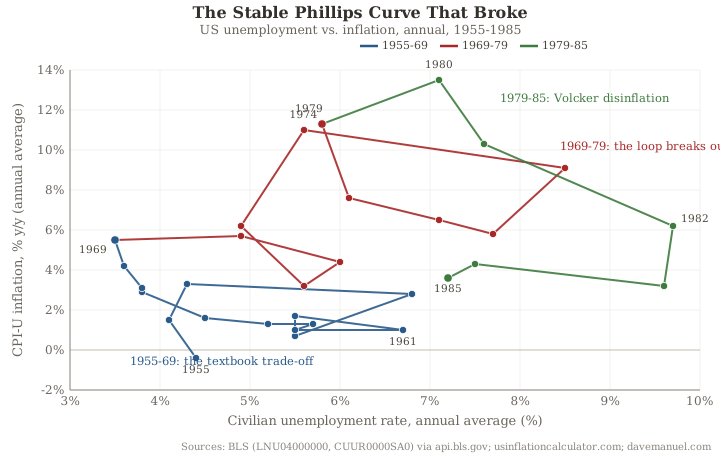
Through both oil shocks the Burns and Miller Fed ran an accommodative policy: it let money grow, hoping to cushion the recession while the price spike “passed through” the system. The Phillips menu told them this was a reasonable trade. What they got instead was inflation that did not pass through but settled in, because every wage contract and price decision started baking in the expectation that the Fed would keep accommodating. The framework that licensed the policy had no way to represent that feedback. The operating-target machinery and the credibility problem underneath it have their formal home in the monetary-policy apparatus.
Then, on October 6, 1979, the regime changed in a single afternoon. Volcker announced that the Fed would stop steering the federal funds rate directly and start targeting the quantity of bank reserves instead, a monetarist-flavored operating procedure that let interest rates go wherever they had to go to choke off money growth. In practice it meant the Fed was no longer promising to keep rates comfortable.
“The Federal Reserve is placing greater emphasis in day-to-day operations on the supply of bank reserves and less emphasis on confining short-term fluctuations in the federal funds rate.”
— after the Federal Reserve’s October 6, 1979 announcement of the new operating procedure
The deep treatment of how that AD-AS machinery responds to a regime change like this lives in the intermediate-macro chapter.
The concrete record of what the Burns/Miller Fed did and how the operating-target shift played out is the substance of History Ch.16 §16.2 (Stagflation as regime crisis).
“The Federal Reserve was itself caught up in the philosophic and political currents that were transforming American life and culture.”
— Arthur Burns, “The Anguish of Central Banking,” 1979
Did politics break the Fed, or did the theory?
Burns’s confession is that the Fed could have stopped the inflation and lacked the political will. It is an honest and partly self-serving account, and it conveniently skips the possibility that the instrument in his hands was broken to begin with.
A broken will, or a broken instrument?
“In the 1960s, the Phillips curve fit the data well, and it was reasonable to treat the trade-off it described as a stable feature of the economy that policy could exploit.”
— the postwar synthesis position, after Paul Samuelson & Robert Solow, “Analytical Aspects of Anti-Inflation Policy,” American Economic Review, 1960
This is the instrument at its strongest, in its own time. Samuelson and Solow were generalizing carefully from the best data available, inside an IS-LM framework with sticky nominal wages that was the serious mainstream of its day. The trade-off looked stable because, through the 1950s and early 1960s, no central bank had ever sustained an attempt to ride it down to its limit. The menu was a faithful summary of a regime in which inflation expectations sat still, and on that reading the failure in the 1970s really is about the Fed losing the will to hold a defensible line.
“The power to abort the inflation was there at every point. It was not used because the central bank was caught in the political and philosophic currents of the age.”
— after Arthur Burns, “The Anguish of Central Banking,” Per Jacobsson Lecture, 1979
Burns’s reply is that the instrument was usable and the will was missing, that under different political conditions the same trade-off framework could have been wielded to hold inflation down, with credibility supplied by the backing the Fed never had. The argument is serious and it captures the credibility channel correctly. What it cannot quite reach is that even a credible Burns, steering by a stable-menu model, would have systematically misread accommodation as a free purchase of lower unemployment, right up to the moment expectations caught up. The will and the instrument were both broken, and the decade needed both repaired. Which side of the profession was actually saying this to each other while it happened, the Keynesian and monetarist camps trading blows over exactly this question, is the subject of “Keynesians vs. monetarists in the 1970s”.
Where this leaves us
The Burns diagnosis is half right, and the apparatus-failure diagnosis is the other half. The Phillips trade-off as a stable policy menu was wrong: there was no permanent point at 4% unemployment and 2.5% inflation, and any attempt to hold one made the inflation accelerate as expectations adjusted. And the Fed’s political position made it impossible to credibly resist what the wrong framework licensed. By 1979 both had to give way together. The decade needed a framework that took expectations and supply shocks seriously, and an operating regime that handed the Fed enough independence to use it. Volcker supplied the regime on October 6. The framework was still being built around him, piece by piece, over the preceding twelve years.
Volcker in October 1979 was running a regime that didn’t quite exist on paper yet: monetarist operating tools in practice, natural-rate-with-rational-expectations theory still under construction. The apparatus had been assembled in stages. Friedman gave the first move in 1968, Lucas the second in 1972, Blinder and the supply-shock economists the third by the early 1980s. Stage 3 walks you through those three moves and shows why the decade made each of them all but inevitable.
What the case demanded
“There is always a temporary trade-off between inflation and unemployment; there is no permanent trade-off. The temporary trade-off comes not from inflation per se, but from unanticipated inflation, which generally means, from a rising rate of inflation.”
— Milton Friedman, “The Role of Monetary Policy,” AEA Presidential Address, December 1967 (published American Economic Review, 1968)
In December 1967 — before the 1970 recession, before Bretton Woods broke, before a single OPEC barrel was embargoed — Milton Friedman walked onto the stage at the AEA meetings and told the profession that the Phillips menu the Fed was using was an illusion. Within five years two more economists had turned the claim into formal theory. Within ten the decade had proved it on the ground.
Three named contributions, each compressed to the one claim that did the work.
1. Friedman and Phelps (1967–68): the natural rate. Independently, Milton Friedman and Edmund Phelps argued that there is no long-run trade-off at all. There is a natural rate of unemployment set by the real structure of the labor market, and the long-run Phillips curve is vertical at that rate. You can push unemployment below it temporarily by surprising people with inflation, but only until they catch on. Once expectations adapt, the same unemployment requires higher inflation, and trying to hold the gap open produces an ever-accelerating price spiral. The 1970s traced that accelerating spiral almost to the letter.
Add expectations to the Phillips relation. Inflation depends on expected inflation plus the unemployment gap:
$$\pi_t = \pi^e_t - \beta\,(u_t - u^*)$$If expectations are adaptive — people expect roughly last year’s inflation, $\pi^e_t = \pi_{t-1}$ — then holding $u_t$ below $u^*$ makes $\pi_t$ exceed $\pi_{t-1}$ every period, so inflation climbs without limit. Set $u_t = u^*$ and the gap term vanishes: in the long run unemployment returns to its natural rate regardless of the inflation rate. The curve is vertical.
If every wage contract bakes in last year’s inflation, then the only way to keep unemployment below its natural rate is to keep surprising people, to run inflation a little hotter than they expected, again and again. You can run faster than expectations for a year. You cannot run faster than expectations forever, because expectations chase you. Eventually all you are left with is the inflation, and the unemployment drifts back to where the labor market wanted it.
2. Lucas (1972): rational expectations and the critique. Friedman left the door open by treating expectations as backward-looking. Robert Lucas kicked it down. People do not just extrapolate last year’s inflation; they form expectations using all the information available, including their understanding of how the Fed behaves. The corollary, the Lucas critique, is devastating for the old policy machinery: the statistical relationships an econometric model estimates under one policy regime will shift the moment the regime changes, because people’s expectations were part of what generated those relationships. A trade-off you measured while the Fed was passive cannot be exploited once the Fed starts actively trying to exploit it. Anticipated policy is baked into expectations the instant it is announced.
Replace adaptive expectations with rational ones, the mathematical expectation conditional on the full information set $\Omega_t$, which includes the policy rule itself:
$$\pi^e_t = E\!\left[\pi_t \mid \Omega_t\right]$$Now a systematic policy, anything with a predictable rule, is already inside $\Omega_t$, so it cannot move real unemployment even temporarily. Only the genuinely unforeseen part of policy has real effects. The exploitable menu disappears.
If the Fed’s habit is “cut rates whenever unemployment rises,” then workers and firms know the habit. The moment unemployment rises they already expect the inflation that’s coming, and they price it in. The Fed’s move no longer surprises anyone, so it no longer moves real unemployment, only the inflation rate. You can’t fool people with a pattern they’ve learned.
That whole apparatus, the Lucas critique and the rational-expectations machinery built on it, is the substance of the real-business-cycle chapter.
3. Blinder and Bruno-Sachs (1979–85): supply shocks. Natural-rate and rational expectations explained why the demand side of the old menu was broken. They did not, by themselves, explain why inflation and unemployment rose together. That took a third move. Alan Blinder’s study of the “great stagflation,” and later Michael Bruno and Jeffrey Sachs’s cross-country work, established that the oil shocks were a shock to aggregate supply, not demand. They pushed the supply curve back, which raises prices and cuts output at the same time. Macro could no longer treat supply disturbances as a residual to be cleaned up after the demand story; they had to be a primary driver in their own right. The aggregate-supply shift that produces the stagflationary co-movement is the move the dynamic AD-AS engine is built to show.
The synthesis. The three moves were folded together into the New Keynesian framework that became the post-1980 mainstream. Sticky prices à la Calvo give the short-run real effects, while a forward-looking Phillips curve carries rational expectations, a natural-rate term anchors the long run, and a cost-push term carries supply shocks. The result is a single equation that contains all three lessons at once. Its formal home is the New Keynesian chapter. The lineage that produced these moves, the monetarist and new-classical counter-revolution, is one rung in the longer story of how the profession came to take expectations seriously, traced across eras in the expectations thread.
The lineage of the apparatus — Friedman’s monetarism, Lucas’s new-classical turn, and the stagflation crisis that connected them — sits as a cluster in the thought graph:
Open the full counter-revolution cluster in the intellectual-lineage graph (Ch.10, The counter-revolution), or read the chapter directly below.
“There is always a temporary trade-off between inflation and unemployment; there is no permanent trade-off.”
— Milton Friedman, AEA Presidential Address, 1967
Was the Phillips curve always an illusion?
The strong Friedman-Phelps claim is that the trade-off was never real. It only looked stable because no one had yet tested it. The softer reading is that it was real and the regime change broke it. The decade is the referee, and its verdict is more interesting than either slogan.
A revolution earned, or a turn that outran its evidence?
“Given that the structure of an econometric model consists of optimal decision rules of economic agents, and that optimal decision rules vary systematically with changes in the structure of series relevant to the decision maker, it follows that any change in policy will systematically alter the structure of econometric models.”
— Robert Lucas, “Econometric Policy Evaluation: A Critique,” 1976
The new apparatus’s strongest claim is to be a genuine intellectual revolution that the case forced. Lucas is saying the entire generation of large policy-simulation models was built on a logical error. They treated as fixed the very relationships that policy would move. The 1970s were the empirical proof: the models calibrated on the stable 1960s broke the instant the regime changed, exactly as the critique predicted. The lineage from Friedman through Lucas is the through-line of the counter-revolution chapter, and on this reading the decade logically refuted the old framework.
“Suppose someone sets out to write a paper that says people are crazy. Standard practice would be to reject it as not economics. But if you assume rationality, you can prove anything. I’d call a lot of the rational-expectations work philosophy, not economics.”
— after Robert Solow’s running 1970s dissent against the new classical program
Solow’s objection is that the rational-expectations turn ran far ahead of its evidence, that it was a methodological commitment dressed as an empirical discovery, and that assuming everyone optimizes with full knowledge of the model idealizes away how a steelworker actually forms a view about next year’s prices. The decade falsified the stable-menu claim, the dissent grants; it did not, by itself, prove that agents are the hyper-rational calculators the new models required. The reply is that the empirical vindication did arrive, on the timescale the theory demanded: the 1980s disinflation and the long stability that followed behaved as the rational-expectations-plus-natural-rate synthesis said they would, which is more than the old menu could ever say for itself.
Where this leaves us
What the decade demanded, the discipline built — partly in 1967–72, before the worst of the case had even unfolded, and partly in 1979–85, after. The synthesis that emerged combined the natural rate, rational expectations, supply shocks, and short-run price rigidity. It became the post-1980 New Keynesian mainstream, and it is what the “new apparatus” in this walkthrough refers to. The discipline did not “turn right” in any political sense; it absorbed three empirical lessons the case forced on it. Whether a central bank should wield this apparatus, and whether it can control the economy at all, is a different question, taken up in “Can central banks control the economy?” One more thread: the natural rate quietly recasts unemployment from a pure labor-market problem into a money-and-expectations problem, a reframe that is the substance of “Is unemployment about labor or money?”, and one rung in the longer expectations lineage traced from Keynes through prospect theory in “Expectations from Keynes to prospect theory” and “Employment from Keynes to New Keynesian”.
The apparatus was assembled between 1967 and 1985. Its first real test arrived in 1979–82, while the theory was still being written. Volcker walked into the Fed with monetarist operating tools, rational-expectations backing, and a natural-rate guide, slammed the funds rate to 19%, and broke the inflation. The country paid for it with a 10.8% unemployment recession. The final stage asks what the new apparatus actually predicted about Volcker, and then what it went on to explain about the quarter-century that followed.
What the apparatus then explained
“By emphasizing the supply of bank reserves rather than confining short-term fluctuations in the federal funds rate, the Federal Reserve intends to assure better control over the expansion of money and bank credit.”
— after Paul Volcker, on behalf of the FOMC, Saturday-night announcement of the new operating procedure, October 6, 1979
On a Saturday in October 1979 the most powerful central bank on earth announced it was changing the rule book. Two years and one double-dip recession later, the inflation that had defined the decade was over. The apparatus the prior stage assembled had its first real test, and it passed, at exactly the kind of cost the apparatus said it would.
Run the Volcker disinflation through the new apparatus and it predicts a specific shape. Under rational expectations, a regime change that is credible should shift inflation expectations down quickly. People who believe the Fed will hold the line stop building the old inflation into their contracts, which lowers the sacrifice ratio, the recession-cost of wringing inflation out. But if expectations are partly adaptive, partly sticky, credibility takes time to earn, and the disinflation costs more than the pure-rational case while still costing less than the pure-adaptive one. The prediction is a disinflation that is expensive but bounded, with the cost falling as credibility builds.
That is almost exactly what happened. The 1981–82 recession was deep, with unemployment at 10.8%, because the Fed’s credibility had to be established; markets had spent a decade watching the Fed blink, and they made Volcker prove he wouldn’t. But once proven, the disinflation held: inflation fell from 13.5% in 1980 to 3.2% in 1983, and stayed down. The record of that campaign — the rate path, the recession, the break in inflation — is the spine of History Ch.16 §16.3 (Volcker’s disinflation).
The single equation that carries all three of Stage 3’s moves at once is the New Keynesian Phillips curve:
Read off the three lessons: $E_t[\pi_{t+1}]$ is the forward-looking, rational-expectations term Lucas demanded; $(u^* - u_t)$ is the natural-rate gap Friedman and Phelps supplied; and $\epsilon^s_t$ is the cost-push term that carries the supply shocks Blinder and Bruno-Sachs insisted on. The 3-equation model this sits inside is the workhorse of modern monetary policy.
If you can make a new, tighter rule credible, you get the disinflation more cheaply than the old framework predicted, because expectations come down to meet you. If you can’t, you pay for it with the full recession. Volcker paid most of it, since credibility took a couple of brutal years to build, and then collected the durable low inflation that credibility buys.
And then came the part that looked, for twenty-five years, like vindication. From roughly 1983 to 2008 the advanced economies enjoyed the “Great Moderation”: output volatility fell, recessions grew milder and rarer, and inflation expectations stayed anchored near the targets central banks now openly announced. The apparatus had hardened into doctrine — Taylor’s 1993 interest-rate rule, formal inflation targeting, DSGE models in every research department — and the data behaved. The cross-country trajectory of that long expansion shows up on the GDP map; the era itself is the subject of History Ch.18 (Globalization and the Great Moderation).
Did Volcker prove the credibility theory?
The clean story is that Volcker established central-bank credibility and the apparatus was vindicated. A skeptic says he just raised rates a lot, which would break inflation under any theory. The specific prediction was about what came after.
Vindicated forward, or vindicated only until 2008?
“The four hyperinflations were stopped almost overnight, and at relatively low cost in lost output and employment, once a credible and coordinated change in fiscal and monetary regime was put in place. The expectations of the public responded to the regime, not to the past.”
— after Thomas Sargent, “The Ends of Four Big Inflations,” 1982
Sargent’s study, Taylor’s 1993 rule, and the long Great Moderation record together make the case that the counter-revolution synthesis became the working operating system of central banking for a generation, and the generation behaved as the theory said. Expectations responded to regimes, inflation stayed anchored, output volatility fell. The intellectual through-line, from Friedman’s monetarism through the new classical program to the New Keynesian synthesis, is the spine of the counter-revolution chapter, and on this reading the 1970s case is settled and the apparatus won.
“The Great Moderation lulled macroeconomics into thinking the system was safe. The models that anchored inflation so well had almost nothing to say about leverage, liquidity, and the financial sector, and that is precisely where the next crisis came from.”
— the post-2008 critique, after Bernanke-Gertler-Gilchrist on financial frictions and Krugman (1998) on the liquidity trap
The objection: the apparatus succeeded at the job it was built for and missed what mattered next. The New Keynesian synthesis tamed inflation beautifully and left financial frictions, leverage cycles, and the zero lower bound almost entirely out of the model, so it never saw 2008 coming, and part of the Great Moderation’s “vindication” was simply the absence of a financial shock big enough to test the omission. This critique is real, and it is the live frontier of the field. But it does not contest what the 1970s apparatus explained about the 1970s. Financial frictions and the ZLB are post-1970s extensions of the framework. Whether 2008 broke macroeconomics is its own argument, taken up in “Did economics cause 2008?” and “Did 2008 break macro?”
Where this leaves us
The 1970s apparatus — natural rate, rational expectations, supply-shock decomposition, the New Keynesian synthesis — predicted that Volcker’s credibility-establishing campaign would eventually break inflation at a real but bounded cost. It did, and the 1980–2008 Great Moderation was the long stretch in which the apparatus appeared to be working. This is the consensus mainstream verdict on the decade, and it remains so. The post-2008 questioning — financial frictions, the zero lower bound, household heterogeneity — is real and live, but it extends the framework; it questions; it is post-1970s work answering post-1970s questions. The 1970s is the canonical case in modern macro of a real-world episode forcing an apparatus to change, and the apparatus that succeeded the Samuelson-Solow trade-off was the right answer. The success of that apparatus also reshaped politics, in the Reagan-Thatcher policy order the disinflation enabled. That aftermath, along with the fiscal-theory and other heterodox readings of the same decade, belongs to other questions on this site.
Three threads the decade hands off: the 1981–82 recession is one instance of the longer recessions question in “What causes recessions?”; the central-bank power question Volcker’s success raises is the subject of “Can central banks control the economy?”; and an alternative, fiscal-theoretic reading of the same inflation is the substance of “Is inflation monetary or fiscal?”, while the political-economy aftermath of the disinflation is taken up in “Did neoliberalism actually rule?”
Read as intellectual history, the decade is the hinge between the postwar synthesis and the modern consensus, the moment the New Keynesian apparatus consolidated and the long stretch from the Great Moderation to 2008 that tested it. That hinge, and the post-2008 re-opening, are the substance of History of Economic Thought Ch.17 § Vindication and falsification, the Great Moderation to 2008.
The verdict
We started with three sentences in a Sunday-night speech that knocked the dollar off gold, and the decade that came apart afterward. Four stages traced how a real-world event forced a discipline to rebuild its engine.
- The case. Gold window, oil embargo, gas lines, two recessions, and the thing the textbook said could not happen, inflation and unemployment high at the same time, across the whole G7. The Phillips menu had no slot for it.
- The broken instrument. The Samuelson-Solow trade-off was the crowning result of the postwar synthesis, and it failed because it assumed the curve would hold still while a central bank rode it. Burns blamed the politics; the deeper problem was that the instrument itself was wrong.
- The apparatus the case demanded. Friedman-Phelps killed the long-run trade-off with the natural rate; Lucas closed the loophole with rational expectations and the critique; Blinder and Bruno-Sachs made supply shocks a primary driver. Folded together, they became the New Keynesian synthesis, the post-1980 mainstream.
- The apparatus tested. Volcker’s 1979–82 disinflation behaved exactly as the synthesis predicted: a heavy up-front cost while credibility was earned, then a durable anchoring of low inflation. The Great Moderation looked like vindication for a quarter-century.
The pre-1970s trade-off menu permitted a whole policy program of buying lower unemployment with permanently higher inflation, and the decade falsified it in real time and at scale. What replaced it was the absorption of three empirical lessons the events made impossible to ignore, and the case that demanded the new apparatus then validated it: Volcker succeeded, in the shape the theory said he would, at the cost the theory said it would take.
What the apparatus does not capture is a separate story with a later date. Financial frictions, the zero lower bound, and household heterogeneity became load-bearing only after 2008, and they extend the framework. Keep the two apart: the natural-rate-plus-expectations-plus-supply-shock synthesis is the right lesson of the stagflation decade and remains the working core of monetary policy, and the live frontier of the field is a different decade’s problem.