How should we pay for climate change?
The world’s effective carbon price is about three dollars a ton. The Paris Agreement needs roughly eighty. The largest actually-existing climate bill of the past decade, the US Inflation Reduction Act, doesn’t price carbon at all. A three-way argument over trillions of dollars of capital allocation is happening right now, and the textbook answer is losing.
Als Debattengraph anzeigen“Fairy tales of eternal growth”

“People are suffering. People are dying. Entire ecosystems are collapsing. We are in the beginning of a mass extinction, and all you can talk about is money and fairy tales of eternal economic growth. How dare you!”
— Greta Thunberg, UN Climate Action Summit, New York, September 23, 2019
Six sentences, watched by tens of millions of people, that named growth economics by its own foundational assumption and called it a fairy tale. The line marks where the climate-economics argument starts.
Take Thunberg’s charge seriously. Mainstream economics treats climate change as a negative externality — a cost imposed by emitters on people they don’t transact with — and the canonical fix is a price. The move was Pigou’s in 1920, generalized through the twentieth century, and turned into modern climate policy by Nordhaus, who won a Nobel in 2018 for the integrated assessment that produces the headline number: the social cost of carbon. Economics Ch.4 (Market Failures) houses the externality framework. Ch.13 (Growth Theory) houses DICE, because in that model the climate problem is solved alongside the optimal-growth path.
The social cost of carbon \(SCC_t\) is the present value of marginal damages from emitting one additional ton of CO\(_2\) at time \(t\), evaluated along an optimal consumption path. In a Ramsey-style integrated assessment, \(SCC_t = \sum_{s \geq t} (1+\rho)^{-(s-t)} \cdot \partial D_s / \partial E_t\), where \(D_s\) is climate damages at \(s\), \(E_t\) is the emission at \(t\), and \(\rho\) blends pure time preference and the marginal utility of consumption growth. The frame-level dispute is a fight over what gets to enter \(D_s\) and over the discount rate \(\rho\). Degrowth says \(D_s\) is fundamentally underspecified by an optimal-growth path. Pigou-orthodox economists say \(\rho\) and \(D_s\) are tractable empirical objects, and that the dispute belongs at the level of the numbers.
Mainstream climate economics says: emitters cause damage to people who didn’t agree to it. Make the emitter pay the damage. Once the price reflects the harm, ordinary markets do the rest. Thunberg’s objection is that the framework treats “optimal growth with damages” as the natural goal, when the question worth asking might be whether growth is the right goal at all.
The question at Stage 1 is whether climate change is a marginal optimization inside growth economics, or whether growth economics is part of what produced the problem. The degrowth wing — Hickel, Raworth, Tim Jackson — isn’t making the empirical claim that growth must stop; it’s making a methodological claim that any framework which takes indefinite growth as parameter, then optimizes carbon price given that parameter, is begging the question. Stage 5 returns to this case on its own terms. For now, the dispute sits one layer above where economists usually want to have it.
The walkthrough’s position: the frame-level dispute is real, and Thunberg points at it correctly, but the operational case for keeping the mainstream frame in place is strong; it has tools that do something, a track record of empirical refinement, and it leaves the goals (welfare, equity, planetary boundaries) negotiable in ways degrowth orthodoxy mostly doesn’t. The remaining four stages run inside the frame; the degrowth challenge is held open for Stage 5.
Granting the mainstream frame for now, the textbook has a clean answer to the carbon question. There’s a price you can compute, a policy you can write, a mechanism that should work. So why hasn’t it?
\$80 a ton, and the world is paying \$3
“International climate policy has set ambitious goals but has failed to establish a realistic architecture for implementation, seen in the ‘price of carbon’ that is far below the level necessary to reach international goals... A global carbon price of \$80 per ton of CO\(_2\) would be necessary to reach the goals of the 2015 Paris Accord.”
— William Nordhaus, interview on the Barrage-Nordhaus DICE-2023 findings, Yale Department of Economics, March 2024
Nordhaus is the central mainstream-econ voice on climate. His DICE model is the integrated assessment that the IMF, the IPCC’s economics working group, and most finance ministries use as the starting point. His 2024 update names the gap: the textbook says \$80, the world is at \$3, and the architecture between the two has “failed.”
Pigou’s 1920 move is mechanically simple. If an activity produces a cost the market doesn’t see — smoke from a factory drifting onto a neighbor, a ton of CO\(_2\) joining the atmosphere — impose a tax equal to the marginal damage. Producers and consumers then face the full social cost in their decisions, and the price system rebalances. Carbon is the textbook case: a near-uniform global pollutant whose damage doesn’t care which smokestack emitted it, so a single price across all sources is theoretically optimal. Ch.4 (Market Failures) works through the proof; the canonical objection, Coase’s 1960 paper on bargaining around externalities, is also there. History of Economic Thought Ch.5 (Marginalist Revolution) carries the marginalist-era welfare-economics lineage Pigou’s externality apparatus sits inside.
Nordhaus’s contribution was to couple the externality logic with growth theory. The DICE model embeds climate damages inside a Ramsey optimal-growth framework: the planner picks an emission path that maximizes the present value of consumption, and the optimal carbon price is the shadow price on emissions. Ch.13 (Growth Theory) covers the integrated-assessment architecture and the discount-rate debate, Nordhaus around 1.5%, Stern at 0.1%, with Weitzman’s fat-tails critique orthogonal to both.
The political-economy side of the textbook story is just as clean. Distributional concerns have a fix. A per-household lump-sum dividend recycles the revenue and makes the package neutral or net-progressive on average. International coordination has a fix too. Nordhaus’s 2015 “Climate Clubs” paper proposes coalitions that levy uniform internal prices and tariff non-members, breaking the free-rider problem through linked enforcement. Ch.18 (Institutional Economics) covers the mechanism-design side.
Argued at full strength, Pigou-Nordhaus holds up. A uniform price on a uniform externality is the closest thing applied economics has to a sure-thing theorem. It equalizes marginal abatement costs across emitters, which is the definition of cost-effective decarbonization. It generates revenue that can be recycled into household rebates, infrastructure, or deficit reduction without distorting the signal. It is technology-neutral: solar over wind over geothermal over nuclear over carbon capture all compete on the same margin, and whichever pathway is cheapest gets the capital. The Mankiw Pigou Club has made this case publicly since 2006.
“Pigovian taxes are popular among economists... they are often the least invasive way to remedy a market failure. They can restore an efficient allocation of resources without requiring a heavy-handed government intervention into the specific decisions made by households and firms... A global carbon tax would be much easier to negotiate.”
— N. Gregory Mankiw, Smart Taxes: An Open Invitation to Join the Pigou Club, 2009
Is the carbon-pricing orthodoxy still the right answer?
The theoretical case for a uniform global carbon price hasn’t weakened. What’s weakened is the assumption that the political ceiling on the policy is movable. The split’s clean: Mankiw is right on the theory and wrong on the assumption. Keep the price as the analytic benchmark, and expect the package that wins elections to look different.
The theory is correct. Major-review social-cost-of-carbon estimates now coalesce in the \$50–\$200/ton range. The global effective price is around \$3/ton, and the share of emissions covered by any carbon price is about a quarter. Nordhaus calls the gap “architecture failure”, meaning the institutional path from the model to a global \$80 price doesn’t exist. Pigou-Nordhaus is the right benchmark to measure other policies against. On present evidence, it is not the policy that scales.
If the textbook answer is theoretically right, why does it keep losing politically? The cleanest answer is an event in France in 2018.
The political ceiling
“The ‘Gilets Jaunes’ protests, sparked by hikes to gas and diesel taxes, drew international attention and forced French president Emmanuel Macron to suspend the tax increase... Preliminary results indicate that Yellow Vests are not anti-ecological per se, but want more egalitarian outcomes and more effective climate action.”
— Vanessa Williamson, Brookings, 2018, and subsequent academic research on Yellow Vest attitudes toward climate policy
Macron’s fuel-tax increase in autumn 2018 was textbook Pigouvian policy. By the end of the year it had been suspended, the government had survived a confidence vote on it, and Macron’s domestic mandate was permanently damaged. The protest movement that did it was not climate-skeptical. It was carbon-tax-skeptical.
The incidence mechanics are well-studied. Consumption taxes on energy are regressive in proportional terms because lower-income households spend a larger share of income on energy, especially on transport fuels in places workers commute from. Ch.4 (Market Failures) covers the standard remedy: pair the tax with a per-household dividend (the Hansen / Climate Leadership Council proposal) and the package becomes distributionally neutral or net-progressive after rebate.
The empirical record at the ballot box isn’t friendly to the textbook framing. Australia legislated a carbon price in 2012; the next government repealed it in 2014. Washington State defeated I-732 in 2016 and I-1631 in 2018. France suspended the fuel tax in 2018. Canada’s carbon-price-and-dividend system survived 2024 leadership politics, but Conservative messaging on “the carbon tax” reshaped the map. Ch.18 (Institutional Economics) houses the political-economy literature; Economic History Ch.19 (The GFC and After) carries the post-2008 historical record these episodes sit inside. The pattern is robust enough that “the dividend solves it” has to be evaluated against the record.
The textbook analysis treats the dividend as identifying-information-complete: each household receives a transparent lump-sum check whose magnitude they internalize alongside the tax cost. The empirical literature on rebate-pass-through (e.g., Cronin, Fullerton, and Sexton, 2019) finds salience asymmetries: the tax is felt at every fuel purchase; the dividend arrives in a quarterly transfer that recipients underweight relative to its present value. The salience asymmetry is a behavioral feature of the carbon-tax-and-dividend package, and one the political-economy outcome is sensitive to.
A carbon tax with a dividend looks, on paper, like getting more money back than the tax costs you (for most households). In practice the tax shows up at the pump every week and the dividend lands once a quarter as a line on a bank statement most people don’t notice. The same dollar of net benefit is felt differently depending on how it arrives.
The political-economy critique at full strength: a national-level Pigouvian carbon tax is institutionally a regressive consumption tax that becomes progressive only conditional on a specific kind of revenue recycling, perfect public understanding of the package, and a stable government willing to defend it against a salience-asymmetric attack. Every one of those conditions is fragile, and the salience asymmetry is permanent. The political opportunity to recharacterize a carbon-and-dividend package as “the carbon tax” while ignoring the dividend is always available. The affected populations — rural workers, long-distance commuters, working-class voters in fossil-fuel-adjacent regions — are politically pivotal across most major democracies. Yellow Vests was a class-anchored objection to whose budget the climate transition would be paid out of, and the objection won.
This challenge is frame-internal to mainstream economics; Stage 5 takes up the heterodox-degrowth case. Welfare-economics itself predicts that an instrument with cost concentrated on a politically pivotal minority and benefits diffused across the electorate will lose. A policy welfare-improving in expectation is not the same as a policy with a path to enactment.
There is a political ceiling on Pigouvian carbon pricing in democratic settings that the textbook treatment underweights. The ceiling is not absolute — British Columbia, Sweden’s \$130/ton tax, and the EU Emissions Trading System all coexist with democratic legitimacy — but it reliably bites when the tax becomes a salient national-election issue and the dividend mechanism doesn’t close the salience gap. The Pigou-Nordhaus framework remains the right analytic benchmark; the architecture-failure problem is a feature of the policy class.
If pure carbon pricing keeps hitting a ceiling, what does actually-existing climate policy look like? Something else has been winning quietly while the carbon-tax debate has been losing loudly, and it has a name in the literature.
The industrial-policy turn
“Industrial policy is back... [The Inflation Reduction Act is] making up for lost time after a failed 40-year experiment with neoliberalism.”
— Joseph Stiglitz, Project Syndicate, September 2023
Stiglitz is mainstream: Nobel 2001, former World Bank chief economist, decades inside mainstream macro. The “failed 40-year experiment” line is the cleanest statement of a position that’s now been adopted by the IMF’s flagship policy magazine, the European Commission, the US Treasury under Yellen, and the Chinese Communist Party’s climate apparatus. Different lines on different details; a convergence on the basic move.
Industrial policy as climate policy works on second-best grounds. Two market failures support direct intervention even when carbon pricing is also on the table. First, learning-by-doing in clean-tech manufacturing: each additional gigawatt of solar lowers the cost of the next gigawatt for everyone, and no private firm can capture the spillover. Second, coordination failures: EV charging needs vehicles, vehicles need charging; the renewable grid needs storage, storage needs grid demand. Ch.13 (Growth Theory) covers endogenous technical change; Ch.20 (Development Economics) covers the industrial-policy literature, worked out since the 1990s East Asian debates.
The 2022 IRA is a quarter-trillion-plus return to a posture the US used to have: DARPA, the interstate system, NASA procurement, the federal R&D apparatus that delivered the integrated circuit and the internet. Economic History Ch.16 (Stagflation and the Neoliberal Turn) covers what the 1970s–90s shift dismantled; Economic History Ch.19 (The GFC and After) covers the post-2008 era the IRA was passed inside. The intellectual lineage Mazzucato is reviving — Hamilton, List, Polanyi, Hirschman, the post-Keynesian state-investment tradition — runs through the Veblen-to-Acemoglu institutional spine in History of Economic Thought Ch.15 (The Institutional Tradition). Its modern revival, where Mazzucato herself sits, lands in Ch.17 (Modern Pluralism).
A learning-by-doing subsidy is welfare-improving when the social return to cumulative experience exceeds the private return: the cost reduction per unit of cumulative output generates a positive externality whose internalization through subsidy restores the optimal investment rate. The IRA’s production tax credit for clean-tech manufacturing maps onto this. A carbon price addresses the externality on the consumption side but not the production-side under-investment in learning-curve climbing. Both instruments are needed if both distortions matter, the formal version of “hybrid policy.”
A carbon tax tells you not to pollute. It doesn’t tell anyone to build the alternative; it just assumes the alternative will get built once polluting becomes expensive. Industrial policy says: if learning curves and coordination problems mean nobody on their own will build the alternative fast enough, the public sector picks up that piece, alongside or instead of the carbon price. The pragmatic case is that the two address different market failures.
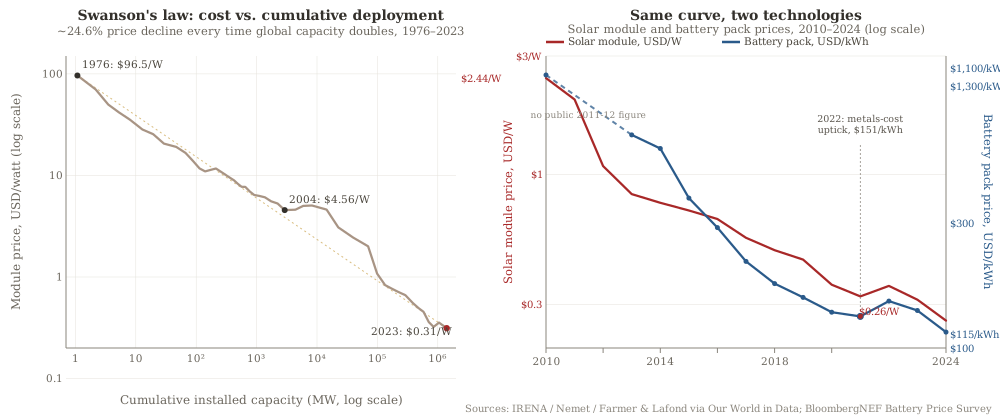
Mazzucato’s case at strength has nothing to do with the state picking winners. Her empirical claim is that the most consequential general-purpose technologies of the postwar era — jet engines, GPS, the internet, mRNA vaccines — came out of public procurement and R&D programs that took risks no private firm could justify quarterly. The climate transition has the same structure: cumulative-investment-led, multi-decade, with complementarities across electricity, transport, industry, agriculture. The historical record of large technology transitions suggests price is necessary but not sufficient.
“Modern industrial policy has great potential to put countries on a different path, but only if it orients investment, innovation, growth, and productivity around bold climate and inclusion goals. It must drive a global green race to the top, not to the bottom.”
— Mariana Mazzucato, “Policy with a Purpose,” IMF Finance & Development, September 2024
Is the IRA model the new climate orthodoxy?
For the first time since the 1970s, the IMF’s flagship policy magazine is publishing the case for state-led mission-oriented investment as the central climate instrument. The “winning” climate package now looks like this because the second-best world is the one we’re in.
Industrial policy is doing what carbon pricing can’t do politically and wasn’t designed to do theoretically: subsidize learning curves, coordinate complementary investments, concentrate visible benefits on constituencies that block the regressive-tax frame. Carbon pricing remains theoretically cleaner for the externality piece, and the IRA model leaves that standing. But the real-world package is now hybrid, partial carbon price plus mission-oriented public investment, and that absorption into mainstream institutional discourse has been faster than the older guard sometimes recognizes.
So a hybrid, carbon price plus industrial policy, is the operational answer. That leaves one piece of the original three-way argument unresolved. Stage 1 held it open. Stage 5 takes it on directly: what about the degrowth challenge, and the global-justice case behind it?
Degrowth, justice, and the verdict
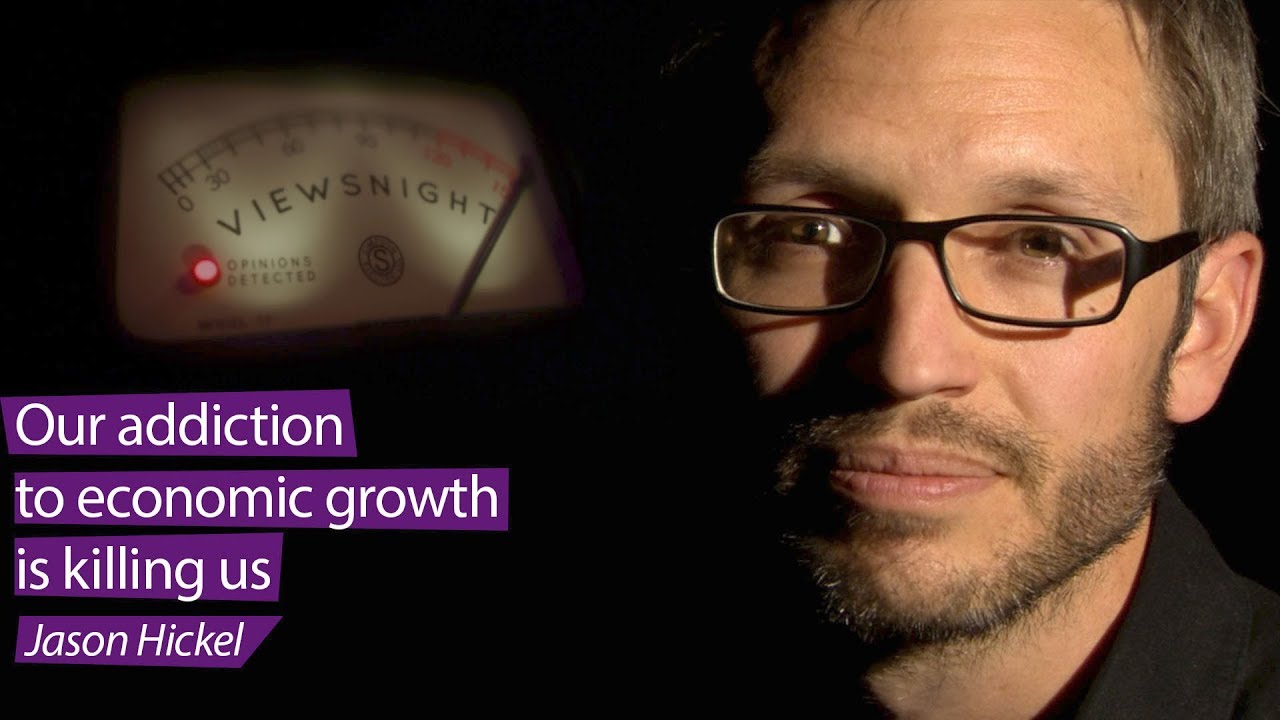
“What looks like ‘green growth’ is really just an artifact of globalization... It is overwhelmingly the rich countries of the Global North — the United States, Canada, Europe, Israel, Australia, New Zealand and Japan — collectively responsible for 92 per cent of excess emissions.”
— Jason Hickel, drawing on his 2020 Lancet Planetary Health analysis and Less is More
Hickel is the most-cited degrowth voice in the current discourse. The “92% of excess emissions” line shifts the climate-cost question from “how should we price the externality” to “whose externality, owed to whom, at what historical accounting.”
The degrowth case has two structural arguments and one empirical one. Structurally: GDP is not human welfare, and the equivalence built into integrated-assessment models breaks at high consumption levels; and the rich-country consumption baseline is hard to square with Paris timelines without either offshoring or a technological miracle on a schedule with no precedent. Ch.13 (Growth Theory) covers the decoupling literature; Ch.20 (Development Economics) covers just-transition financing and the historical-responsibility accounting behind the loss-and-damage debate. History of Economic Thought Ch.17 (Modern Pluralism) carries the post-Keynesian and modern heterodox lineage degrowth sits inside.
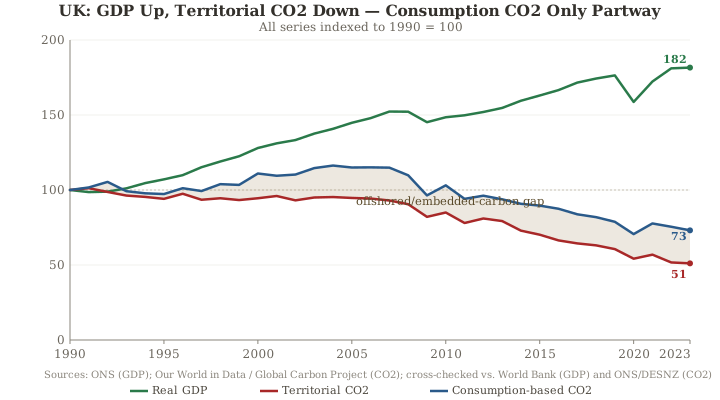
The empirical piece. The UK, Sweden, Denmark, and a handful of others have, on paper, decoupled GDP growth from territorial CO\(_2\) emissions. Hickel’s reply is that consumption-based accounting — which assigns CO\(_2\) to the country that consumes the good — substantially closes the gap.
Production-based emissions and consumption-based emissions differ by net imports of embedded carbon. A country whose production-based number is falling while its consumption-based number is steady or rising is decarbonizing on one measure and not the other. The literature (Peters et al., 2011; updated through GCB 2024) finds 20–40% of the UK, Germany, Sweden, and Denmark apparent territorial decoupling reflects offshoring; the remainder is real. Both “green growth is an illusion” and “decoupling proves degrowth is unnecessary” overstate what that finding supports.
If a British steel mill closes and the steel gets imported from China instead, the UK’s emissions go down on paper. Globally, the emissions are the same or higher (Chinese grids are dirtier). British consumption-based accounting catches this; British territorial accounting doesn’t. The decoupling question turns on which number you use, and reasonable people land in different places.
The structural argument: any framework that holds aggregate output as a parameter to maximize, then optimizes the carbon price subject to it, has conceded the question that needs asking. Raworth’s doughnut formalizes the alternative target, a floor of human-needs provisioning, a ceiling of planetary boundaries, distance-from-boundary replacing growth. The doughnut is not anti-development; the Global South is explicitly entitled to growth within it.
“What exactly is the Doughnut? Put simply, it’s a radically new compass for guiding humanity this century. And it points towards a future that can provide for every person’s needs while safeguarding the living world on which we all depend.”
— Kate Raworth, Doughnut Economics: Seven Ways to Think Like a 21st-Century Economist, 2017
Hickel’s 92%-excess-emissions number turns the methodological dispute into a justice claim with an empirical anchor: historical responsibility for the cumulative atmospheric stock is overwhelmingly rich-country, and the climate-finance gap is the corresponding unpaid debt.
CBAM makes this concrete. The EU’s border adjustment is textbook Nordhaus-style anti-leakage policy, but it lands on countries whose per-capita historical emissions are a fraction of Europe’s, and whose current emissions are the necessary cost of an industrialization Europe already completed. The just-transition wing, degrowth and mainstream development economists alike, reads CBAM as a regressive tariff using climate language to defend rich-country competitiveness. That reading is an honest application of the same welfare-economics tradition that produced Pigou, run on different distributional weights.
The verdict
The working hybrid pairs a partial-and-expanding carbon price with mission-oriented public investment, justified on second-best, learning-curve, and coordination-failure grounds inside the same theory, and it treats the political ceiling on pure Pigouvian taxation as a feature of democratic politics.
On degrowth: the methodological critique, that IAMs bake in a parameter that ought to be a variable, is more serious than the mainstream often grants. But degrowth as universal policy fails the democratic-path test, and the global-justice claim it carries is better operationalized through historical-responsibility-weighted climate finance and differential timelines than through universal contraction. The verdict is a calibrated hybrid, price plus industrial policy, with explicit equity provisions (weighted finance, just-transition adjustment, CBAM coupled with technology transfer).
The pattern here, a theoretically clean instrument that loses politically, replaced operationally by a hybrid that includes industrial policy, recurs across these questions. The Big Tech antitrust walkthrough shows the same structure with consumer-welfare doctrine. The healthcare walkthrough shows a third instance. And the historical-responsibility thread — who owes whom for the cumulative atmospheric stock, and whether the Global South is entitled to grow into it — runs straight into the walkthrough on why some countries are rich and others poor.
Where this leaves us
Five stages, one position:
- The frame is contested (Stage 1). Thunberg’s charge is methodological, and the mainstream frame stays in place while the dispute reopens at Stage 5.
- The textbook answer is theoretically right (Stage 2). Major reviews converge on a social cost of carbon around \$50–\$200/ton; the world is paying \$3. Nordhaus calls the gap architecture failure.
- The political ceiling is real (Stage 3). Yellow Vests, Washington State twice, Australia 2014, the Canadian carbon-tax fight; the dividend-fixes-everything reply has to be evaluated against repeated democratic rejection.
- Industrial policy is what’s actually winning (Stage 4). The IRA, the EU Green Deal Industrial Plan, China’s clean-tech build-out, the IMF’s editorial turn.
- The justice constraint binds (Stage 5). Hickel’s 92% framing is empirically anchored and welfare-economically legible. Degrowth as universal policy fails the democratic-path test; degrowth as justice constraint inside a hybrid package is what the mix has to include.
The position, then: a calibrated hybrid, partial-and-expanding carbon price plus mission-oriented industrial policy plus explicit equity provisions. The price is the analytic benchmark. The industrial policy does the work while the price is being built toward, and the equity package is what makes the whole thing legitimate at scale. The three-way fight Greta, Mankiw, and Stiglitz appear to be having is, at the level of policy design, a three-way complementarity.