Did colonialism enrich Europe or impoverish the rest?
Hold the same five centuries of empire and ask the question two ways. One framing measures Europe’s growth dividend; the other measures the receiving end’s ruin. The same evidence answers both, and which framing you choose decides what the evidence can even see.
The enrichment framing: colonialism made Europe rich
“Without the easing of land constraints that New World resources provided — sugar that fed workers, cotton that clothed them, timber and grain that the home islands could not spare — Britain’s path would have looked far more like the Yangzi Delta’s: a labor-intensive intensification that ran into the same ecological wall. The Atlantic supplied the ‘ghost acreage’ that Europe’s own soil could not.”
— after Kenneth Pomeranz, The Great Divergence: China, Europe, and the Making of the Modern World Economy, 2000
Pomeranz broke a Eurocentric consensus with one move. Britain industrialized first partly because it had a coerced-labor periphery the Yangzi Delta lacked. That is the framing this stage steps inside. Ask whether colonialism enriched Europe, and a specific apparatus lights up, one with a real verdict to deliver.
Step inside the enrichment question and you are handed the machinery of growth economics: sources-of-growth decomposition, capital-share accounting, and the harder-to-quantify institutional-channel argument. The question becomes arithmetic, what fraction of European capital formation, of the British takeoff specifically, can be attributed to colonial profits, cheap colonial inputs, and the institutions that the colonial trades built? The formal home of the decomposition is Growth Theory §13.6 (Convergence and growth accounting). The inside-discipline fight over what the numbers actually say, the cliometric swing from Engerman’s benchmark to the neo-Williamsite revival, is walked at depth in the slavery walkthrough.
Run the apparatus honestly and it returns a number with a shape. The defensible central tendency is Allen-modest. Colonial inputs add a real but single-digit share to the British takeoff through factor-price and institutional channels. Berg and Hudson’s 2023 recalibration pushes the defensible upper bound higher, to something like eleven percent of British GDP from the slave economy at the end of the eighteenth century. Beckert presses from a different angle. The standard apparatus undercounts because GDP-share is the wrong outcome variable for an institutional substrate built on coerced labor. Each estimate sits inside the enrichment framing, and the framing is choosing what to count. What it counts is a flow, growth added to Europe’s macroeconomy. Stage 2 reads the same empire through an apparatus that counts something else entirely.
Eric Williams put the strong form on the table in 1944. The slave trade and the plantations financed the rise of British industry. The commercial capitalism of the eighteenth century built the wealth of Europe by means of slavery and monopoly, and that accumulated wealth turned over into the industrial capitalism of the nineteenth. Beckert’s Empire of Cotton (2014) modernizes the claim into a system: “war capitalism” — armed merchants, expropriated land, enslaved labor — was the substrate the Manchester mill grew out of, and the Lancashire spinning frame was one node in a transatlantic circulation. The institutional-channel depth here, why GDP-share badly measures what war capitalism built, is carried in the slavery walkthrough’s Stage 3. Berg and Hudson (2023) put a recalibrated number under it, double the parameter the prior forty-year consensus had settled on. The recalibration arithmetic is walked at that walkthrough’s Stage 3.
“The profits obtained provided one of the main streams of that accumulation of capital in England which financed the Industrial Revolution.”
— Eric Williams, Capitalism and Slavery, 1944
The Williams framing: European wealth from a colonial source
This is the framing-direction in its purest form. Read the colonial encounter as a story about European wealth, and slavery becomes the financier of industrialization. As literal historical magnitude the strong thesis is overstated, the slavery walkthrough walks the cliometric correction, but as a framing, it is the apparatus Stage 2 will flip out of. Asking the question this way is what makes the percentage the thing worth measuring.
The framing reaches past Atlantic slavery. Pomeranz’s ghost-acreage move generalizes it. Britain’s takeoff was land-saving in a way the Yangzi Delta could not replicate, because Britain drew on a coerced-labor-and-resource periphery — Caribbean sugar as caloric input, American cotton as textile feedstock, the silver-driven Indian Ocean circulation — that supplied flows its own soil could not. The parity-until-1750 evidence underneath that claim is the spine of the Great Divergence walkthrough’s Stage 1. Allen’s high-wage account sharpens the mechanism. Britain’s peculiar factor-price configuration — expensive labor, cheap coal — is what induced labor-saving, capital-deepening innovation, and the cotton half of that configuration ran on the slave-cotton complex; the Allen mechanism is walked at Stage 2 there.
Inside the enrichment framing, the verdict is clean. European wealth carries a real but bounded colonial dividend. The cliometric arithmetic that fixes its size lives in the slavery walkthrough; the broader comparative-historical case lives in the Great Divergence one. The framing inhabits a genuine phenomenon and returns a genuine magnitude. Allen-modest with the Berg-Hudson recalibration is the center of gravity, the strong Williams thesis the ceiling, the old Engerman benchmark the floor, and every one of those numbers is true within the framing. Stage 2 reads the very same empire through an apparatus pointed the other way.
A colonial encounter has two parties, and we have spent a full stage inside the colonizer’s. Turn the question over, did colonialism impoverish the rest?, and a different scholarly community hands you a different toolkit, one that measures a wound at the colony, persistent across centuries. The settler-mortality econometrics of Acemoglu, Johnson, and Robinson and the deindustrialization history of Amiya Bagchi are about to read the same five hundred years and return a verdict shaped nothing like this one.
The impoverishment framing: colonialism made the rest poor
“The colonial state and the institutions it left behind are at the root of much of the poverty we see today. Where Europeans faced conditions that let them settle, they built institutions to protect property and constrain power; where they could not, they built institutions to extract. Those institutions persisted long after the colonizers left, and so did their consequences.”
— after Daron Acemoglu & James Robinson, Why Nations Fail, 2012
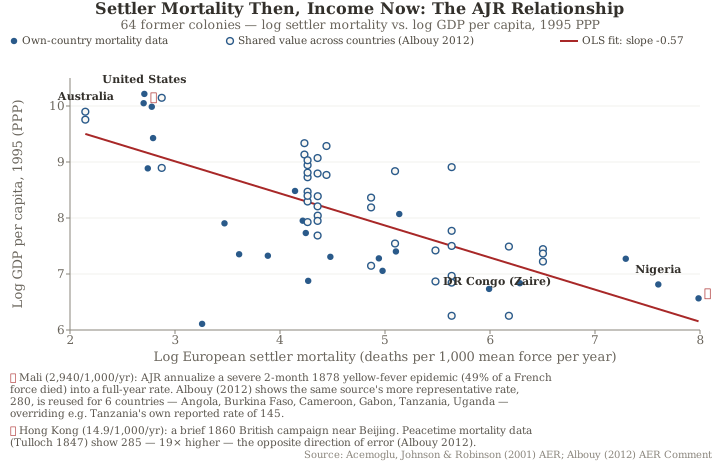
The 2024 Nobel went to this line of work. Flip the question, ask whether colonialism impoverished the rest, and the apparatus that answers it is institutional persistence. It measures a developmental trajectory bent, at the colony, and held bent for centuries.
The first strand is the institutional-persistence econometrics. Acemoglu, Johnson, and Robinson needed a way to treat institutional quality as a cause rather than a consequence of wealth, and they found one in colonial-era European settler mortality: where mortality was high, Europeans could not settle and installed extractive institutions to pull resources out; where it was low, they settled and built the inclusive institutions they wanted to live under; and those institutions channel into today’s incomes. The instrument is well-identified, the estimated effects are large, and the mechanism is colonial, an institutional choice made in the colonial period and transmitted across the centuries since. Dell’s regression-discontinuity work on Peru’s mining mita and Nunn’s gravity-equation estimates of Africa’s slave trades extend the same channel down to specific colonial sub-mechanisms. The apparatus is the spine of Institutional Economics §18.3 (the AJR framework), with the institutional lineage in History of Economic Thought §15.4.
The second strand documents an existing economy being taken apart. Bagchi’s Perilous Passage (2005) reads the colonial system in India as active destruction: a cotton-handloom industry that was globally competitive in 1750 and a marginal supplier by 1850, dismantled by an asymmetric tariff regime (free entry for British textiles into India, protection against Indian textiles into Britain), by a land-revenue assessment that left cultivators no margin for non-agricultural work, and by the unwinding of artisanal credit. Bayly and Chatterjee read the colonial fiscal state itself as the institutional intervention, a machine for reshaping the receiving end’s political economy that outlived independence. Davis’s Late Victorian Holocausts (2001) adds the sharpest case. The great Indian and Chinese famines of the late nineteenth century were the predictable output of forcing subsistence economies into global grain markets after their own famine-management institutions had been broken. The historical record sits in Economic History §10.2 (the deindustrialization of India); the long-run empirics in Development Economics §20.4.
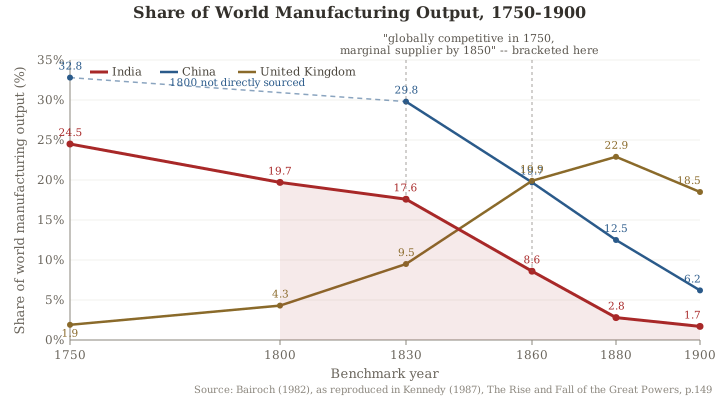
The third strand names the whole as a structure. Wallerstein’s world-systems analysis and Frank’s account of Latin American underdevelopment cast the colonial system as a core-periphery extraction machine in which the periphery’s development was prevented by the way it was integrated into the world economy. The dependency school’s “development of underdevelopment” is the political-economic name for what the AJR regressions measure with an instrument and what Bagchi measures in the handloom records. The receiving end’s trajectory was actively disrupted by the colonial system. The lineage, Prebisch-Singer through dependency to import-substitution, is carried in History of Economic Thought §16.3 (the periphery answers back).
The settler-mortality identification, in two lines. First stage: $\text{Institutions}_i = \pi_0 + \pi_1 \log(\text{Settler mortality}_i) + \varepsilon_i$. Reduced form: $\log(\text{GDP per capita}_i) = \beta_0 + \beta_1 \log(\text{Settler mortality}_i) + u_i$. Instrumenting current institutional quality with colonial-era mortality isolates the part of institutions that is exogenous to today’s income, and that part carries a large, robust effect.
Europeans installed extractive institutions where they could not safely settle and inclusive ones where they could. Those institutions outlasted the empires that built them. So the disease environment of three centuries ago, which has nothing directly to do with how rich a country is now, predicts present-day income, because it predicted which kind of institutions got built and stuck.
The colonial period installed extractive institutions where Europeans could not settle, and those institutions did not dissolve at independence; they channel forward into present-day incomes, and the channel is large enough that institutional quality explains a substantial slice of the gap between rich and poor countries. Twenty years of attempts to break the result mostly failed, which is what the 2024 Nobel was recognizing. The apparatus is informative because it is not uniform: it returns a strong effect in the extractive cases — the Congo under Leopold, the Caribbean sugar islands, the mita zones of Peru, much of British India — and a more modest one in the settler cases, the United States, Canada, Australia, where the institutions imposed resembled the metropole’s own. That variation is the finding. The disruption concentrates exactly where extractive institutions were installed and then kept, because the rent-extraction structure of the colony was the structure post-independence elites inherited and had every reason to maintain. The colonial choice was load-bearing for centuries because it built the political-economic floor that everyone after had to stand on.
“The Europeans set up extractive institutions in places where the disease environment made settlement difficult, and these institutions have persisted, explaining a large part of the variation in income across former colonies today.”
— after Daron Acemoglu, Simon Johnson & James Robinson, American Economic Review, 2001
Extractive institutions persist for centuries
Institutions chosen in the colonial period — extractive where Europeans died, inclusive where they survived — persist across centuries to shape current incomes. Persistence is the signature finding; the variation by colony type is what makes it informative. Where you find extractive institutions installed and kept, you find the long shadow; where you find settler institutions, the shadow is shorter. The apparatus is reading the colony, and that is why it returns a different verdict than Stage 1 did.
The framing runs deeper than institutional persistence alone. Bagchi’s India is a place that was deindustrialized: an existing competitive manufacturing base taken apart by tariff asymmetry and fiscal extraction, the receiving end disrupted by the colonial intervention itself. Davis’s famines are the same mechanism at its most lethal: late-Victorian mass death manufactured by forcing subsistence economies into world grain markets after the institutions that had managed scarcity were already broken, externalities of empire. And Wallerstein and Frank give the whole its name. The periphery was peripheralized, its surplus pulled toward the core by the very terms on which it was admitted to the world economy. Whether that long-run wound is still visible in the cross-country income gap today — and how it stacks against geography, human capital, and the rest of the menu — is the question the rich-and-poor-countries walkthrough takes up at Stage 4. The impoverishment framing returns its own verdict: a developmental disruption that is real, variable by colony type, and persistent across centuries.
The AJR-strong effect holds in the extractive cases and is too well-identified to wave away; Bagchi’s active-destruction mechanism extends the apparatus into the places institutional-persistence alone undercounts; Wallerstein and Frank supply the structural name for what the econometrics measures. The center of gravity is AJR-strong in extractive cases and more modest in settler ones; the ceiling is the strongest dependency-theory reading; the floor is the human-capital pushback of Glaeser and co-authors, which narrows the effect without erasing it. All of it true within the framing. We now hold two verdicts, each honestly reached inside its own apparatus, and the work left is to ask how they compose.
Two framings, two real verdicts: Europe was enriched and the rest was impoverished. But how do the two readings compose? Are they the same phenomenon seen from two sides — one empire, one circulation, scored once for the colonizer and once for the colonized — or are they different things that need different apparatus to see at all? Stage 3 is the question the whole flip was built to ask.
What the flip surfaces: attribution, persistence, symmetry
“The profits obtained provided one of the main streams of that accumulation of capital in England which financed the Industrial Revolution.”
— Eric Williams, on Europe’s enrichment, 1944
“The institutions Europeans imposed are at the root of much of the poverty we see today.”
— after Acemoglu & Robinson, on the rest’s impoverishment, 2012
Both quotes are right. They are reading the same colonial system through different framings and returning different verdicts. How the two compose, and what the answer reveals about either apparatus, is the work of this stage.
Start with what the two apparatus actually measure, because they do not measure the same thing. The enrichment apparatus — sources-of-growth decomposition, capital-share accounting, the institutional-channel argument — measures Europe’s growth rate, additional to its other engines, attributable to colonial inputs. That is a flow, it lives in the metropole’s macroeconomy, and it comes back single-digit-percent-sized. The impoverishment apparatus — settler-mortality econometrics, colonial-fiscal-state history, world-systems analysis — measures the receiving end’s developmental trajectory, disrupted and held disrupted. That is a level and an institutional channel, it lives in the colony, it runs for centuries, and it comes back large in extractive cases. Neither apparatus is wrong. Each measures exactly what it was built to measure. The framing-direction selects the apparatus, and the apparatus selection bounds what either framing can even see.
Which is why the two verdicts are additive. Europe was enriched and the rest was impoverished; the system handed a wealth-dividend to the colonizer and a disruption-dividend to the colonized, and both are real and both are measurable. But the magnitudes are bounded differently, and the difference is an artifact of the instruments. The enrichment side is capped by the reach of growth accounting, which returns a single-digit attribution and leaves the institutional channel only partly quantified. The impoverishment side is sized by the reach of the settler-mortality identification, which returns large effects in extractive cases and extends further where active-destruction mechanisms apply. The colonizer’s gain reads smaller than the colonized’s loss because the two are different quantities, identified by different strategies, scaled on different rulers.
Take the same-phenomenon reading first. The colonial system is one system. The cotton-textile-and-finance circulation that Beckert and Berg-Hudson put at the center of the enrichment story is the same circulation Bagchi puts at the center of the impoverishment story, same merchants, same shipping lanes, same flow from plantation extraction to metropolitan investment. Every pound of textile revenue booked in Manchester has a coerced-labor-and-displaced-handloom counterpart at the periphery; the gain and the wound are two readings of a single ledger entry. On this reading the two framings are making one finding from two vantage points, and their verdicts should largely converge. This reading is partly true.
Now take the different-phenomena reading at equal strength. The two apparatus quantify different things. The enrichment side asks what fraction of British capital formation was attributable to Atlantic colonial profits, a flow in the metropole’s macroeconomy, bounded by the reach of growth accounting. The impoverishment side asks what fraction of today’s cross-country income variation traces to colonial-period institutional choices, a level and a trajectory in the colony’s long-run political economy, bounded by the reach of the settler-mortality instrument. A flow-side estimate and a persistence-side estimate are not interchangeable; you cannot net them, average them, or convert one into the other. On this reading the two framings measure genuinely different aspects of the system, and their verdicts should not be expected to converge. This reading is also partly true.
Both are partly right, and that is a claim about the relationship itself. At the level of what is being measured, the same-phenomenon reading holds. There is one colonial system underneath both framings. At the level of how each apparatus quantifies it, the different-phenomena reading holds. The two instruments cut the system along different axes and return magnitudes that are asymmetrically bounded by which one you picked up. The framings inhabit a single underlying phenomenon and surface different faces of it through different apparatus selections. That is the reframe’s point. The apparatus you pick bounds what you can see, and the two verdicts compose asymmetrically.
Attribution. On how much of European wealth is attributable to colonialism, the enrichment apparatus returns real but bounded. Allen-modest is the defensible center, a single-digit share of the British takeoff through factor-price and institutional channels; the strong Williams thesis overstates it, the old Engerman 4-to-5-percent GDP-share line undercounts the institutional channel, and Berg-Hudson’s eleven percent is the defensible upper bound. Most of European wealth came from elsewhere — coal geography, the cultural-epistemic institutions Mokyr stresses, political fragmentation, the scientific revolution — and the colonial dividend is real, additive, and bounded. The magnitude fight is walked at depth in the slavery walkthrough’s verdict; the other-channels case in the Great Divergence one.
Persistence. On how much of today’s cross-country gap is attributable to colonial impoverishment, the impoverishment apparatus returns real but variable. The AJR-strong effect in extractive cases is too well-identified to dismiss; the more modest effect in settler cases is part of the finding, the apparatus telling you the disruption concentrates where extractive institutions were installed and kept. The Glaeser-and-co-authors human-capital pushback narrows the effect without eliminating it. The institutional channel is one of several long-run channels, alongside human capital, geography, and culture, and it holds its magnitude within the bounds of its identification. How it ranks against the rest of the menu for the modern gap is the rich-and-poor-countries walkthrough’s verdict.
Symmetry. On whether the two framings read one phenomenon from two sides or two phenomena needing two apparatus, the answer is both, asymmetrically. One colonial system underneath; two apparatus selections cutting it along different axes; magnitudes bounded asymmetrically by which you choose. The methodological surfacing, that framing-direction selects apparatus and the selection bounds what each framing can see, is the load-bearing finding. The honest answer to “did colonialism enrich Europe or impoverish the rest?” is that the “or” is the wrong word, and seeing why is the point.
Each axis has a deeper home. The attribution magnitude, the Atlantic-slavery sub-case walked through the full cliometric revision, lives in Did the West get rich because of slavery? The broader-than-Atlantic enrichment side, the Pomeranz-Allen-Mokyr mechanism ranking, lives in Did Britain have to industrialize first? The persistence side, the full apparatus menu for the modern income gap, lives in Why are some countries rich and others poor? The framework-vs-framework comparison this walkthrough performs implicitly — Pomeranz against Acemoglu, resource-and-contingency against inclusive-institutions — has its own walkthrough, as does the methodological flip that asks why-rich rather than why-poor.