Smith vs. List on national economy
One framework says trade what you already make. The other says build what you can’t make yet. Two centuries later, the CHIPS Act is still arguing about which one is right.
Voir comme graphe de débatSmith’s framework at full strength
“It is the maxim of every prudent master of a family, never to attempt to make at home what it will cost him more to make than to buy… What is prudence in the conduct of every private family can scarce be folly in that of a great kingdom.”
— Adam Smith, The Wealth of Nations, Book IV, 1776
Smith was writing against an orthodoxy that treated trade as a contest for bullion, where one nation’s gain was another’s loss. His framework was the first to argue the opposite: that a nation grows rich by buying what others make more cheaply and specializing in what it makes best.
The Smithian framework has a logical spine. Division of labor makes workers more productive, but specialization is limited by the size of the market; a village pin-maker can only specialize so far. Exchange extends the market, so opening to trade lets specialization run further than any single nation could sustain alone. Ricardo, in 1817, supplied the framework’s sharpest edge: a nation gains by specializing in what it sacrifices least to produce, even when a trading partner is better at making everything. The decisive quantity is opportunity cost.
Country A has a comparative advantage in good $X$ when its opportunity cost of $X$ is lower than country B’s:
$$\frac{P_X}{P_Y}\bigg|_A < \frac{P_X}{P_Y}\bigg|_B$$Both countries gain when each specializes where its opportunity cost is lower and trades for the rest, regardless of who is the more productive producer in absolute terms.
Specialize in what you give up the least to make. If a surgeon is the fastest typist in town, she still hires a typist. Every hour she spends typing is an hour of surgery forgone, and that is the expensive sacrifice. Nations face the same arithmetic.
The full opportunity-cost derivation with worked numbers, the gains-from-trade range, and the tariff deadweight-loss triangles are already laid out one walkthrough over, see Is free trade always good? § Stage 1, and the intro-level diagram lives in Ch 2 §2.6 (International Trade). The framework takes each nation’s productive capacity as given and asks how to allocate it efficiently, today.
Smith’s framework grew out of the classical school and was built explicitly against the mercantilism it demolished. Here is that lineage as a small influence map: Smith, Ricardo, Mill, and the classical school they built.
Want the whole classical genealogy? Open the History of Economic Thought lineage at Ch.3 (Classical political economy).
The framework at its best, and the gap it leaves open
“Under a system of perfectly free commerce, each country naturally devotes its capital and labour to such employments as are most beneficial to each. This pursuit of individual advantage is admirably connected with the universal good of the whole.”
— David Ricardo, On the Principles of Political Economy and Taxation, 1817
This is the cosmopolitan case at full strength, and it is a theorem. Ricardo’s claim survives every generalization he could not have imagined: multiple goods, multiple countries, varying factor endowments. The moral edge is that open exchange raises the wealth of all nations at once. Two centuries of trade data have confirmed the gains are real and large. This is bedrock, and nothing that follows takes it back.
“The system pre-supposes a state of things which has yet to come into existence… a universal union and a state of perpetual peace.”
— after Friedrich List, on the cosmopolitan school, The National System of Political Economy, 1841
Here is the crack the framework itself admits, a held-open question. The gains from trade are aggregate and they are real, but the theorem is silent on one thing: the distribution of wealth across nations standing at different stages of development. Specialize where your opportunity cost is lowest, the framework says, but what if a nation’s comparative advantage today is being a permanent supplier of raw materials, and the efficient-today allocation locks it out of ever building anything more? Smith’s framework takes productive capacity as given.
Where this leaves us
The Smithian-Ricardian baseline is real and the gains are real. The framework holds one thing constant: it treats each nation’s productive capacity as fixed and asks how to allocate it efficiently now, which makes it a framework of exchange value and static allocation. The question it never asks, because by its own design it cannot, is what happens when a nation’s productive capacity is built.
Smith’s framework asks how to trade what you already make. In 1841, a German economist who had watched Britain grow rich behind a century of tariffs and then preach free trade to everyone else asked a different question: what if the point of national economy is to build the power to produce tomorrow? His name was Friedrich List, and he wrote his entire book against Smith.
List’s framework at full strength
“The power of producing wealth is therefore infinitely more important than wealth itself… The prosperity of a nation is not, as Say believes, greater in the proportion in which it has amassed more wealth (i.e. values of exchange), but in the proportion in which it has more developed its powers of production.”
— Friedrich List, The National System of Political Economy, 1841
List was a German economist and political exile who had seen the United States protect its young industries up close. He wrote The National System as an open polemic against “the school”, Smith and Say by name. The framework he built is the deliberate negative of Stage 1.
List’s framework has a formal core the mainstream recognizes: the infant-industry argument. When producing a good involves learning-by-doing, unit costs fall as cumulative output rises. A new domestic entrant cannot match established foreign rivals at today’s costs, even though it would become competitive once it accumulated enough experience. The social return to building the industry exceeds the private return any single firm can capture, so the market under-invests. Temporary protection lets the industry survive the learning phase. That is the externality that turns List’s slogan into economics.
Productive power compounds. An industry that learns to make steel also trains engineers, builds supplier networks, and seeds the next industry that depends on cheap steel. Smith’s framework values the steel you can buy cheaply today; List values the capacity to make it, because capacity is the national asset that throws off everything else. Buy cheap forever, and you may be richer this year and poorer in capacity for a century.
The formal apparatus — the learning curve, the present-value condition under which temporary protection is welfare-improving, the strategic-trade extensions — is developed at length one walkthrough over (see Is free trade always good? § Stage 4) and in Ch 20 §20.8. List accepts the theorem and disputes its scope.
List’s three moves, and the mainstream’s honest reply
List makes three moves, and each is stronger than the protectionist caricature lets on.
Productive powers over exchange value. A nation’s capacity to produce wealth — its industries, skills, institutions, infrastructure — matters more than the stock of exchange value it can buy today. A country that imports cheap manufactures and exports raw materials may post higher consumption this year and lose the capacity to ever do otherwise.
The historical-stages argument. Free trade is the right policy for a nation that has reached the manufacturing frontier, as Britain had by 1841. It is the wrong policy for one still climbing to it, as Germany and the United States were in 1841. The same prescription is correct or ruinous depending on the stage. This is a stage-relativization of Smith.
“It is a very common clever device that when anyone has attained the summit of greatness, he kicks away the ladder by which he has climbed up, in order to deprive others of the means of climbing up after him. Any nation which by means of protective duties and restrictions on navigation has raised her manufacturing power to such a degree of development that no other nation can sustain free competition with her, can do nothing wiser than to throw away these ladders of her greatness, to preach to other nations the benefits of free trade, and to declare in penitent tones that she has hitherto wandered in the paths of error, and has now for the first time succeeded in discovering the truth.”
— Friedrich List, The National System of Political Economy, 1841
“Kicking away the ladder.” Britain spent a century behind protective duties building the industries it now told everyone else to expose to free competition. This is List’s sharpest charge, and, as Stage 3 will show with the catch-up record, it is historically accurate.
“The infant-industry argument is the most respectable case for protection, and the most abused. Even where the case is valid, it is an argument for a subsidy, not a tariff, and it requires the government to know what the market does not.”
— the mainstream rejoinder, after J.S. Mill and the modern trade-theory consensus
The serious reply qualifies List’s framework. Dynamic comparative advantage is real, but a nation can create advantage without government picking the industry; capital markets can fund a venture whose costs fall with experience. The static gains from trade are certain while the dynamic gains are speculative, and the externality has to be genuine, a real learning spillover the market cannot capture. List’s framework opens a real door. Whether walking through it works is an empirical question.
Where this leaves us
List’s framework poses a genuinely different question, how to build capacity, with a real theoretical core in the infant-industry externality and a charge against Smith’s followers, the ladder, that the historical record will confirm. Both questions are real. What the verdict cannot yet say, because the question is empirical, is whether List’s prescription works.
List had a theory. Theories are cheap. The expensive question is whether the prescription works in practice, and on that, history has run the experiment many times. Every country that industrialized late tried some version of List’s policy. Most of them failed. A few of them became the richest economies on Earth.
The empirical record
“Almost all of today’s rich countries used tariff protection and subsidies to develop their industries… Once they have become rich, these countries start demanding that the poorer countries practise free trade and refrain from using subsidies. They are trying to kick away the ladder.”
— after Ha-Joon Chang, Kicking Away the Ladder, 2002
Chang, a SOAS development economist, took List’s 1841 charge and pressed it with two more centuries of data. The book made the old argument a live 21st-century controversy: the now-rich countries, he argued, are pressuring developing nations into a free trade the rich never practiced during their own catch-up. So does the record vindicate List, or does it just show that countries protect, and a few succeed anyway?
The infant-industry exception is valid under a tight set of conditions. The learning externality has to be genuine. Protection needs a credible sunset, an expiry the protected firm believes, before it becomes a politically powerful adult that lobbies to keep its shelter forever. And the state needs the capacity to discipline the firms it protects: export targets, hard budget constraints, the willingness to let failures die. Institutional quality is the hinge. The apparatus for why these conditions are rarely met sits in Ch 18 §18.3, and the convergence record for whether a late starter can close the gap is in Ch 13 §13.6.
The record runs partly on List’s side. Every country that industrialized late did so behind some version of his policy. The United States grew up behind nineteenth-century tariffs; Germany caught up behind coordinated bank finance, technical education, and protection; the second-industrial-revolution latecomers all needed more than the market to close the gap. The canonical catch-up record is History Ch.8 §8.7 (What Catch-Up Required), with the German case at §8.3. The modern half is sharper still: postwar Japan, Korea, and Taiwan built world-leading industries behind targeted protection and brutal export discipline (History Ch.14 §14.3, the East Asian developmental state), and China extended the playbook (History Ch.17 §17.4, the Asian Tigers and after). Korea’s POSCO, a state steel firm the World Bank refused to fund because Korea had no comparative advantage in steel, became one of the most efficient producers on Earth. The learning curve worked as List’s framework said it could.
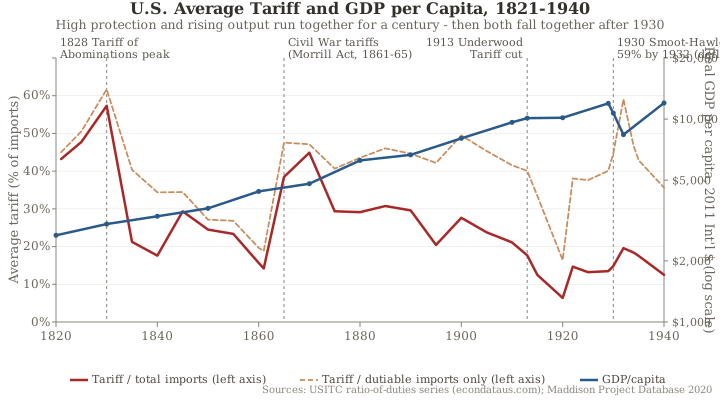
The record also cautions against him. POSCO is the exception. Latin American import substitution from the 1960s to the 1980s produced sheltered industries that never grew up, protection without export discipline, lock-in instead of catch-up (History Ch.10 §10.4 on the commodity-export economies the strategy tried to escape). The dependency tradition, Raúl Prebisch and the thesis of a secular decline in commodity terms of trade, read Latin America’s protectionism not as a blunder but as a defensive response to a rigged system, attempted under institutions that could not sustain it; the lineage runs through Prebisch in the development-economics tradition. The mainstream verdict still lands against blanket ISI, but the charge that the global order kept the periphery poor remains live in Global South policy.
“The rich countries did not develop on the basis of the policies and the institutions that they now recommend to, and often force upon, the developing countries.”
— Ha-Joon Chang, “What Is Wrong with the ‘Official History of Capitalism’?,” in A Guide to What’s Wrong with Economics, 2004
Did the rich countries get rich by protecting?
Chang revived List’s 1841 charge with two centuries of data: the now-rich preach a free trade they never practiced during their own catch-up. The history is on his side. Whether that makes protection a development strategy is a harder question.
Strategy or selection?
“Korea did not get the prices right. It deliberately got them wrong, subsidizing and protecting industries that would not have existed under free trade, and disciplined the firms that received support by tying it to export performance.”
— after Alice Amsden, Asia’s Next Giant, 1989
The developmental-state literature — Amsden on Korea, Robert Wade on Taiwan — is the strongest evidence for List. These economies targeted industries, financed them, protected them, and forced them to export. The discipline of global competition is what kept the protection from rotting into the rent-seeking that killed infant industries everywhere else. Where the conditions held, List’s prescription did what his framework promised.
“Countries that grew fastest in the nineteenth century, including the United States, did so during periods of falling trade barriers. The East Asian cases are real, but they are the exception, and the role of protection in them is far from settled.”
— after Douglas Irwin, Free Trade Under Fire, 5th ed., 2020
Irwin, the leading historian of trade policy, supplies the calibration. He accepts the catch-up record and disputes the easy causal reading of it. The US tariff was mostly a revenue measure, and growth came as barriers fell. East Asia’s real drivers may have been savings, schooling, and macro discipline, with protection incidental. And the cases that worked had an export discipline that almost no other state could replicate. The catch-up record is real; the inference from it to “protection causes development” is where the honest disagreement sits.
Where this leaves us
The record runs partly on List’s side and partly against him, and what is left to argue about is how often and how much. The conditions under which infant-industry protection works are real, since Stage 2’s externality is genuine, but they are rarely met. The catch-up record is part causal and part selection. The ladder charge is historically accurate. The exception is narrow and the base rate of failure is high. Free trade as baseline; infant-industry as a real-but-dangerous exception.
So the line between Smith’s baseline and List’s exception is real but thin, and right now the wealthiest economies in the world are arguing about where it sits. The CHIPS Act, the Inflation Reduction Act, the chip war with China: every one of them is a bet that this time, the conditions for List’s exception are met. Are they?
The modern synthesis
“America’s industrial base had been hollowed out… A new approach was needed. Building our economic strength… means deploying targeted public investment in areas that private markets are ill-suited to address on their own.”
— after Jake Sullivan, US National Security Adviser, Brookings Institution, April 2023
Two centuries after List, the world’s richest economies are running industrial policy, exactly what Smith’s framework calls a mistake and List’s framework calls sometimes necessary. The CHIPS Act, the Inflation Reduction Act, the EU’s strategic-autonomy turn, the US-China tech war: the 1776-versus-1841 confrontation is the operating system of the whole dispute.
The modern synthesis holds both frameworks at once. Comparative advantage and the gains from trade are the locked baseline, the apparatus from Ch 2 §2.6. The infant-industry argument is the conditional exception (Ch 20 §20.8), licensed only when a genuine externality, a credible sunset, and a capture-resistant state with export discipline are all present. Whether those conditions hold is an institutional question, which is why the condition set lives in Ch 18 §18.3.
Where the two frameworks land in the 2020s
“The choice is not between the state and the market. Markets need to be shaped… The question is not whether to intervene but how to do it intelligently, with missions that create new markets rather than merely fixing old ones.”
— after Mariana Mazzucato, The Entrepreneurial State, 2013
This is List’s framework in modern dress. The case for today’s industrial policy is that the externalities have changed shape but not vanished: national-security dependence on a single foreign chip supplier, supply-chain fragility exposed by the pandemic, and the learning curves of the clean-energy transition are all places where private returns fall short of social returns. A capable state can, on this view, build the productive powers the market will not, provided, as the developmental-state record insists, it disciplines what it subsidizes. List’s question is back, and the proponents argue the conditions are met.
“The conditions that made East Asian industrial policy work — insulated bureaucracies, hard budget constraints, ruthless export discipline — are precisely the conditions democratic, lobbied governments find hardest to reproduce. The 2018 tariffs are the cautionary tale, not the model.”
— the free-trade-default position, after Douglas Irwin
The Smithian-modern reply grants that the externalities exist and doubts that today’s states can act on them without being captured. Industrial policy is as likely to become protection for politically connected industries as it is to become strategy. Comparative advantage still governs the baseline, the conditions for the exception are rare, and the recent record of broad, undisciplined tariffs is not encouraging. The full live adjudication of whether today’s industrial policy is justified is a controversial question in its own right; it belongs to the Is industrial policy back, and is it justified? walkthrough, and to the modern-policy treatment in Is free trade always good? § Stage 4. The point here is to place the two founding frameworks inside that debate.
Where this leaves us
List won the exception, real but narrow and conditional: the infant-industry argument is theoretically valid, the catch-up record partly vindicates it, and the ladder charge is historically accurate. The live disagreement, whether today’s industrial policy meets the conditions, is an argument about the application. The modern debate leaves 1776 settled and relitigates where, in 2024, Smith’s baseline ends and List’s exception begins.
The verdict
We held two frameworks against the same object, what makes a nation prosper through trade, and watched them return different answers. Smith’s cosmopolitan framework, presented at its best, showed that the gains from trade are real and that comparative advantage is a theorem; its blind spot is that it takes a nation’s productive capacity as given. List’s national-developmental framework, presented at its best in his own 1841 voice, asked the question Smith’s could not, how to build that capacity, and grounded it in a genuine externality and a historically accurate charge against the rich. The empirical record then adjudicated: every late industrializer used protection, a few of them built miracles, and most of them built sheltered failures. The modern synthesis placed both frameworks inside one mainstream view.
The two-part verdict: Smith won the baseline outright — free trade is the right default for most countries most of the time, and the mainstream is not split on it — and List won the exception (real, narrow, and conditional — valid only under a genuine learning externality, a credible sunset, and a capture-resistant state). The live argument — the CHIPS Act, the IRA, the chip war — is a dispute about the application: which stage, which conditions, and is the state capture-resistant enough to run the play. The full adjudication of that modern question waits in the Is industrial policy back, and is it justified? walkthrough. What you take away is the question to ask the next time someone says “free trade is always optimal” or “we need protection to catch up”, because both slogans are answering a question they refuse to name.