Why are countries rich?
Ask why countries are poor and you reach for one toolkit. Ask why they are rich and a different one appears. Same data, the question chooses the apparatus.
See as debate graphThe framing we usually inhabit
“The wealth of the world’s rich countries is no protection against the consequences of extreme poverty in the rest of the world. Our generation, in the U.S. and abroad, can choose to end extreme poverty by the year 2025.”
— after Jeffrey Sachs, The End of Poverty, 2005
Notice the verb: end. Sachs treats wealth as the achievable baseline and poverty as the deficit to be closed. The question underneath is why does poverty persist, and what closes the gap? Almost every serious effort to fight global poverty starts from there.
When you ask why some countries are poor, you reach, almost without deciding to, for the apparatus of development economics. Its starting datum is a gap that ought to be smaller than it is. At purchasing-power parity, the United States produces around \$80,000 per person, India around \$9,000, the Democratic Republic of the Congo roughly \$1,500. That is a factor of more than fifty between top and bottom. The Solow model, the workhorse of growth accounting, predicts that capital scarcity alone should generate a gap of maybe three- or four-fold, with poor countries growing fast and catching up. The world delivers a hundred-fold gap and stubborn non-convergence. Most of the difference lives in the residual the model labels $A$ — productivity, broadly defined — the part we do not yet understand.
Write output per worker in the standard form $y = A\,k^{\alpha}$, with capital share $\alpha \approx 1/3$. To explain a fifty-fold gap in $y$ through capital alone, $k$ would have to differ by a factor of $50^{1/\alpha} = 50^{3} = 1.25\times10^{5}$ — a hundred-and-twenty-five-thousand-fold difference in capital per worker, which is empirically absurd. The arithmetic forces the gap into $A$:
$$\frac{y_{\text{rich}}}{y_{\text{poor}}} = \underbrace{\left(\frac{A_{\text{rich}}}{A_{\text{poor}}}\right)}_{\text{the residual}} \cdot \left(\frac{k_{\text{rich}}}{k_{\text{poor}}}\right)^{\alpha}$$Decompose actual cross-country data and capital deepening accounts for only a quarter to a third of the gap. The rest is $A$ — the development question, restated as an equation.
A factor of fifty is not “somewhat poorer.” It is the distance between a year’s wages and about a week’s wages for the same work. If the only thing separating Kinshasa from Oslo were machines and roads, you could ship the machines and watch the gap close. We have tried versions of that for seventy years. The gap barely moves. Whatever holds it open is not mainly a shortage of capital.
So the apparatus extends past Solow, and it does so in a single direction: it asks, step by step, what is blocking convergence. Capital deepening was the first answer, poor countries lack machines and infrastructure, so finance the investment. When that explained only a slice, the apparatus reached for ideas: poor countries fail to adopt the productive knowledge rich ones already have, so accelerate the diffusion. When ideas-diffusion stalled on the question of why some places adopt and others do not, the apparatus reached for institutions: Acemoglu, Johnson, and Robinson argued that extractive institutions trap countries below their potential, so reform the rules. And when grand institutional theories proved hard to act on this quarter, the apparatus reached for the randomized controlled trial: stop theorizing growth, find a specific intervention, measure it, scale what works.
Read those four answers as one stack and a shape appears. Each is an answer to the same question, what is keeping this country from converging? Each is policy-actionable by design: a binding constraint to diagnose, an intervention to run, an outcome to measure, an iteration to make. To ask why a country is poor is already to treat wealth as the default and the country’s poverty as a present-day failure to reach it, and a failure, unlike a historical accident, is something you can set out to fix.
The full account of this stack — the facts of the gap, the institutional turn, and the methodology of credible measurement — is Ch 20 (Development Economics); the convergence accounting that anchors the Solow backdrop is Ch 13 §13.6. And the question this stage compresses into a single apparatus stack — measurement, capital, ideas, institutions, experiments, each argued at depth as a candidate cause — is the companion walkthrough “Why are some countries rich and others poor?” If you want the apparatus walk inside this framing, that walkthrough is the place; here we are after the framing itself.
“The poor are no less rational than anyone else, quite the contrary. Precisely because they have so little, we often find them putting much careful thought into their choices. To make progress we have to abandon the habit of reducing the poor to cartoon characters and take the time to really understand their lives.”
— after Abhijit Banerjee & Esther Duflo, Poor Economics, 2011
Can experimental development economics close the gap?
The randomized controlled trial brought a credibility revolution to development economics and won a Nobel Prize. It is the why-poor framing at its most disciplined, and it is where the framing’s limit becomes visible from the inside.
Is the development-economics apparatus the right one for the question we’re asking?
“Just because we cannot end poverty once and for all does not mean that we cannot make progress. We may not have a grand answer, but we have a thousand small answers, each of which makes someone’s life a little better.”
— after Abhijit Banerjee & Esther Duflo, Poor Economics, 2011
This is the apparatus speaking at full strength. Banerjee and Duflo are making a disciplined choice about where rigor is possible. The question they ask is the one a development minister actually faces: given this budget, this country, this year, what do I do that demonstrably helps? Sachs presses the same direction from the macro end with the poverty-trap and the big push, coordinate enough investment at once and a stuck economy can be lifted onto a self-sustaining path. The tradition this stack flows from runs from Arthur Lewis’s 1954 dual-economy model through the structural-adjustment era to the RCT turn, traced as history in History of Economic Thought Ch.16 (Development economics). Every layer of it asks the same policy-actionable question, and that consistency is its strength.
“The development community has gradually narrowed its focus from the transformation of nations to the amelioration of the conditions of the poor, from countries that are poor to people who are poor. These are not the same question, and the apparatus that answers one cannot answer the other.”
— Lant Pritchett, paraphrasing the argument of Alleviating Global Poverty (CGD), 2018
Pritchett is still working inside this question, naming its limit. The development apparatus, he argues, has drifted from the transformation of poor nations to the welfare of poor people, because the second is measurable and the first is not. Both are worthy, but they are different problems, and the tools that crack the second leave the first where it was. The frustration is real and it points somewhere: the framing keeps producing answers to a question it can act on, while the question of how the rich world’s prosperity came to exist in the first place sits outside the apparatus entirely.
Where this leaves us
The apparatus we pick up when we ask “why are countries poor” has real strength behind it: the credibility revolution, the institutional turn, decades of programs that saved real lives, the working machinery of a serious profession. Its limit is structural: the presupposition that wealth is the default and poverty a failure to reach it is built into the question before any model is chosen. Change the question and the apparatus changes with it.
So change it. Ask the reverse instead, why are some countries rich? Asked as a methodological move, with the historical record as the starting point. Hold the same data and turn the question around, and a different apparatus comes up in your hands.
The flip
“It makes more sense to ask why Western Europe escaped from the common constraints than to ask why other regions did not. In 1750, the most developed regions of Europe and the most developed regions of East Asia look surprisingly alike.”
— after Kenneth Pomeranz, The Great Divergence, 2000
Pomeranz did not change his data. He changed the question. If the Yangzi delta and England were roughly comparable in 1750 — similar life expectancies, similar wages in grain, similar market sophistication — then there is nothing to explain about why China “stagnated,” because it had not yet fallen behind. The thing that needs explaining is why Europe shot upward. Same numbers, read from the other end. And the moment you read them that way, the question is no longer what is blocking convergence but what made the takeoff possible at all.
Start the clock further back than development economics ever does. For roughly ten thousand years, from the first farming to about 1800, human living standards barely moved. Better technology raised the population and left the wage where it was; a good harvest meant more mouths to feed. This is the Malthusian trap, and it held everywhere, for almost everyone, for almost all of history. Against that baseline the rich-world economy is the anomaly, a one-and-a-half-century rupture, between about 1700 and 1850, that broke a ten-millennium pattern and produced, as a side effect, the gap development economics measures today.
Galor’s unified growth theory makes the rupture precise. In Malthusian dynamics, output per capita $y_t$ is pinned to subsistence $\bar{y}$ because population $N_t$ absorbs any technological gain: $\dot{N}_t = \phi\,(y_t - \bar{y})\,N_t$, so $y_t \to \bar{y}$ whatever happens to technology $A_t$. The takeoff is the moment the link from income to fertility inverts, rising returns to human capital push families from quantity toward quality of children, fertility falls as income rises, and population stops eating the surplus:
$$y_t \approx \bar{y} \;\;\text{for } t < t^{*}\,(\text{Malthus}), \qquad y_t = A_t\,h_t \;\;\text{for } t \ge t^{*}\,(\text{modern growth})$$The same Maddison time series that development economics reads as a present-day gap, Galor reads as a phase transition at $t^{*}$. The interesting object is the date and mechanism of the break.
Picture the whole human income chart as a flat line running ten thousand years long. Pharaohs, Roman senators, Song-dynasty merchants, all of them lived on a few dollars a day in modern terms, because for all of history a richer harvest just meant more children, never a higher standard of living. Then, in one corner of the line, near its very end, it suddenly bends almost vertical. That bend is the thing to explain. Ask “why are countries poor?” and you stare at the right-hand edge of the chart. Ask “why are countries rich?” and you stare at the bend.
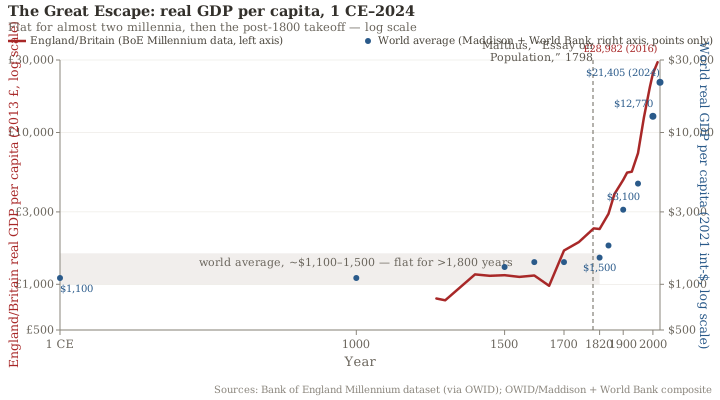
Stare at the bend and a different apparatus assembles itself, the economic-historian’s stack. Pomeranz looks for the contingencies that let one region escape the trap when its peers could not: Britain’s coal lay near its population and its water, and its New World colonies supplied “ghost acreage” — sugar, cotton, timber grown on someone else’s land — that released the land constraint a closed economy could never escape. Allen sharpens the mechanism into prices: Britain had unusually high wages and unusually cheap energy, so labor-saving, coal-burning machines were profitable to invent and adopt there and nowhere else. Industrialization, on this reading, was a rational response to a peculiar set of factor prices.
Mokyr looks past prices to knowledge itself. The takeoff, he argues, required a culture of growth, an Industrial Enlightenment in which useful knowledge gained status, the Royal Society and the Republic of Letters built an infrastructure for sharing and contesting it, and tinkerers and natural philosophers began talking to each other. Sustained innovation comes from a society that keeps producing inventions, and that takes institutions of the mind. McCloskey pushes the cultural claim further still: what changed, she insists, was rhetoric, a new dignity and liberty granted to the bourgeoisie, so that buying low and selling high stopped being shameful and became respectable enough to do at scale. Galor ties the threads into one mechanism, the demographic transition that finally let income outrun population.
Coal seams, ghost acreage, factor prices, the Republic of Letters, bourgeois dignity, a fertility inversion, none of these are inputs the why-poor framing naturally surfaces, because none are policy-actionable this quarter. You cannot run a randomized trial on the status of merchants in seventeenth-century Holland. The flipped framing reaches for culture, contingency, and rhetoric because it is asking a historical-explanatory question. The gap is a historical anomaly, and a historical question selects a historical apparatus.
The formal scaffolding sits in the economics text, the dynamic-optimization backbone in Ch 13 §13.1 (the Ramsey model) and the endogenous-growth machinery, where ideas are produced rather than assumed, in Ch 13 §13.4 (Romer’s endogenous-growth model). (Read through the flipped lens, endogenous growth stops asking “why don’t poor countries copy ideas?” and starts asking “what made the ideas inventable in the first place?”) The institutional apparatus, which the why-poor framing met as a present-day extractive-versus-inclusive distinction, returns here as a historical-mechanism question, Ch 18 §18.3 (the AJR framework). The historical evidence for the whole divergence — Pomeranz, Allen, and Mokyr argued at depth on the Britain-versus-China case — is the spine of the companion walkthrough “Did Britain have to industrialize first?”.
Ghost acreage points straight at slavery: the cotton and sugar that fed Britain’s factories were grown by enslaved people on plantations whose land was, in the ledger of the European core, free. The specific question of whether slavery was the central mechanism that made the West rich, rather than one contingency among Pomeranz’s several, is its own dispute, worked at depth in the companion walkthrough “Did the West get rich because of slavery?” and in History Ch.9 (Atlantic slavery and after). Here it appears as one element of the apparatus the flipped framing surfaces, with no verdict on its weight.
The flipped framing has a lineage of its own. It runs from Adam Smith’s reading of commercial society as the engine of the wealth of nations, traced in History of Economic Thought Ch.3 (Classical political economy), through the historicist reaction that insisted economies are made by specific histories: Marx’s account of the historical rise of capitalism (the root of that tradition, in History of Economic Thought Ch.4 (Marx)), and on through Weber’s Protestant ethic and Polanyi’s great transformation, into Pomeranz’s own work. These last figures are the historical-sociology current the development apparatus quietly left behind.
“The Industrial Revolution… was the result of an intellectual sea change, a shift in attitudes toward the role that useful knowledge could play in the betterment of the material conditions of mankind, and the institutions that supported the growth of such knowledge.”
— after Joel Mokyr, A Culture of Growth, 2016
Did a culture of growth make the modern world?
Mokyr says the takeoff needed more than coal and prices, it needed a society that gave status to useful knowledge. The claim is the kind of thing the why-poor framing never surfaces and the flip puts at the center.
Is the historical-anomaly framing the right one for the question we’re really asking?
“The puzzle of the Great Divergence is not why poor countries stayed poor, that was the human norm. The puzzle is why, in one place and one century, sustained growth began at all.”
— the flipped-framing case, after Pomeranz, Mokyr & Galor (The Great Divergence 2000, A Culture of Growth 2016, Unified Growth Theory 2011)
Here these three speak as a single framing. Each made the reversal an explicit methodological commitment: Pomeranz by insisting that the divergence of Europe is what needs explaining; Mokyr by building an account of the cultural-institutional preconditions of sustained innovation; Galor by writing a single model whose central object is the takeoff itself. Read against the Malthusian baseline, prosperity is the deviation and poverty is the rule, so the apparatus is built to explain the deviation. The mechanism dispute among them, how much weight coal versus culture versus demography carries, runs at depth in the great-divergence walkthrough; their shared move is to ask the question this way in the first place.
“The historical-anomaly question is genuinely interesting. It is also not the question a finance minister in Lusaka is asking. Pomeranz’s puzzle is for historians; ours is for the country that needs help this year.”
— the policy-actionability case, after Banerjee, Duflo & Sachs
Granting every word of the flip — that the takeoff is the real anomaly, that the historical apparatus explains it — still leaves the development minister exactly where she started. Knowing that Britain had cheap coal and a Republic of Letters does not tell Zambia what to do with next year’s budget. The why-poor framing keeps its priority because it is the one that can act, and acting on poverty cannot wait for the historians to finish. The flip may be true and still not be what the moment demands.
Where this leaves us
The reversed question picks up another apparatus, surfaces other evidence, and answers a different version of the same datum. Pomeranz, Mokyr, and Galor work a stack built for coal and culture and demography. The framing decision is upstream of the apparatus selection, and so upstream of which answers are available at all.
If two framings of the same question select two different apparatus stacks, what follows for policy? And what follows for the verdict, is one framing right and the other wrong, or do they coexist, each earning its keep somewhere? The last stage walks the consequences and, where the two stacks turn out to converge, names what that convergence means.
What the framing does to policy and to the verdict
“Why is Nogales, Arizona, so much richer than Nogales, Sonora? The two halves of the same town share a climate, a culture, and an ancestry. The difference is the border, and the institutions on either side of it.”
— after Daron Acemoglu & James Robinson, Why Nations Fail, 2012
That is the why-poor framing in miniature, a present-day gap, a policy-actionable cause, a fence you could in principle move. Yet the same book opens with the Roman Empire, the Maya collapse, and the Korean DMZ, deep history, read as natural experiments in why some societies took off and others never did. That is the why-rich framing. Why Nations Fail is the canonical case of one set of authors holding both framings at once and using a single institutional theory to bridge them. Which makes it the right place to ask what the framing choice finally does.
Three things follow from the flip, and they are the verdict. First, framing-direction is upstream of framework-disagreement. Sachs and Pomeranz reach different conclusions because they have chosen different framings of the same phenomenon, and the framings handed them different apparatus before either of them estimated anything. A great many “disputes” in growth and development are disagreements about which question the model is built to answer.
Second, each framing has a natural domain where it earns its keep. The why-poor framing’s domain is the policy-actionable present, which intervention moves outcomes in a specific country this year, which institutional reforms have a track record, what aid does and does not do. The why-rich framing’s is the historical-explanatory register, what made the original takeoff possible, what conditions preserve it, and why those conditions reassembled in South Korea, Taiwan, and Singapore, and (so far, mostly) Botswana, but not across most of Sub-Saharan Africa. Calling one framing “wrong” because it does not answer the question the other framing is asking is a category error.
Third, where the framings converge, they converge on institutions. AJR’s institutional turn is the why-poor framing’s deepest cause; Mokyr’s epistemic institutions, North’s rules-and-enforcement, and the deep-history sections of Why Nations Fail are the why-rich framing’s institutional substrate. They are working the same family of mechanisms from opposite ends of the question. When both framings are applied honestly — one to the present gap, one to the historical bend — they keep landing on the same answer.
The institutional apparatus both stacks lean on lives in Ch 18 §18.3 (the AJR framework) — met in Stage 2 as a historical-mechanism question, re-read here as the place the two framings meet — and in Ch 20 §20.4 (Institutions and Development), the same section that anchored the why-poor stack in Stage 1, now carrying the convergence reading. And the institutional tradition itself, traced as intellectual history from Veblen through Coase and North to the AJR turn, is History of Economic Thought Ch.15 (The institutionalist tradition), the lineage both framings draw from differently.
Picture the income gap as a hill that, once climbed, is hard to fall off. The why-poor framing studies the people still at the bottom and asks how to get them up. The why-rich framing studies the few who made the original climb and asks how the climb was possible. China, Korea, Singapore and Botswana are the cases where the second question pays off practically, they reassembled enough of the historical preconditions to start climbing too. Same hill, two vantage points, and at the summit they describe the same terrain: institutions that let effort compound.
Can one institutional theory hold both framings?
Why Nations Fail asks why-rich in its deep-history chapters and why-poor in its present-day ones, and bridges them with a single account of inclusive versus extractive institutions. Is that the synthesis, or one framing wearing the other’s clothes?
Is the framing flip a methodological insight, or a distraction from the work?
“The Bourgeois Revaluation… not trade or investment or exploitation, but a change in the way people talked and thought about the bourgeoisie and its projects, was what made the modern world.”
— after Deirdre McCloskey, Bourgeois Equality, 2016
McCloskey states the case we’re making in its sharpest form. The choice of question has apparatus consequences, and knowing which framing you are inhabiting sharpens the apparatus. Her bourgeois-dignity account is itself the proof, it became thinkable only once she asked why the modern world arose rather than why the rest stayed behind. Understanding the flip lets you notice when a whole class of causes has been ruled out before the analysis even began.
“Whatever the framing flip reveals about apparatus selection, the country that needs help today needs the apparatus that is policy-actionable now. The flip is interesting. It does not change what we should do this week.”
— the practical-priority case, after Banerjee, Duflo & Easterly
The verdict grants this objection. The why-rich framing’s apparatus is built for historians; the why-poor framing’s is built for the minister with a budget. If the only thing the flip bought were a more elegant account of the eighteenth century, the practical defender would be right to shrug. The second layer of the verdict exists to honor this objection: each framing has a domain, and the policy-actionable present is the why-poor framing’s domain by right.
Where this leaves us
The cross-country income gap is the same datum either way you frame it. The framing, why poor or why rich, is not neutral: it selects a different apparatus, surfaces different evidence, and produces different policy. Both framings are honest readings of the data; neither is uniquely correct; the choice of framing is itself a methodological commitment. Framing-direction sits upstream of framework-disagreement, so what looks like a fight inside a model is often a disagreement about which question the model answers. Each framing earns its keep in its own domain — the why-poor framing in the policy-actionable present, the why-rich framing in the historical-explanatory register — and faulting one for not answering the other’s question is a category error. And where the two framings meet, they meet at institutions, because both stacks applied honestly land on the same family of mechanisms. Why Nations Fail is the proof of concept, one set of authors holding both framings, one institutional theory bridging them.
Read on: the why-poor framing walked in full as a controversial question is “Why are some countries rich and others poor?”, now legible as one of two framings of the same question; the great-divergence apparatus argued at depth on the Britain-versus-China case is “Did Britain have to industrialize first?”; the slavery-as-central-mechanism question is “Did the West get rich because of slavery?” The framework-by-framework comparison of Pomeranz against Acemoglu is “Pomeranz vs. Acemoglu on the divergence”, and the intellectual lineage of growth theory from the classical economists to the endogenous models is “Growth theory from the classics to endogenous models”.
The verdict
We started with Sachs proposing to end poverty by 2025, and watched a single verb hand us a whole toolkit. The three stages traced what that toolkit was, what changed when we turned the question around, and what the turn finally costs and reveals:
- The framing we usually inhabit. Ask why countries are poor and you pick up the development-economics apparatus — Solow, ideas, institutions, RCTs — a single stack that asks, step by step, what is blocking convergence, and that is policy-actionable by design because the framing treats poverty as a present-day failure to fix.
- The flip. Hold the same data and ask why countries are rich, and against the ten-thousand-year Malthusian baseline wealth becomes the anomaly, a one-and-a-half-century bend in the chart. The reversed question selects the economic-historian’s stack: Pomeranz’s coal and colonies, Allen’s factor prices, Mokyr’s culture of growth, Galor’s demographic transition, apparatus the why-poor framing structurally cannot surface.
- What the framing does. Framing-direction is upstream of framework-disagreement; each framing earns its keep in its own domain; and where the two converge, they converge on institutions, with Why Nations Fail as the canonical case of one institutional theory holding both questions at once.
Both framings are honest readings of the same Maddison series. The question you ask is never innocent: it reaches into the toolbox before you do and decides which instruments are on the bench. A methodology built to answer “what works at this intervention point?” will never reach for the status of merchants in seventeenth-century Holland. That factor is real; the question rules it out of view.
Hold both questions, know which one you are asking, and you can see the gap from both vantage points at once, the failure to converge and the anomaly that needs explaining.