Germany vs. UK: two paths through late industrialization

Britain ran the first industrial revolution. Germany was a generation behind — and then, in a single human lifetime, caught up and passed it in the industries that mattered next. The usual lesson is that Germany was clever and Britain grew complacent. Hold both countries at their own strongest, and a different and more honest story falls out: two rational paths, neither of them the foil.

Stage 1 of 4

Two clocks

“In a number of important historical instances industrialization processes, when launched at length in a backward country, showed considerable differences, as compared with more advanced countries, not only with regard to the speed of the development… but also with regard to the productive and organizational structures of industry which emerged from those processes. … the more backward a country’s economy, the greater was the part played by special institutional factors designed to increase supply of capital to the nascent industries.”

— Alexander Gerschenkron, Economic Backwardness in Historical Perspective, 1962

This is the most influential single idea ever written about exactly this pairing. Gerschenkron took the obvious handicap of starting late and turned it inside out: a follower can skip the leader’s blind alleys and adopt its best techniques wholesale — but only if it can invent the institutions to mobilize capital and skill at a tempo organic growth never demanded. Backwardness, on this reading, is not just a deficit to overcome. It is a different problem, solved with different tools. The German catch-up is his home case, and the question this whole walkthrough turns on is whether his lens fits.

Before any institutions, fix what counts as surprising. Growth theory says a follower sitting below the technological frontier can grow faster than the leader simply by adopting frontier technology instead of inventing it — the convergence baseline. So Germany growing faster than Britain after 1840 is the null, not the puzzle: that is what catch-up looks like when it works at all. What convergence does not supply is the mechanism. Gerschenkron’s addition is that catch-up is never automatic — it has to be organized, and the form of the organizing institution varies with how far behind you start. The convergence-and-induced-innovation apparatus lives in Economics Ch.13 (Growth Theory) §13.6; the German timeline, the Zollverein-to-1913 record, and the five-economy catch-up comparison are the spine of Economic History Ch.8 (Industrialization Beyond Britain) §8.1, with the British first-mover record it is measured against in Ch.7 (The Industrial Revolution) §7.1.

The convergence baseline is one line. If a country’s income $y$ sits a distance below the frontier $\bar{y}$, its growth rate rises with that gap:

$$\frac{\dot{y}}{y} = \lambda\left(\frac{\bar{y} - y}{y}\right)$$

The further behind you are, the faster you should grow — so fast catch-up is the prediction, not the mystery. The mystery Gerschenkron names is the coefficient $\lambda$: closing the gap requires institutions to mobilize the capital and skill, and those institutions are what differ between the German and British paths.

直觉模式

Copying is faster than inventing. A country behind the frontier can grow quickly just by adopting machines someone else already proved out, so Germany racing ahead of Britain is exactly what catch-up is supposed to look like. What that simple story leaves out is how the copying gets paid for and staffed. Germany had to build banks and schools to do at speed what Britain had grown slowly and organically. That “how” is the whole comparison.

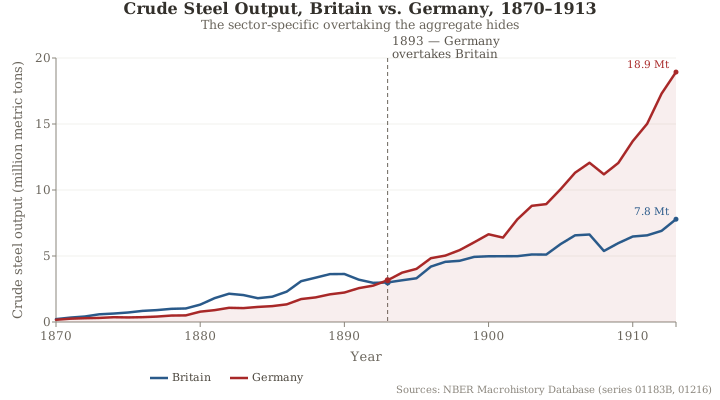
You can watch the two clocks run. The long-run GDP-per-capita series carries the British and German lines side by side: Germany — held back by political fragmentation until the 1871 unification — converging toward Britain across the second half of the century, closing to near-parity by 1900, edging past in 1913. One caution the map itself enforces, and the prose must keep: the “overtaking” was real but sector-specific — chemicals, electricals, steel, precision engineering — while in aggregate income per head the two ran close to level, Britain still ahead on several measures into the twentieth century. This is convergence to near-parity with a lead in the new sectors, not a clean total-economy reversal.

Two solutions, two different problems

“The Industrial Revolution was an energy revolution first, and everything else second.”

— the first-mover path at full strength, after the Economic History Ch.7 reading

Take Britain’s clock at its own strongest. The first industrial revolution was organic, bottom-up, and driven by prices on the ground — cheap coal, dear labour, a textiles-and-steam stack assembled by tinkerers who learned by doing. It needed no coordinating bank and no developmental state because it grew its own prerequisites as it went, slowly, one workshop at a time. Nobody planned it; nobody could have. That is not a primitive version of what Germany would later do deliberately — it is the only way the frontier could be reached the first time, when there was no leader to copy and no proven technique to buy. Britain’s institutions were the right institutions for inventing the frontier.

“The nation must sacrifice and give up a measure of material prosperity in order to gain culture, skill, and powers of united production.”

— Friedrich List, The National System of Political Economy, 1841

Now Germany’s clock, equally at strength. Germany arrived after Britain had already proven the frontier — which meant it did not have to re-run the first industrial revolution slowly and could instead organize directly toward the next one, the science-based second IR of chemicals, electricals, and steel. Organize it with what? With banks that coordinated capital across firms, with states that built railways and customs unions, with technical schools that manufactured engineers. The German developmental tradition understood itself in exactly these terms: Friedrich List had argued a generation earlier that a late starter must build its productive powers behind temporary protection rather than expose infant industries to a leader’s mature competition — the national-economy frame against Smith’s free-trade default. Germany’s catch-up was not Britain’s industrialization arriving late. It was a structurally different industrialization, built on substituting institutions.

Where this leaves us

Gerschenkron’s reframe is the right organizing lens for this comparison, and it earns that status by sorting the two questions cleanly. The convergence baseline already tells us the speed of German catch-up was expected — a follower below the frontier should grow fast. What needs explaining is the institutional form, and that is precisely what Gerschenkron supplies: late industrializers substitute institutions for the prerequisites first-movers grew organically. So the lens fits the German half well. One caveat goes on the table now and is collected at the end: we are testing the thesis on its home case, and whether it holds as a universal law — the same monotonic ladder running from Britain through Germany to Russia — is a separate question the later stages will have to answer.

Gerschenkron said the deeper you start in the hole, the bigger the institution you need to climb out. For Germany the first big institution was not the state — it was the bank. And not the bank as Britain knew it. Britain invented the joint-stock company and the deepest capital market on earth; so why did the late industrializer, not the first, end up with the financial institution that coordinated heavy industry?

Stage 2 of 4

Two ways to fund a factory

“A German bank… accompanied an industrial enterprise from the cradle to the grave, from establishment to liquidation throughout all the vicissitudes of its existence.”

— Alexander Gerschenkron, Economic Backwardness in Historical Perspective, 1962

This is the German universal bank — the Grossbank — doing what an English clearing bank would not. Deutsche Bank, Dresdner, Commerzbank, the Darmstädter took long-term equity stakes, placed their own directors on industrial supervisory boards, and shepherded firms through the cycle. Deutsche Bank’s relationship with Krupp is the paradigm: long-term credit the short-bill London market would not supply, an equity holding, a board seat, financing coordinated with the whole strategy of the Ruhr. The relationship was structural, not transactional — and it became Gerschenkron’s central exhibit for how a backward economy mobilizes capital it cannot raise on a thin market.

The apparatus here is institutions as solutions to a coordination problem — getting capital to industry under information asymmetry and long payback horizons — and the two financial systems are two different solutions to that one problem. Relationship finance internalizes the monitoring: the universal bank sits on the board, holds the equity, and has skin in the game across the whole cycle, so it can lend long against soft information no arm’s-length lender could price. Transactional finance externalizes it: the arm’s-length market relies on price signals, liquidity, and the option to exit. Neither is generically better. A catch-up economy mobilizing lumpy capital toward heavy and second-IR industry under thin information is well served by the coordinating bank; a mature economy with deep markets, a large stock of existing firms, and abundant trade and overseas investment opportunities is well served by liquid arm’s-length markets. The institutions-as-coordination-solutions framework lives in Economics Ch.18 (Institutional Economics) §18.1; the Grossbanken record itself — Deutsche Bank, Krupp, the bank-on-the-board pattern against the British clearing bank — is in Economic History Ch.8 §8.3.

A coordinating brain, and a market that worked

“The German investment banks… were the very embodiment of the rationalization and the planning that backwardness required.”

— the German universal-bank model at full strength, after Gerschenkron

The German universal bank at its strongest is not a second-best workaround for a missing capital market. It is a genuine institutional innovation that solved the catch-up coordination problem better than arm’s-length markets could have for that task. Heavy and second-IR industry — steel furnaces, chemical plants, electrical networks — needed capital in large, lumpy, long-horizon commitments, and it needed the timing of supplier, producer, and customer investment to move together. A bank that held the equity, sat on the boards, and coordinated across firms could do that; a bond market pricing a steel firm at arm’s length, refusing to lend past a short commercial bill, could not. The Grossbanken built German chemicals, electricals, and steel at a scale and speed the German market on its own would never have reached. This is the cleanest single piece of evidence that Gerschenkron is right: a substituting institution the late industrializer built and the first-mover never needed.

“The City’s capital was not idle or misallocated; it was placed where the risk-adjusted return was highest — which, for Britain, lay abroad and in trade.”

— the British arm’s-length market at full strength, against the gentlemanly-capitalism charge

Here is the place the comparison most wants to crown Germany and shame Britain, and it is the place to refuse. The standard charge — the gentlemanly-capitalism reading of Cain and Hopkins — is that the City and the British establishment diverted finance away from domestic industry toward empire, foreign sovereign lending, and rentier returns, starving the factories at home. Argue that at its strongest: British industrial firms did find the City more distant than a German firm found its Grossbank, and the bank-industry gap was real. But the reply is decisive. The City was the most sophisticated capital market on earth, and it allocated efficiently to the opportunities Britain actually had — established first-IR firms that needed no coordinating bank, and an empire-and-trade structure where overseas infrastructure and sovereign lending genuinely offered higher risk-adjusted returns than marginal Lancashire textiles. Chasing those returns abroad is not a failure of finance. It is exactly what a deep, liquid market is built to do. The British market was not broken. It was solving a different problem.

Where this leaves us

The universal bank is the cleanest evidence for Gerschenkron on the board — a substituting institution the late industrializer built and the first-mover did not need — and the German half of this stage vindicates the thesis squarely. But the verdict resists the slide that the German bank’s success proves British finance failed. The arm’s-length market was not dysfunctional; it was optimized for a different opportunity set, and given Britain’s actual returns it allocated rationally. The honest read is two-sided and calibrated: German relationship finance was a real institutional advantage for catch-up in capital-heavy second-IR sectors, and that is not the same claim as British finance being broken. Pro-Gerschenkron on Germany; anti-failure on Britain.

A bank can move money to a chemical plant. It cannot, by itself, produce the chemist who knows what to build. The second industrial revolution was science-based in a way the first was not — the new industries came out of the laboratory, not the workshop — and for that Germany built something Britain never quite did: a pipeline from the lecture hall to the laboratory bench to the factory floor.

Stage 3 of 4

Two ways to make a chemist

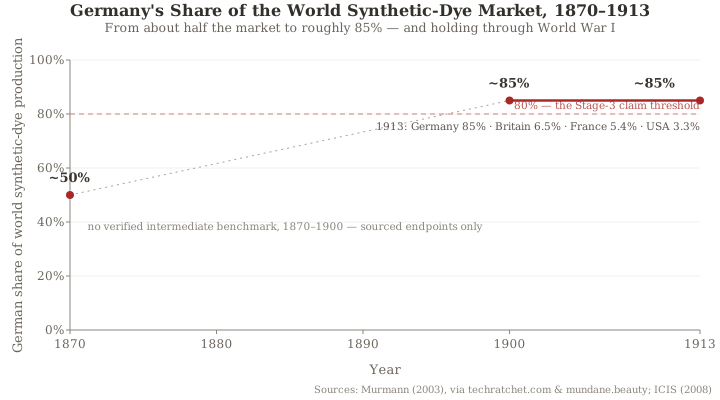
“By 1900, German synthetic dyes had destroyed the natural-dye industries of India and Latin America and captured over 80 percent of the world market. Britain’s craft-apprenticeship model could not replicate what the Technische Hochschulen produced: a systematic pipeline from scientific research to industrial application.”

— Economic History Ch.8 §8.3, on BASF and the synthetic-dye industry

The exhibit is concrete and it is German: BASF’s chemists, trained at the technische Hochschulen and working in purpose-built corporate research laboratories, synthesized alizarin from coal tar in 1869 and indigo in 1897 — dyes that had been natural products for millennia — and inside a generation captured four-fifths of the world dye market from Bayer and Hoechst benches. Behind the firms stood the upstream supply: technical universities at Berlin-Charlottenburg, Munich, Aachen, and Karlsruhe, training engineers and applied chemists to a standard no British institution matched. The first industrial revolution had run on artisanal skill passed through apprenticeship and workshop trial-and-error. The second ran on organic chemistry, and you cannot tinker your way to a synthesized molecule.

The apparatus is human capital and the science-industry linkage as an institutional input to innovation. The second IR raised the knowledge intensity of industry: returns to formal technical training and to organized in-house R&D rose sharply, so the institutions that produced trained scientists and channeled them into firms became a source of comparative advantage in exactly the new sectors. The amateur-inventor, learning-by-doing model — where the marginal innovation came from a skilled tinkerer responding to factor prices — was the correct institution for the first IR and hit diminishing returns precisely where the frontier turned science-based. This is the same institutions-as-coordination logic as the bank, applied to skill rather than capital; the human-capital-and-induced-innovation apparatus lives in Economics Ch.13 (Growth Theory) §13.6 and the institutional framing in Ch.18 (Institutional Economics) §18.1; the education dimension of the German catch-up — technische Hochschulen, corporate labs, the dye industry — is the record in Economic History Ch.8 §8.3.

A built pipeline, and a tradition that fit its own frontier

“The technical universities trained engineers and applied scientists to a standard that no British institution matched.”

— the German technical-education system at full strength, after the Ch.8 reading

Germany’s system at its strongest is a deliberately built institution doing what no spontaneous tradition could. The technische Hochschulen, the state technical schooling that fed them, and the in-house corporate research laboratory together formed a continuous pipeline: from the lecture hall, where systematic organic chemistry was taught, to the company bench, where it was turned into product. That pipeline gave Germany a structural lead in exactly the science-based second-IR sectors — synthetic dyes, pharmaceuticals, electricals, precision steel — because in those sectors the marginal advance came from a trained chemist predicting a reaction pathway, not from a gifted mechanic adjusting a machine. This is the second substituting institution on the board: where the frontier was science, Germany manufactured the scientists, and it did so on purpose.

“Britain’s technical knowledge was artisanal… The system had produced the first industrial revolution. It could not produce the second.”

— the British tradition read at strength, not as failure

The British amateur-inventor tradition is the easiest thing in this whole comparison to caricature as backwardness, and the caricature is wrong. That tradition — apprenticeship, workshop practice, learning by doing — produced the deepest stock of practical engineering skill in the world and built the first industrial revolution outright. It was the correct institution for a frontier reached by tinkering, and its weaker fit for science-based industry is the rational persistence of a first-mover’s human-capital stack, not a cultural defect or a failure of nerve. The educational-deficit charge against Britain — that it under-invested in technical and scientific training relative to Germany — is real, and it should be argued at strength: Britain genuinely lagged in formal technical education. But the answer holds. Britain’s human capital was optimized for its existing comparative advantage, and the “deficit” shows up only relative to the new science-based frontier Germany was racing toward. Measured against the first IR it built, Britain’s skill base was not deficient at all.

Where this leaves us

The science-to-industry pipeline is the second clean piece of evidence for Gerschenkron — a substituting institution the late industrializer built deliberately, paying off precisely in the sectors where Germany overtook Britain. Two substitutions are now on the board: the bank for capital, the technical school for skill, and both are real. But the verdict again resists the failure slide. The British educational “deficit” is genuine relative to the new frontier and overstated as a pathology: it is the expected lag of a first-mover whose human-capital institutions were built for a different technology. So the running score after two stages is consistent — Gerschenkron’s lens fits the German half well, and the decline-as-failure reading of the British half still looks like mislabeled rational adaptation. Which makes the next stage’s question unavoidable.

Two institutions — the bank and the technical school — and on both, Germany looks like Gerschenkron’s poster child. So here is the uncomfortable question the comparison has been building toward: if Germany did everything right, does that mean Britain did something wrong? Slower growth, a closing gap, a rival passing you in the industries of the future — that sounds like failure. Did Britain fail?

Stage 4 of 4

Did Britain actually fail?

“The Englishman… was content to follow the conservative dictates of an aging economy. … the third generation of British industrialists let down the side. They were content to live on the accumulated capital, intellectual as well as material, of their predecessors.”

— David S. Landes, The Unbound Prometheus, 1969

This is the decline-as-failure thesis at its sharpest: the third-generation British industrialist who rested on inherited success, under-invested, clung to outdated technique, and let the dynamic rivals pass. For a long time it was the dominant reading, and it has the intuitive shape of the whole comparison behind it — Germany built the new institutions, Britain coasted on the old. But Landes is one voice in a live scholarly fight, and the reply that broke the consensus has not even entered yet. The stage opens on the disagreement, not on a verdict.

The apparatus is a single test, and stating it precisely is what keeps the verdict honest. A first-mover holds a large sunk capital stock optimized for the old technology; factor prices, comparative advantage, and the existing population of firms determine whether the privately rational marginal investment is to upgrade to the new frontier or to keep exploiting the old stack plus services, trade, and finance. “Failure” is the claim that British firms left money on the table — that they made privately irrational choices. “Rational adaptation” is the claim that they made privately rational choices that happened to be nationally slower-growing because of the inherited structure. The test is not which country grew faster; it is whether British behaviour was privately suboptimal or privately optimal given the constraints. The convergence-and-vintage-capital logic lives in Economics Ch.13 (Growth Theory) §13.6; institutional lock-in and path dependence in Ch.18 §18.2; the British first-mover capital stock in Economic History Ch.7 §7.4 and the comparison record with the 1900/1913 crossing in Ch.8 §8.7.

Three readings, each at full strength

“They had developed firms whose managerial structures and attitudes were inadequate to the requirements of large-scale, science-based industry.”

— the failure readings: Landes (entrepreneurial failure) and Cain & Hopkins (gentlemanly capitalism)

The failure readings were dominant for a reason, and they get argued first, at strength. Landes’s entrepreneurial-failure thesis names a cultural and managerial complacency: the third-generation owner who inherited the firm, preferred the gentleman’s life to the works, and under-invested in the science-based capacity the second IR demanded. Cain and Hopkins’s gentlemanly-capitalism reading sharpens the financial edge of the same charge: the City and the establishment diverted finance and talent away from domestic industry toward empire, foreign lending, and rentier returns, so the manufacturing base was structurally under-served by its own elite. And the educational-deficit strand from the last stage feeds straight in: Britain under-built the technical schooling Germany was racing ahead on. Put together, these were the serious, long-dominant account of British relative decline, and they capture something real about a country whose elite culture and capital both drifted away from the factory floor.

“Britain’s early start and the institutions it bred became, in the changed conditions of the late nineteenth century, a source of rigidity and constraint.”

— Bernard Elbaum & William Lazonick, The Decline of the British Economy, 1986

The second reading is the one the mainstream keeps, and it relocates the problem from the individual entrepreneur to the structure: institutional sclerosis. Elbaum and Lazonick argued that Britain’s first-mover institutions — a fragmented industry structure, entrenched craft-union work rules, family-firm governance, the bank-industry distance from Stage 2 — were rational when they formed and then hardened into rigidities that blocked the very reorganization the second IR rewarded. No single actor was being foolish; the configuration as a whole could not restructure itself, because restructuring required coordinated change across firms, unions, banks, and owners that none could force alone. This is the version of “decline” that survives scrutiny, and its intellectual ancestry runs straight back to Thorstein Veblen’s “penalty of taking the lead” — the idea that the first mover gets locked into the vintage of technology and organization it pioneered — the founding insight of the institutionalist tradition. (HET Ch.15 §15.1 traces the Veblen-to-Acemoglu lineage.)

“The late Victorian entrepreneur did not fail. By and large, he responded rationally and effectively to the conditions he faced.”

— Donald McCloskey & Lars Sandberg, “From Damnation to Redemption,” 1971; McCloskey, Economic Maturity and Entrepreneurial Decline, 1973

Then comes the reply that has to be argued, not asserted, because it is the load-bearing move of the whole stage. McCloskey and Sandberg took the failure thesis sector by sector — steel, coal, cotton — and ran the actual cliometric arithmetic: given British factor prices, the sunk first-IR capital stock, the comparative advantage Britain actually held, and the real returns available, were British firms leaving money on the table? Their finding was that, by and large, they were not. The Victorian entrepreneur who declined to scrap a still-productive open-hearth furnace for the latest German design was usually making the privately optimal call given his vintage of plant and his input prices, not failing a test of nerve. And much of the measured “decline” is simply the arithmetic of convergence — a leader necessarily grows slower than a catch-up follower closing the gap — compounded by measurement artifacts in the early productivity series. This is not a claim that nothing went wrong in Britain. It is the claim that widespread entrepreneurial irrationality, the engine of the strong failure thesis, is not in the data.

The verdict

On decline-as-failure: substantially overstated. The McCloskey-Sandberg rational-adaptation case is the mainstream’s honest answer to the strong failure thesis — a first-mover growing slower than a catch-up rival is convergence, not pathology, and the cliometric record does not show widespread entrepreneurial irrationality. But the verdict is calibrated, not flat, because there is a real residue, and it is the Elbaum-Lazonick institutional-rigidity reading. Britain did lock into its first-mover institutions; the fragmented industry structure, the craft-union work rules, and the bank-industry distance were genuine rigidities that slowed reorganization. So the honest line is layered: “Britain failed” is overstated; “Britain’s first-mover institutions hardened into rigidities the second IR penalized” survives. The disagreement between Landes, Elbaum-Lazonick, and McCloskey is not a war between economic schools — all of them work inside one shared institutions-and-factor-prices frame — it is a contest over how much of the gap was rigidity-failure versus rational adaptation, and this walkthrough commits to: mostly adaptation, with a real rigidity residue.

On Gerschenkron, pulling the whole comparison together: the German half vindicates the institutional-substitution thesis — the universal bank and the technical-education pipeline were both real, both operative, both substituting institutions the late industrializer built and the first-mover did not need. But the thesis over-fits Germany and breaks as a universal law. Its monotonic ladder — later start, larger substituting institution, the state at the limit — is contested at the Russia endpoint, where state-commanded industrialization is read by many as coercion-driven and dysfunctional rather than clean institutional substitution, and it is broken outright by the United States, a late industrializer that was bank-light and state-light and overtook everyone on the strength of a continental market. Even Gerschenkron’s own habit of treating France as not testing the thesis cleanly is a tell that the lens was calibrated to Germany. Both paths in this comparison were rational: Britain rationally built and then over-persisted in its first-mover stack; Germany rationally built substituting institutions for a frontier already reached. Neither is the foil — and the Gerschenkron lens is the right lens for the German half and a real-but-overstated-into-failure lens for the British half.

Scope note: this walkthrough engages the institutional comparison — what Germany built and whether Britain failed. The framework comparison behind it, Smith’s free trade against List’s national economy, is the work of a sibling comparative walkthrough; the intra-Europe question of why Britain industrialized before France belongs to another. Those are deferred deliberately, not skipped.

Where this leaves us

We started with two clocks on one frontier: Britain’s organic first industrial revolution and Germany’s late, built, catch-up-then-overtake. Holding both at their own strongest turned the obvious moral — clever Germany, complacent Britain — into something more exact. The universal bank coordinated capital toward heavy and second-IR industry where Britain’s arm’s-length market, rationally chasing higher returns abroad, did not. The technische Hochschulen and corporate labs manufactured the chemists that Britain’s amateur-inventor tradition, correct for the first IR it built, could not match at the science-based frontier. Both are real substituting institutions, and both are exactly what Gerschenkron said a late industrializer would build.

The two-layer verdict is the honest one. Gerschenkron’s institutional-substitution thesis is partly vindicated — it describes the German half well — but it over-fits Germany and breaks as a universal law at Russia and the United States. And the “British decline as failure” reading is substantially overstated: a first-mover growing slower than a catch-up rival is convergence, not pathology, and the cliometric record shows mostly rational adaptation, with a real residue of institutional rigidity that the Elbaum-Lazonick reading captures. The payoff is that both paths read as rational. Britain exploited and then over-persisted in its first-mover stack; Germany built different institutions because it was catching up to a frontier already reached. Neither country is the foil. The next time someone tells you Germany was simply better at industrializing, or that Britain stopped trying, you have the comparison to push past both — to the bank, the school, the sunk capital stock, and the arithmetic of catching up that did the actual work.