Are CBDCs a good idea?
A hundred and thirty central banks are building digital money. One half of the internet calls it overdue modernization. The other half calls it the architecture of surveillance. They are describing the same thing.
Als Debattengraph anzeigenThe two framings collide
“… to protect Americans from the risks of Central Bank Digital Currencies (CBDCs), which threaten the stability of the financial system, individual privacy, and the sovereignty of the United States … agencies are hereby prohibited from undertaking any action to establish, issue, or promote CBDCs.”
— Executive Order 14178, Strengthening American Leadership in Digital Financial Technology, January 23, 2025
In January 2025 the President of the United States banned the Federal Reserve from issuing a digital dollar, on the grounds that it would be a surveillance weapon. In the same window the European Central Bank moved its digital euro into the preparation phase, and China’s digital yuan passed hundreds of billions of yuan in cumulative transactions. The world’s monetary authorities cannot agree on whether a CBDC is the future of money or a threat to freedom. To answer that you first have to know what a CBDC is, because almost everyone in the fight is arguing about something it doesn’t have to be.
There are already two kinds of money in your life, and only one of them is public. The cash in your pocket is central-bank money, a direct claim on the state, with no credit risk; it cannot bounce. The number in your banking app is commercial-bank money, a claim on a private bank, backed by that bank’s solvency and a government deposit guarantee. Almost all the money you use is already digital. It is just private digital money.
A retail CBDC is the missing third box: central-bank money in digital form, the digital analogue of cash, a direct claim on the state that ordinary people can hold and spend. It is not crypto: it is centralized and state-issued, the opposite of a permissionless blockchain. It is not a stablecoin: that is a private token pegged to a currency, issued by a company. And it is not inherently a surveillance tool, nor inherently private, the privacy of the ledger and the programmability of the money are design choices. The two camps are arguing about two different CBDCs, and the technology can be built as either one.
For the deeper question of what money is — commodity, fiat, credit, public versus private — the dedicated home is Is money real, or just a shared illusion? And the institution doing the issuing is the subject of What do central banks actually do? A CBDC sits at the seam between those two: it is a new central-bank liability aimed at the public. The long arc that got us here — coins, gold, fiat, the disappearance of cash — is traced in Money, theory, and regime: from coins to CBDCs; we take that arc as given and ask the narrower, live question: is building this particular box a good idea?
“As people increasingly choose digital over cash, a digital euro would give them the option to pay with public money, safe, free, and accepted everywhere across the euro area. We should not leave the future of money entirely to private companies.”
— after the European Central Bank’s digital-euro project framing (preparation phase, 2023–25)
Is a CBDC just the next step after cash?
The modernizer’s claim: cash is vanishing, private companies are taking over money, and a public digital currency is the obvious, overdue response. How much of that survives contact with the costs?
Two halves of the internet, one technology
“A digital euro would be central bank money, like cash, but digital. It would be a public means of payment available to everyone, free of charge, and a safe complement to private payment solutions, not a replacement for the choices people already have.”
— The progress framing, in the voice of a central-bank digital-currency advocate
As cash dies, leaving money entirely to private banks and platforms is a real choice with real costs. A public digital option is universal, neutral, and not rent-extracting, the digital descendant of the banknote. In a world where a handful of companies route nearly every payment, keeping a public alternative on the table is prudent. That is the case the European Central Bank leads with.
“A central bank digital currency would give an unaccountable institution a window into, and a switch over, every transaction in the economy. Financial privacy is not a luxury. It is a precondition of a free society.”
— The threat framing, in the voice of a financial-privacy advocate
A ledger of money that can be programmed is a money that can be restricted, expired, or frozen. China’s digital yuan shows those capabilities are not hypothetical. The privacy concern is a serious civil-liberties question; the only thing in dispute is whether the technology has to be built that way. You cannot judge a CBDC without taking both halves of the room seriously.
Where this leaves us
A CBDC is a design space. The same three letters can mean a privacy-preserving public payment rail that competes with the card networks, or a state ledger that reads and programs every transaction you make. The fight is about which CBDC, for what, and for whom. To see the stakes you have to take both framings seriously, first the case that this is overdue and good, then the case that it is dangerous. Start with what a CBDC could do for you.
Over a billion people lack a bank account, cash is vanishing, and private companies are quietly taking over money. A public digital currency answers all three. Before we count what it could break, let’s count what it could fix, and notice which argument the marketing leaves out.
What CBDCs could do
“In Kenya, M-Pesa put a payment account in the pocket of people who had never had a bank. In India, UPI moved over a billion people onto instant digital payments in barely a decade, processing more than ten billion transactions a month, and Brazil’s Pix reached two-thirds of adults within two years of launch.”
— The fast-payment record: M-Pesa (2007–), India UPI (2016–), Brazil Pix (2020–)
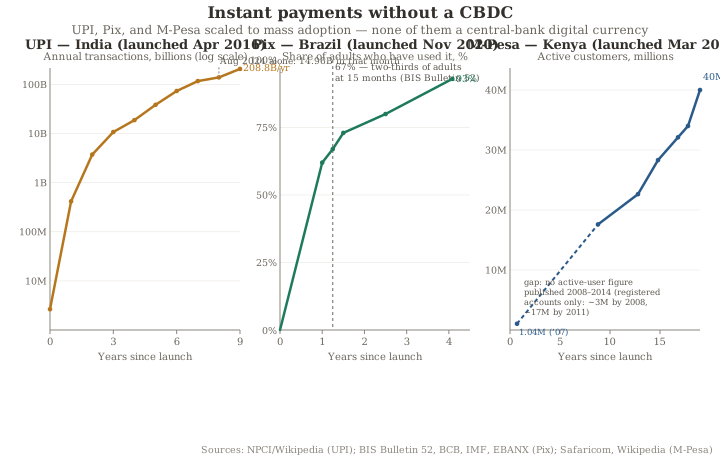
The case for a CBDC starts here: a public, universal, instant payment rail that doesn’t require a bank account or a Big-Tech wallet. The financial-inclusion prize is real, and the technology to deliver it is proven. The question is whether you need a central-bank digital currency to win it, or whether the prize is somewhere else.
To see why a state might build its own money, start with why payments concentrate. A payment network has powerful network effects: you want to be where everyone else already is, so payments tend to pile up onto a few rails, a couple of card networks, a couple of Big-Tech wallets. Left alone, the market for payments tilts toward natural monopoly. That is the condition under which economists treat a service as a candidate for public provision, the way roads or the postal system are: a universal, neutral option that doesn’t extract rents and doesn’t gate access on owning the right account. A CBDC is, on this reading, public infrastructure for the digital-payment age.
So what could a CBDC do? Three things, in ascending order of how strong the argument is.
1. Financial inclusion. A public account with no minimum balance, no bank required, reachable from a basic phone, for the roughly 1.4 billion adults worldwide without a bank account, that is a genuine welfare gain. This is the case the marketing leads with.
2. A public money option in a cashless world. As physical cash, the one form of public money the public can hold, disappears, a CBDC keeps a public alternative to private bank money and Big-Tech wallets alive. A refusal to let the public’s only sovereign money quietly vanish.
3. Monetary-sovereignty defense, the strongest professional case. This is the one the Bank for International Settlements and most central banks lead with. The domestic payment and unit-of-account layer is starting to be colonized from two directions: dollar-pegged private stablecoins, and the prospect of a foreign CBDC, an internationalized digital yuan, running inside other countries’ economies. If a small country’s citizens drift onto a private dollar token or a foreign state’s money for everyday payments, that country has quietly ceded control of its own monetary system. A public CBDC is how the state keeps a seat at its own table. The case is defensive.
The first two wins, inclusion and a cashless-age public option, are largely achievable without a CBDC. M-Pesa did inclusion with mobile-network money; India’s UPI and Brazil’s Pix did instant, near-free, universal payments with fast-payment systems sitting on top of ordinary bank accounts. So the payment-efficiency case is real but mostly solvable by cheaper means. The one argument that needs a public instrument is sovereignty, and that is why the verdict later turns on which kind of country is asking. The financialization and electronic-payment build-out that set this stage is the backdrop of Economic History Ch.18 §18.3 (Financialization).
The sovereignty argument sits next to a larger question this walkthrough doesn’t reopen: whether the state should create money in the first place, the territory of Is Modern Monetary Theory crank or serious? The cross-border contest — whether the dollar’s dominance, a foreign CBDC, or a private stablecoin ends up running on your rails — is a sibling question, taken up in Is the dollar’s reserve status sustainable? and Is dollarization good economics?; here it matters only as the threat the sovereignty case is defending against. For the deeper what-is-money grounding, see Is money real, or just a shared illusion?
“If we do not provide a public digital means of payment, others will fill the gap, foreign currencies, foreign technologies, private stablecoins. A digital euro is about preserving our monetary sovereignty in the digital age.”
— The monetary-sovereignty case, in the voice of a euro-area central banker
Does a country need its own digital money to stay sovereign?
The strongest professional argument is defense: keep a public option before private stablecoins and foreign CBDCs colonize the payment layer. How much does the defensive motive justify?
Public money, or just a faster pipe?
“The cost of doing nothing is not zero. If the public has no sovereign digital money, the default settles onto private rails, and whoever owns those rails owns a chokepoint over the economy.”
— The sovereignty-and-public-money advocate, at full strength
The advocate reframes the question from “what does a CBDC add?” to “what happens if we don’t have one?” Cash is fading; the public-money slot it occupied is being filled by private companies and, potentially, foreign states. On this framing a CBDC is the cheapest insurance against a chokepoint, you keep a neutral, public, always-available rail so that no single private or foreign actor can dictate terms. The inclusion and speed benefits are a bonus; the sovereignty insurance is the point.
“India moved a billion people onto instant digital payments without a CBDC. Brazil did it with Pix. If the goal is inclusion and speed, build a fast-payment system, it’s cheaper, faster to deploy, and doesn’t put the central bank in everyone’s wallet.”
— The fast-payment-system skeptic, at full strength
The skeptic concedes nothing on inclusion and speed. The proven way to get a billion people instant, near-free, universal payments is a fast-payment system layered on existing bank accounts. UPI, Pix, and FedNow already do most of what the CBDC marketing promises, without inserting the state into the ledger. So the skeptic narrows the live question to the one thing fast payments don’t answer, sovereignty, and asks whether that single motive is worth the surveillance and bank-run risks a retail CBDC carries.
Where this leaves us
The case for a CBDC is real, but it is narrower than the hype. Financial inclusion and instant payments are genuine goods, but M-Pesa, UPI, and Pix got them without a central-bank currency. The part that actually needs a public instrument is sovereignty: when private stablecoins and foreign digital currencies start running on your monetary rails, a public option is how the state stays in the game. The central banks lead with it, and it is defensive. Which is why the next question matters: if the upside is modest and mostly defensive, are the costs worth it?
Here is where the other half of the internet stops nodding and starts shouting. Because a public digital currency the state can see, and program, is also the most powerful surveillance and control instrument a government has ever been handed. And there is a second, quieter danger the bankers worry about more: that a perfectly safe public account could empty every private bank in a panic. Two risks, both real.
What CBDCs could break
“The digital yuan can carry an expiry date, so money must be spent by a deadline. It can be restricted to certain goods. And the issuing authority can, in principle, see every transaction and freeze any wallet. This is not a bug in the design. It is the design.”
— The surveillance critique, drawing on reporting of China’s e-CNY programmability
China’s digital yuan can be programmed: money that expires if you don’t spend it, money that can’t be spent on certain things, an account the state can freeze with a keystroke. It is a design that ships. The anti-CBDC movement looks at this and sees the architecture of control, and on the facts they are not wrong about what the technology can do. The fight is over whether it has to.
The surveillance hazard, taken seriously, then bounded. A CBDC ledger can be state-readable and programmable, and that is a civil-liberties hazard. Financial privacy is a real freedom: what you buy reveals who you are, and a money the state can read and switch off is a coercion tool. The e-CNY proves the capability ships, and “trust us” is not a privacy guarantee. But this is a design choice, not a property of the concept. Privacy-by-design is technically possible, tiered anonymity that makes small payments cash-like below a threshold, data minimization, no direct central-bank access to identities, and hard legal limits on programmability, and the European Central Bank’s digital-euro design explicitly targets cash-like privacy for low-value payments. The threat frame is right that the capability is real and a hostile state would use it; it is wrong that the outcome is inevitable, because a liberal democracy can build the privacy in. Whether it will is a political choice, which is why the concern stays serious even after the design answer.
The bank-run hazard, the mechanism the central bankers fear most. Today the banking system is two-tier: the public holds commercial-bank deposits, and banks hold reserves at the central bank. A retail CBDC inserts a new option, a direct, default-free claim on the central bank that the public can hold. In normal times that competes with bank deposits: if a perfectly safe public account is one tap away, banks have to pay more to keep your money, cheap deposit funding shrinks, and credit gets pricier. In a crisis it is far worse. The moment a bank looks shaky, depositors can flee to the perfectly safe CBDC instantly and at scale, no queue outside the branch, just a phone. Every wobble can become a system-wide run faster than any in history. This is the digital amplification of the 2008 wholesale-funding runs, where money fled a stumbling bank in days; a CBDC could compress that into minutes.
The mechanism is a balance-sheet migration. In a run, a household’s claim moves from a commercial-bank deposit liability to a central-bank liability:
$$\Delta(\text{CBDC held}) = -\,\Delta(\text{bank deposits}) \;\Rightarrow\; \text{bank reserves drain 1-for-1}$$Each unit fleeing to the CBDC pulls a matching unit of reserves out of the banking system. With no friction in the way, the speed of that migration is what turns a wobble into a collapse.
A bank run used to need a queue and a Tuesday. With a CBDC, the safest money in the country is one tap away on your phone. At the first rumor that your bank is in trouble, you, and everyone else, can move your money to the central bank in seconds. The thing that historically slowed runs down, the friction of getting your cash out, disappears. A safe public account is wonderful right up until the moment everyone wants only the safe account.
The canonical modern demonstration of how fast funding flees a wobbling bank is 2008, the spine of Economic History Ch.19 §19.1 (September 2008), and the run-acceleration logic the disintermediation worry borrows is the same one explored in Did economists cause the 2008 crisis? A CBDC doesn’t invent the bank-run risk; it removes the friction that used to slow it down.
The design space that bounds the run risk. The central-bank research literature converges on three mitigations:
- Holding limits, a cap per person, set high enough for everyday payments but far too low to drain the banking system in a panic.
- Tiered or zero remuneration, no interest above a threshold, so the CBDC works as a payment instrument without out-competing bank deposits in calm times.
- Intermediated, two-tier architecture, banks and payment providers distribute the CBDC and run the customer accounts; the central bank doesn’t hold retail accounts directly, preserving the banking system’s role.
The catch: a CBDC capped, un-remunerated, and intermediated enough to be safe for banks is also capped enough to be a modest payment instrument. You can have a CBDC that protects the banking system or one that displaces it, but the safe version is the small version. The enthusiasts’ “payment revolution” and the realistic, well-designed product are not the same thing. The institutional-design lens for trading off these constraints is Economics Ch.18 §18.5 (Property Rights and design). And the idea of a public money so safe it strips the banks of deposits has an ancestor: the “narrow banking” / Chicago-Plan tradition, Friedman’s interest in 100%-reserve money, whose lineage sits in History of Economic Thought Ch.10 §10.1 (Friedman’s monetarism), where the libertarian, anti-state-money strand the surveillance frame also draws on is situated (not endorsed).
The CBDC sits at the recent end of a long intellectual argument over who should control money; the era-cluster view of that fight is the counter-revolution cluster of the money lineage. And because a CBDC reshapes the central bank’s direct relationship to the public, it bears on what central banks are for, What do central banks actually do?
“A CBDC would give the federal government direct authority over how every American spends their money. That is a power no free government should hold over its citizens.”
— The financial-privacy critique, in the voice of an anti-CBDC campaigner
Is programmable money a surveillance trap?
The most serious objection: a money the state can read, restrict, and freeze is a control instrument no earlier monetary system offered. The e-CNY proves the capability ships. The question is whether design can defuse it, and whether anyone will bother.
Two real mechanisms, can design defuse them?
“A state-readable, programmable money is the architecture of control, and a perfectly safe public account is a permanent invitation to a bank run. The danger runs on two axes at once, and both are intrinsic to what a CBDC is.”
— The anti-CBDC case, at full strength on both axes
On privacy, the capability to surveil and program is real and, the critic argues, will be used, power does not leave tools unused. On stability, the same safety that makes a CBDC attractive makes it a run accelerant: depositors will always prefer the default-free account in a panic, and a CBDC lets them act on that preference in seconds. So the critic claims the danger is not an implementation detail but the nature of the thing: public money the state issues directly to citizens is, by construction, both watchable and run-prone.
“Both risks are real mechanisms, and both are bounded by design choices that already exist on paper. Privacy-by-design, holding limits, intermediation. The question is engineering and political will, not an inherent property of the concept.”
— The design-can-defuse-it case, at full strength
The designer concedes both mechanisms are real. The answer to surveillance is privacy-by-design: cash-like anonymity for small payments, no central-bank view of identities, programmability barred by law. The answer to the bank run is the mitigation menu: holding limits cap how much can flee, zero remuneration keeps it a payment tool rather than a deposit substitute, and intermediation keeps banks in the loop. This is the live design of the digital euro. Both risks are bounded; the prize shrinks as you bound them.
Where this leaves us
Both fears are real, and the anti-CBDC movement deserves more credit than the technocrats give it. A money the state can read and program is a coercion instrument, the e-CNY proves the capability ships, and “trust us” is not a privacy guarantee. And a perfectly safe public account could drain the banks in a panic faster than any run in history. But both risks are bounded by design choices that already exist on paper. Privacy-by-design can make small payments cash-like; holding limits and intermediation can keep the banks intact. The catch is that the design that makes a CBDC safe also makes it modest, cap it enough to protect the banks and the privacy, and you have built a useful public payment rail. So the risks aren’t disqualifying. But they do shrink the prize. Which leaves the question: is the modest, well-designed version worth building at all, and for whom?
We’ve now got the full ledger: a real but narrow upside, two real but design-bounded risks, and a design space where safety and usefulness pull against each other. The enthusiasts oversold the upside. The alarmists oversold the danger. So what’s the honest answer, and why does it depend so much on which country is asking?
The verdict: modest, context-dependent, oversold by both sides
“In the United States, the costs of a retail CBDC seem to outweigh the benefits. We already have a safe, efficient, dynamic payments system, cards, FedNow, near-universal bank access. It is hard to see what problem a digital dollar would solve that is not already being solved.”
— The “solution in search of a problem” critique, the US-skeptic reading
By 2025 the United States had banned a retail digital dollar and the European Central Bank was building one. Both are rich democracies with good payment systems. They looked at the same evidence and reached opposite conclusions, and both can defend themselves. The answer to “are CBDCs a good idea” turns on for whom, against what alternative, and built how?
When a public payment rail earns its weight. A CBDC is worth building where two conditions line up. Either the existing payment system is weak or exclusionary — a large unbanked population, no good fast-payment system — so the inclusion and efficiency gain is large; or there is a real monetary-sovereignty threat, with private stablecoins or a foreign CBDC poised to colonize the domestic payment layer, so the defensive public-option gain is real. And in either case the design has to protect privacy and bound the run risk.
When it’s a solution in search of a problem. Where private rails already work well — cards, FedNow, near-universal bank access, the United States and much of Western Europe — the marginal payment gain is small, the surveillance and run risks are non-trivial, and the only live motive is the sovereignty defense, which reasonable people weigh differently. The skeptic camp, and the US political verdict, says the sovereignty motive alone doesn’t clear the bar in such a country; the defensive camp, and the European Central Bank, says build the option before stablecoins entrench, because building after the network tips is far harder. This is the live, contested edge, and the parameter that resolves it is how fast private stablecoins and foreign CBDCs are judged to threaten the domestic payment layer.
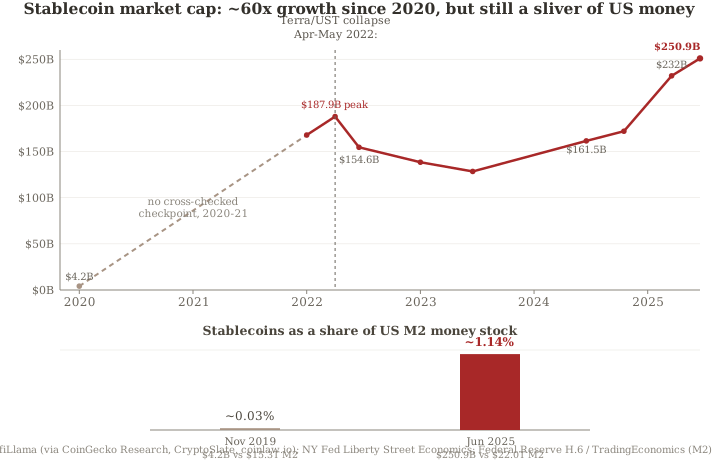
Both extremes oversell. The enthusiast’s “payment revolution / programmable-money future” oversells an upside that the safety-vs-usefulness design constraints keep modest: the version that protects the banks is the small version. The alarmist’s “surveillance tyranny / end of cash and freedom” oversells an inevitability that good design and political will can prevent: the capability is real, the dystopia is a choice. The mainstream sits between them — not out of lazy centrism, but because each extreme is wrong about a different, nameable thing. The post-2008 challenger debate this lands in, digital money, stablecoins, state-versus-private money, is mapped in History of Economic Thought Ch.17 §17.5 (the expanding frontier).
The “solution in search of a problem” assessment depends on what payment infrastructure a country already has, the electronic-payment build-out narrated in Economic History Ch.18 §18.3 and the post-crisis monetary regime in Ch.19 §19.3. A country with weak rails and a country with FedNow are not asking the same question, even when they use the same three letters.
“The U.S. already has a strong, efficient payments system. A retail CBDC would add surveillance and bank-run risk in exchange for benefits we already enjoy. For us, it is a solution in search of a problem.”
— The advanced-economy skeptic, the US reading
When good payment rails already exist, why bother?
For a country with cards, instant payments, and near-universal bank access, the skeptic says a retail CBDC is all risk and no benefit. The skeptic is right, for that country. The argument is whether “not today” survives “in five years.”
Banned in Washington, built in Frankfurt
“We already have FedNow, cards, and bank accounts that work. A retail CBDC adds surveillance and run risk without a benefit. For the United States, the right answer is no.”
— The good-rails skeptic, right for its context
The skeptic’s strength is specificity. In a country where private and public rails already deliver fast, cheap, universal payments, a retail CBDC is mostly downside, new risk for a benefit that already exists. The US case is the cleanest example: the most-used currency in the world, the deepest payment system, the least sovereignty exposure. For that country, “no” is a correct reading of the cost-benefit balance. The 2025 ban over-claims when it generalizes to a universal principle, but as a verdict about the United States it is well within reason.
“Sovereignty is an option you have to buy before you need it. Build the public rail while stablecoins are still small, because once the network tips to private or foreign money, building it back is far harder.”
— The defensive-option advocate, the European reading
The advocate’s strength is the clock. Network effects make the public-money option cheap to preserve now and expensive to recover later, so even a rich democracy with good rails has reason to build the option as insurance against a threat that is forward-looking. Neither voice is the universal answer, each is right for a different country, against a different alternative, on a different timeline. The reading is to see that they are answering correctly for their own circumstances, and that the disagreement is about a parameter: threat speed.
The verdict
So, are CBDCs a good idea? The honest answer is five claims. One: the case is real but narrow, and strongest for specific contexts, weak or fragmented payment systems and high financial exclusion, where a well-designed public rail delivers genuine gains. Two: the strongest professional argument is monetary-sovereignty defense: a public option that keeps the state in its own monetary system as cash dies and private stablecoins and foreign CBDCs rise. It is defensive. Three: the bank-disintermediation risk is real but largely addressable by design, holding limits, tiered or zero remuneration, and an intermediated architecture bound it, though they also shrink the product.
Four, and this is where the threat frame is right: the surveillance and financial-privacy concern is serious and a design constraint. A naively-designed CBDC would give the state a readable, programmable ledger of every transaction, and the e-CNY shows the capability ships. Privacy-by-design is possible — cash-like anonymity for small payments, no central-bank view of identities — but it is a political-economy choice baked into the architecture. The alarmist framing oversells the inevitability; it is right about the capability if privacy is not deliberately protected. Five: for advanced economies with good private rails, it is closer to a solution in search of a problem — small marginal gain, non-trivial risk, sovereignty the only live motive — and whether that motive alone justifies a retail CBDC is the contested edge.
The one-line verdict: CBDCs are good economics for a narrow set of circumstances — weak payment systems, high financial exclusion, or a real monetary-sovereignty threat from stablecoins or foreign CBDCs — and modest-to-unnecessary where private payment rails already work well. The disintermediation and privacy risks are real but design-addressable, with the privacy risk a serious civil-liberties constraint. Both the enthusiast framing and the alarmist framing oversell. Calibrate by country-circumstance and design choices.
To be precise about how settled each part is: that a CBDC is a modest, context-dependent, design-conditional tool is near-consensus among monetary economists; both public extremes sit outside the professional mainstream. How big the bank-run risk is after the mitigations are applied is still argued inside that frame, economists agree on the mechanism and on the menu of fixes, and disagree on how much risk is left over. And whether the sovereignty motive alone justifies a retail CBDC in a good-rails advanced economy is the closest thing to a frame-level edge, with the resolving parameter named: how fast private stablecoins and foreign CBDCs are judged to threaten the domestic payment layer. That is the mainstream’s honest answer, with the open question and the thing that would settle it stated plainly. For where this debate sits in the longer story of money and the state, see Is money real, or just a shared illusion?, What do central banks actually do?, and, for the frontier this debate is currently writing, Money, theory, and regime: from coins to CBDCs.
Where this leaves us
- The clash of framings. A CBDC is digital central-bank money, the third box next to cash and bank deposits. It is not crypto and not a stablecoin. It is a design space, and the two halves of the internet are arguing about two different versions of it.
- What it could do. Financial inclusion and instant payments are real but mostly achievable without a CBDC (M-Pesa, UPI, Pix). The one argument that needs a public instrument is monetary-sovereignty defense, and it is defensive.
- What it could break. Two real mechanisms: a state-readable, programmable ledger (the surveillance hazard) and a perfectly safe public account depositors flee to in a panic (the bank-run hazard).
- The safety-vs-usefulness tension. The design space — holding limits, tiered remuneration, intermediation, privacy-by-design — does bound both risks. But the design that makes a CBDC safe also makes it modest. You can protect the banks and privacy, or build a revolution.
- The context-dependent verdict. Good economics for weak-rails, high-exclusion, or sovereignty-threatened economies; modest-to-unnecessary where private rails already work. Both extremes oversell. Calibrate by country and design.
We started with two halves of the internet describing the same technology in opposite words: overdue modernization on one side, the architecture of surveillance on the other. Both were partly right, and both oversold. The enthusiasts oversold an upside that the design constraints keep modest, the version safe for banks and privacy is the small version. The surveillance capability is real, but the dystopia is a choice a society can refuse. The professional reality the public debate flew past is quieter than either side: a modest, context-dependent, design-conditional payment tool.
So the honest answer to “are CBDCs a good idea?” is not yes or no but for whom, against what alternative, and built how? For a country with weak payment rails, a large unbanked population, or a real sovereignty threat from stablecoins and foreign CBDCs, a well-designed public option is good economics. For a rich democracy with cards, instant payments, and a dominant currency, it is closer to a solution in search of a problem, and reasonable people disagree only about how fast the sovereignty threat is moving. The next time someone tells you a CBDC is the future of money or the end of freedom, you have the tools to ask the better question back: which CBDC, for which country, designed how?