Hayek vs. Keynes: whose framework did the 1930s vindicate?
Two of the century’s greatest economists looked at the same catastrophe and saw opposite things. One saw a failure of demand to be filled. The other saw a necessary purge to be endured. The decade picked a winner, and it isn’t the one either of them would have predicted.
Als Debattengraph anzeigenThe duel
“The book, as it stands, seems to me to be one of the most frightful muddles I have ever read, with scarcely a sound proposition in it beginning with page 45… It is an extraordinary example of how, starting with a mistake, a remorseless logician can end up in Bedlam.”
— J. M. Keynes, review of Hayek’s Prices and Production, Economica, 1931
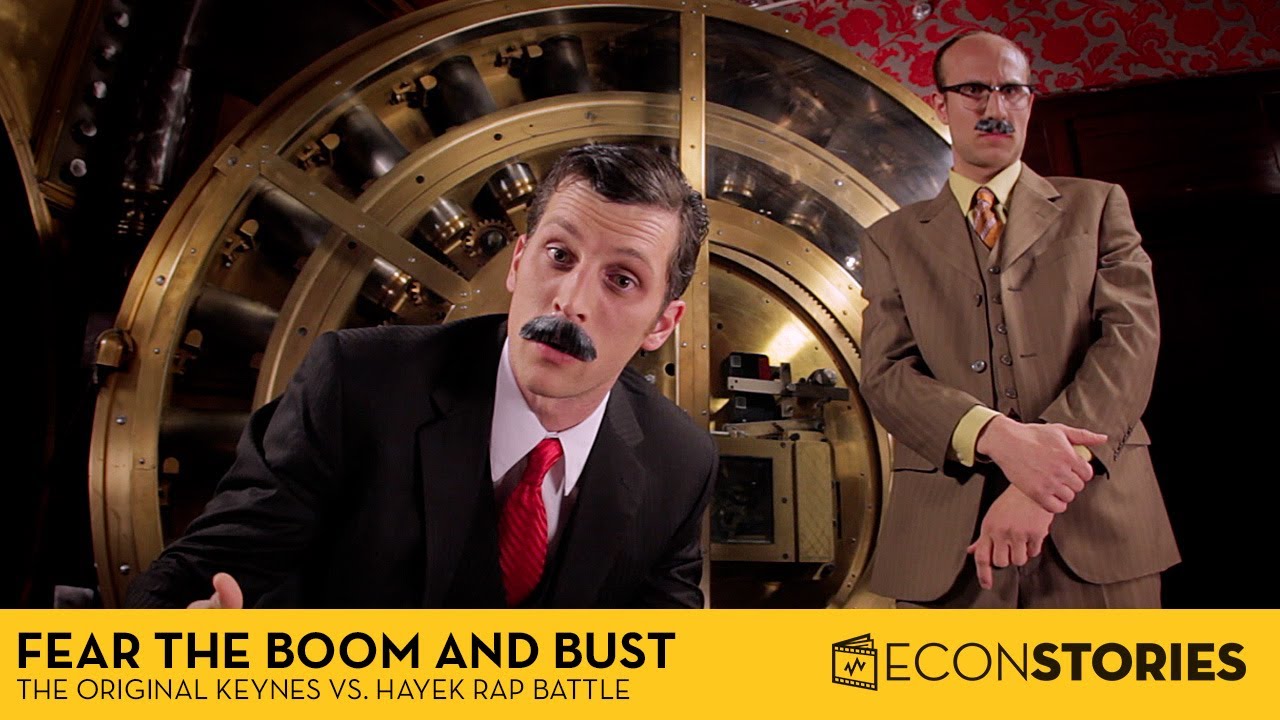
In 1931 two economists set out to demolish each other in print, and meant it. The rap video above, almost nine million views, dramatizes this fight, which survived to become a meme. What the two men were arguing about was real: what an economy is, and what a depression is. They could not agree on what they were even looking at.
Start with the thing both men had to explain, because it is the one thing they agreed on: the size of the wreck. Between 1929 and 1933 US industrial production fell by nearly half, a quarter of the labor force was out of work, and the money stock contracted by a third. Two complete theories were about to offer opposite accounts of why it happened and opposite prescriptions for what to do.
The two frameworks came with two institutions and two cities. Keynes was Cambridge, the British establishment, the insider who advised the Treasury. Hayek was Vienna by training and the London School of Economics by 1931, where Lionel Robbins had imported him specifically as a weapon against Cambridge. It was an institutional war over which framework the next generation of economists would be taught. The Keynesian lineage runs through History of Economic Thought Ch.8 (The Keynesian revolution); the Austrian lineage that carried Hayek runs through Ch.6 (The Austrian tradition). You can see the whole opposition laid out as a lineage map, the two clusters and the edge between them, in the school view of the thought graph (switch the filter to austrian to see the other pole).
“Mr. Keynes’s aggregates conceal the most fundamental mechanisms of change.”
— F. A. Hayek, reviewing Keynes’s Treatise on Money, Economica, 1931
Was this a real clash, or just two men talking past each other?
One reading says better data would have settled it. The other says the two frameworks disagreed about what an economy is at a level no data could reconcile. The line above, Hayek’s charge that Keynes’s aggregates hide the mechanism, is the whole quarrel in one sentence.
Two worldviews colliding
“The problem of how to overcome a crisis once it has occurred is, in the main, the problem of how to bring about a redistribution of resources… a problem which any artificial stimulus to demand can only postpone.”
— The Hayekian position, drawn from Prices and Production, 1931
Hayek arrives in London as the insurgent. His charge is that the boom was the disaster, that cheap credit in the 1920s had pulled the economy into the wrong shape, and that the slump is the economy painfully getting its shape back. Spending to stop the slump, on this view, is spending to preserve the distortion. Robbins gives it the LSE’s full institutional weight to break Cambridge’s grip on the question.
“Dr. Hayek has seen a vision, and tried to put it into words. But it is, I think, a frightful muddle… one of the most frightful muddles I have ever read.”
— after J. M. Keynes, on Hayek’s Prices and Production, 1931
Keynes is the establishment, and he answers contempt with contempt. But behind the barbs is a substantive charge: Hayek’s framework, for all its elegance about the structure of capital, has no answer to the central fact of 1931, that millions of willing workers and idle factories were sitting unused while Hayek counseled patience. When Piero Sraffa took up Keynes’s side in the Economic Journal in 1932, he pressed the technical knife in: Hayek’s “natural rate of interest” that the whole theory turned on did not even have a single well-defined value in an economy with many goods.
Where this leaves us
This was a genuine duel: two complete, opposite theories of the same crisis, argued in real time by two antagonists who each thought the other was confused at the root. We will hear Keynes at his strongest, then Hayek at his strongest, and only then let the empirical record of the 1930s decide. If you want the same decade cut a different way, lever by lever, asking whether the whole thing was preventable, that is the work of “Was the Great Depression preventable?”; this walkthrough holds two frameworks side by side and watches one fit the data.
Start with the framework that won. Keynes’s answer to the slump became the operating manual for two generations of policy. To see why, you have to hear it the way he meant it, before it became the tidy IS-LM diagram: a disturbing claim that the economy could sit broken, with everyone behaving rationally, indefinitely.
Keynes at full strength
“We have magneto trouble. We have involved ourselves in a colossal muddle, having blundered in the control of a delicate machine, the working of which we do not understand. The result is that our possibilities of wealth may run to waste for a time, perhaps for a long time.”
— J. M. Keynes, “The Great Slump of 1930”, 1930
Magneto trouble: the engine is sound, the fuel is in the tank, but a small failed part means nothing turns over. Keynes’s whole framework is in that metaphor. The economy still has its capacity to produce; it has lost the coordination that gets the capacity used. (“Was the Great Depression preventable?” uses this same line as one lever among several; here it carries the entire Keynesian theory against Hayek’s.)
The classical answer to a slump was that it would cure itself: wages and prices fall, that makes hiring and buying attractive again, and the economy returns to full employment. Keynes’s framework explains why this did not happen, why the economy could clear at a level below full employment and stay there. Three moves build the argument. The paradox of thrift: when everyone tries to save more at once, spending collapses, incomes fall, and the economy ends up saving no more in total but producing far less. The underemployment equilibrium: there is nothing in the machinery that forces a return to full employment, and the economy can settle with idle workers and idle plant. And the liquidity trap: at the floor, when the interest rate is already near zero, cutting it further is impossible, so the usual monetary cure runs out of road. What is left is the multiplier and direct demand support, the government spending the demand the private sector won’t.
The liquidity trap is the sharp edge of the argument. In the IS-LM picture, the LM curve goes flat once the interest rate hits its floor at $r = 0$:
$$r \geq 0 \quad\Longrightarrow\quad \text{LM horizontal at } r = 0$$Monetary expansion shifts LM rightward but cannot lower a rate already at zero, so output does not move, money policy is impotent. Fiscal policy is the opposite: shifting IS rightward along the flat LM raises output with no crowding out, because the interest rate does not rise to choke off private investment. The economy needs a real rate the nominal floor cannot deliver; only direct demand support can reach it.
Imagine everyone in a town deciding, on the same morning, to spend less and save more. Each household is being prudent. But one household’s spending is another’s income, so as everyone cuts back, everyone’s income falls, shops close, and the town ends up poorer, with no more saved than before, because there is less income to save out of. Now the bank cannot help: it has already cut interest to zero, and nobody wants to borrow at any price to expand a business with no customers. The only actor who will spend because everyone else won’t is the government.
This apparatus — the Keynesian cross, the multiplier, the liquidity trap — is the formal home of Stage 2’s argument; its full derivation, with the interactive IS-LM diagram, lives in the macro chapters. Peek the multiplier mechanics and the liquidity-trap geometry below. The lineage, the Treatise-to-General Theory arc, the Cambridge Circus that hammered the book into shape, and Hicks’s IS-LM rendering that carried it into the postwar mainstream, is History of Economic Thought Ch.8 §8.2 (what Keynes actually argued).
“The economic system may find itself in stable equilibrium… at a level below full employment.”
— J. M. Keynes, The General Theory of Employment, Interest and Money, 1936
Could the economy really stay broken on its own?
The strong Keynesian claim is not that recessions happen. It is that a market economy can settle into mass unemployment as a stable resting point — everyone behaving rationally, nothing self-correcting it — and that monetary policy alone cannot lift it out.
The framework, and the experiment it later passed
“We are now, I believe, in the midst of the worst slump the world has ever seen… If our poverty were due to… acts of God, then indeed it might be hard to find the remedy. But it is not of this character.”
— after J. M. Keynes, “The Great Slump of 1930” and “The Means to Prosperity,” 1930–33
The depression is a coordination failure to be fixed. The capacity is there; the demand is missing; the missing demand can be supplied. Hicks would later compress the whole apparatus into the IS-LM diagram, and in doing so make it teachable, exportable, and, Keynes’s defenders would say, partly drained of the radicalism that made it true. But the policy lesson survived the compression: in a deep slump at the floor, fiscal expansion is the lever that moves output.
“If you want to know what to do in a liquidity trap, ask what Japan did, then ask what would have happened if it hadn’t. The case for fiscal action when the central bank is out of room is not a 1930s curiosity. It is the live macroeconomics of our own crisis.”
— after Paul Krugman, on the 2008–09 crisis, when a Depression historian ran the Fed and still needed Congress to spend
The 2008 crisis was the closest thing to a rerun of 1931 the modern world has produced: rates at zero, a paralyzed banking system, a demand shortfall the central bank could not close alone. Ben Bernanke, who built his career studying the Depression, ran the Fed, did everything monetary policy could, and it was not enough without fiscal support. The depth of the modern fiscal-multiplier debate — how big the multiplier is, when crowding out bites — belongs to “Does government spending help the economy?”; here it is enough that the 1930s framework predicted the 2008 result.
Where this leaves us
The Keynesian diagnosis is coherent, powerful, and, on the evidence of 2008, predictive. It explains the persistence that classical theory could not, and it tells you what to do when the monetary cure runs out. Whether the deficient-demand account is the right account, or only a coherent one, is exactly what Hayek disputes. The narrower question of whether unemployment is best read through a labor-market lens or a monetary-demand lens is its own reframe, walked in “Unemployment: a labor problem or a money problem?”.
There was a man at the LSE who thought this entire diagnosis had the disease and the cure exactly backwards. To him the slump was the solution, and everything Keynes proposed would make the real problem worse.
Hayek at full strength
“To combat the depression by a forced credit expansion is to attempt to cure the evil by the very means which brought it about… because we are suffering from a misdirection of production, we want to create further misdirection.”
— F. A. Hayek, Monetary Theory and the Trade Cycle, 1933 (English ed.)
“Liquidate labor, liquidate stocks, liquidate the farmers, liquidate real estate… It will purge the rottenness out of the system.”
— attributed to Treasury Secretary Andrew Mellon, in Herbert Hoover’s memoirs
Mellon’s “liquidate” line is the blunt public face of the prescription, cruel, and easy to mock. Hayek’s position was far more sophisticated than Mellon’s slogan: a theory that the suffering was a symptom of a deeper misallocation, and that stopping it would preserve the misallocation.
Hayek’s framework, Austrian Business Cycle Theory, inverts Keynes’s causal arrow. The disaster is the boom that preceded the bust. The mechanism runs through the interest rate. When the central bank holds the market rate below the “natural rate” that genuine saving would set — the Wicksellian gap, $r < r^{*}$ — credit is artificially cheap. Cheap credit pulls investment toward long-duration, capital-intensive projects that only look profitable at the fake rate. The time-structure of production distorts: the economy builds the wrong things, in the wrong proportions, for the wrong horizon. When credit eventually tightens, those malinvestments are exposed as unviable and must be liquidated. That liquidation is the recession.
The engine is the Wicksellian gap between the market rate and the natural rate:
$$r_{\text{market}} < r^{*} \quad\Longrightarrow\quad \text{credit-funded lengthening of the capital structure}$$where $r^{*}$ is the rate that would equate genuine (voluntary) saving with investment. Holding $r_{\text{market}}$ below $r^{*}$ funds investment not backed by real saving; the capital structure lengthens beyond what the time-preferences of savers can sustain. When the gap closes, the long-horizon projects are revealed as unviable and must be abandoned. Forcing the rate back down to arrest the liquidation re-opens the gap and re-funds the very malinvestment that is trying to clear.
Suppose the bank offers thirty-year loans at an absurdly low rate that does not reflect how much anyone has actually saved. Builders respond by starting enormous, slow projects — skyscrapers, factories, whole new industries — that only pencil out at that fake rate. For a while it looks like a boom: cranes everywhere, everyone employed. But the saving to finish and use all that capital was never really there. When the rate finally rises to honest levels, half the projects can’t be completed or filled, and they have to be written off. The crash is the bill for the boom coming due, and, Hayek says, propping things up just runs up a bigger bill.
This stage states Hayek’s 1930s diagnosis. The full Austrian apparatus and the broader scorecard on the school are the work of “Were the Austrians right?” The interest-and-money machinery the natural-rate argument leans on is in Economics Ch.16 §16.1 (why people hold money, and what sets the interest rate); the intellectual lineage — Menger to Böhm-Bawerk’s capital theory to Mises’s 1912 monetary theory to Hayek’s 1931 statement, with Robbins as the LSE conduit — is History of Economic Thought Ch.6 §6.4 (Hayek and the knowledge problem).
“The curious task of economics is to demonstrate to men how little they really know about what they imagine they can design.”
— F. A. Hayek, The Fatal Conceit: The Errors of Socialism, 1988
What if the cure really is the disease?
The strong Hayekian claim has two halves, and both deserve a serious hearing: that intervention prolongs the misallocation it is meant to relieve, and that the planner cannot even know what to stimulate. Hear both before the record breaks them.
The two halves of Hayek’s case
“It is a fact that the existing maladjustments… cannot be cured by creating a new disequilibrium. We must not forget that, for the last six or eight years, monetary policy all over the world has followed the advice of the stabilizers.”
— after F. A. Hayek, the ABCT case against demand stimulus
ABCT is a coherent rival theory. It has something Keynes’s framework lacks: an answer to why this particular bubble formed at this particular time. Where the demand framework shrugs and says “animal spirits,” ABCT points at the 1920s credit expansion — the Fed’s easy money, partly run to help Britain hold the pound at an overvalued parity — and says the boom was systematically engineered by cheap credit, the 1929 crash was the recognition that the engineering was unsound, and the bust was the unavoidable correction. Whatever else is wrong with it, the framework takes the boom seriously as the cause, which the demand framework tends to treat as a mere prelude.
“The mere existence of an excess capacity… can never explain why the depression should be so deep and so prolonged.”
, the objection ABCT struggles to answer, that Hayek himself eventually granted
The knowledge-problem half is the part of Hayek that outlived the prescription. Even grant that the boom misallocated capital. The planner who proposes to fix it still has to know which industries are malinvested, how much demand to inject, and where the distortions sit, and that knowledge is dispersed across the very price system the crisis is resetting. Hayek’s charge is that confident demand-management substitutes a planner’s guess for that distributed knowledge, and that the substitution fails not because planners are wicked but because no one can hold that much information. This critique of fine-tuning is powerful and durable. The 1974 Nobel Lecture, “The Pretence of Knowledge,” is its sharpest statement, and its target is fine-tuning precision. Whether crisis-time stabilization is also wrong is a separate question, and Stage 4 turns on it. The fuller account of where the knowledge-problem critique landed is in “Were the Austrians right?”
Where this leaves us
Hayek’s framework is a genuine rival. It diagnoses the boom in a way Keynes’s framework does not, and its critique of fine-tuning is real and has aged well. The liquidationist logic has real pull by now. Maybe the slump is doing necessary work, and maybe the planners do know less than they claim. The framework has earned a serious causal account of the boom and a durable critique of overconfident management. It has not yet been tested on its central prescription, that the bust should be allowed to run. That prescription is a prediction about what happens in economies that let the slump liquidate versus economies that fight it. The 1930s ran exactly that experiment, in real countries, and Stage 4 reads the result.
Two complete theories. Two opposite prescriptions. The 1930s ran the experiment in the actual economies that took each path. The data are not kind to one of them.
The verdict the decade rendered
“The stock of money… fell by over a third… The contraction is in fact a tragic testimonial to the importance of monetary forces.”
— Milton Friedman & Anna Schwartz, A Monetary History of the United States, 1963
“Countries that left the gold standard recovered from the Depression more quickly than countries that remained on gold.”
— after Barry Eichengreen, Golden Fetters, 1992
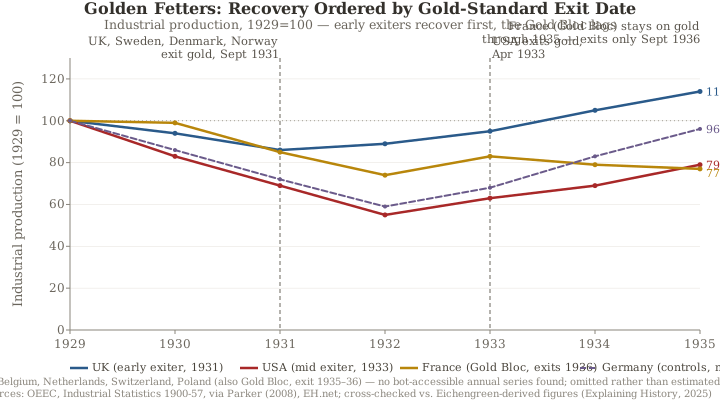
Two of the most influential findings in twentieth-century macroeconomics, and they disagree about the lever. Friedman and Schwartz blame the Fed for letting the money stock collapse; Eichengreen blames the gold standard for forcing deflation. Both accounts are demand-side. Both say the disaster was a collapse of demand that policy could and should have offset, and both count against Hayek. (The panic-by-panic chronology and the gold-exit regression are narrated in “Was the Great Depression preventable?”; here they are the adjudicating evidence base.)
The verdict turns on a single policy question that the two frameworks answer in opposite directions: when the slump comes, does the state support demand and act as lender of last resort, or does it stand back and let the malinvestment liquidate? Keynes says support; Hayek says stand back. The 1930s ran it as a natural experiment, because different countries made different choices, and we can read off who recovered. Two demand-side mechanisms (Friedman-Schwartz monetary contraction, Eichengreen gold-standard deflation) and the cross-country recovery record are the adjudicating data. Peek the gold-exit record and the fiscal-multiplier evidence below.
Where liquidation was allowed to run its course, it did not heal the economy. It deepened the Depression.
— the cleanest one-line reading of the 1930s cross-country record
Keynes won the 1930s, so what survived of Hayek?
The verdict has layers. Keynes won the policy and most of the empirics. Hayek’s prescription lost on the record. But two parts of his framework outlived the loss, and pretending otherwise is its own kind of dishonesty.
The record, and what outlived the loss
“The gold standard was the proximate cause of the worldwide deflation… The countries that abandoned it earliest recovered earliest.”
— after Barry Eichengreen & Peter Temin, the gold-standard mechanism
The adjudication is decisive on the prescription. The two frameworks made opposite predictions about economies that let the slump run. Hayek’s framework predicted that liquidation would clear the malinvestment and restore health. Keynes’s predicted that letting demand collapse would deepen and prolong the slump. The record sided with Keynes without much ambiguity: leaving gold — which freed countries to reflate, to support demand rather than defend deflation — tracks recovery across the whole interwar sample, and the Gold Bloc’s long bleed is the control group. Both of the canonical mainstream mechanisms, monetary contraction and golden fetters, are demand-side, and both count for Keynes. The gold-exit record is in Economic History Ch.12 §12.6; the early-exiter-versus-Gold-Bloc divergence shows in the 1914–1945 frame of the GDP map for France, Germany, Britain, and the US. Open it below.
“Financial booms… can endogenously generate financial busts. The credit cycle is real, it is long, and it leaves real economic damage.”
— after Claudio Borio, Bank for International Settlements, the financial-cycle literature
The knowledge-problem critique of fine-tuning, that planners cannot read the economy precisely enough to dial it, survived the loss and was revived by 2008, when the confident pre-crisis consensus shattered. The malinvestment kernel survived too: Borio and the BIS, Schularick and Taylor, Mian and Sufi have built a serious empirical literature showing that credit-fueled booms reliably precede severe recessions. That is Hayek’s diagnosis of the boom, vindicated in modern data. What that literature did with the insight is the decisive detail: it absorbed the boom-causation story and rejected the let-it-liquidate cure, prescribing macroprudential regulation and, in the bust, demand support. Hayek is the rival who lost the policy argument and won two lasting arguments inside it. The full account of how the Austrian tradition persisted — the 1974 Nobel, the post-2008 partial hearing — is in History of Economic Thought Ch.10 §10.4, and the broad Austrian scorecard is “Were the Austrians right?”
Where this leaves us
The 1930s adjudicated the duel, and the verdict has three layers. First: Keynes won the policy argument and the bulk of the empirical argument. The demand-deficiency account fit the decade; both canonical mainstream mechanisms are demand-side; recovery tracked leaving gold and supporting demand. Second: Hayek’s strong no-intervention prescription is empirically discredited by the 1930s record itself. Where liquidation was allowed to run, it deepened the Depression; “the cure is the disease” was tested, and the disease without the cure was worse. Third: Hayek’s knowledge-problem critique of fine-tuning survives as a permanent caution that aged better than the confidence it attacked, and his malinvestment kernel survives as a minor cyclical mechanism, absorbed after 2008 without the prescription. Keynes won the 1930s, and a generation later the 1970s came for the framework that won here, the next round of this same duel, with Keynes’s framework now the establishment and the monetarists on the attack.
The verdict
We started with two economists who could not agree on what they were looking at, and a rap video that proves the fight is still alive. We heard Keynes at full strength, the economy as a stalled machine that can sit broken indefinitely, lifted only by demand the private sector won’t supply. We heard Hayek at full strength, the slump as a misbuilt structure correcting itself, and intervention as the act that preserves the distortion. Then the decade arbitrated what the rivalry could not. The empirical record of the 1930s fit the demand-deficiency account: both mainstream mechanisms are demand-side, recovery tracked leaving gold and supporting demand, and where liquidation was allowed to run it deepened the slump. Hayek’s prescription failed the test the decade set for it. But his knowledge-problem critique of confident fine-tuning, and his diagnosis of the credit-fueled boom, outlived the loss and are now mainstream, absorbed, in the case of the credit cycle, without the cure he attached to it.
A framework duel teaches what no single framework can: which parts of the loser survived the loss, and why. This was the first round of a sequence. When the framework that won here had become the establishment, a new set of challengers came for it on a new decade’s evidence.