Does democracy cause growth?
The fastest growth in human history happened under one-party rule. So does democracy actually help an economy grow, or is it a luxury rich countries can afford?
The China counterexample
“With few exceptions, democracy has not brought good government to new developing countries… What a country needs to develop is discipline more than democracy. The exuberance of democracy leads to undisciplined and disorderly conditions which are inimical to development.”
— Lee Kuan Yew, founding prime minister of Singapore, from separate 1992 speeches in Tokyo and Manila
In 1980 China was poorer than Malawi. Forty years later it is a middle-income superpower that lifted 800 million people out of poverty, under one-party rule, with no opposition, no free press, no elections. Meanwhile India, the world’s largest democracy, grew respectably but never matched it. So here is the heretical question polite company avoids: does democracy help an economy grow, or is it, as Lee Kuan Yew insisted, an obstacle to the hard choices development demands?
Before you can decide whether the China case kills the democracy-and-growth consensus, notice what it is a case of. China grew by building a set of institutions: enforceable property rights for entrepreneurs in the special economic zones, reliable contract enforcement for foreign investors, the household-responsibility system that gave farmers a residual claim on what they produced. The growth-relevant question is which institutional goods got supplied, and by what.
That reframing comes from institutional economics. The Acemoglu-Johnson-Robinson tradition argues that what drives investment and growth is secure property rights and constraints that stop whoever holds power from expropriating the gains, the difference between inclusive institutions (broad access, secure rights) and extractive ones (rents captured by an elite). China is interesting because a one-party state supplied some of the inclusive-institution menu, credible commitment not to seize the returns of the entrepreneurs it had just legalized, without supplying the democratic form. The counterexample is institutional reform under authoritarian rule.
There is a second deflation. A poor country growing fast is partly just catch-up: when you start far below the technological frontier, you can grow by adopting what the rich world already invented, and the convergence literature predicts the rocket-like rates a starting-from-Malawi economy can post. Some of China’s miracle is the catch-up any low-base economy with minimally functional institutions could capture, which conditions how much credit the regime type can claim. The reform sequence that turned the potential into realized growth is the historical spine of History Ch.17 §17.1–17.2 (Deng’s opening; the SEZ takeoff); the China-path-versus-Soviet-path comparison belongs to a companion walkthrough.
“Is democracy a luxury that growth buys?”
The China model says a capable, unelected state can deliver growth faster than any democracy, and that elections, at the development stage, are a luxury or even an obstacle. It is the most uncomfortable case the democracy-and-growth consensus has to answer.
The model and what it conflates
“Political leaders in China are chosen on the basis of merit and experience accumulated over decades, not on the basis of who can raise the most money or perform best in front of the cameras.”
— after Daniel A. Bell, The China Model: Political Meritocracy and the Limits of Democracy, 2015
Bell makes the strongest version of the meritocratic-governance case, and it deserves to be met head-on. His claim is that selection by demonstrated competence over decades can out-perform selection by election for the specific task of running a developing economy. The long-horizon freedom is the sharp edge: a leadership that need not win the next vote can absorb short-term pain — closing loss-making firms, building infrastructure a generation ahead of demand — that an electoral cycle punishes. For three decades the East Asian record made this look like an empirical regularity.
“The replicable part of the China model is the institutional content — secure property rights, contract enforcement, export discipline, human capital — not the political form that happened to deliver it.”
— the institutionalist reading (see “Why are some countries rich and others poor?”, Stage 3)
The counter grants the meritocratic machinery and denies that the machinery is what the growth attaches to. The provinces Bell points to grew because Deng legalized private return and credibly promised not to seize it, an institutional move, available in principle to a democracy too. And the selection argument has survivorship bias baked in: the same unchecked-executive design that lets a Deng commit to the long run lets a Mao commit to the Great Leap, and the historical record holds far more of the latter. The Deng-era reform sequence that did the work is documented in History Ch.17 §17.2 (TVEs, SEZs, and the first industrial takeoff).
Where this leaves us
The China counterexample is genuine, and any honest answer has to carry it. But it does one thing the slogan misses: it dissolves the binary. The useful question is what democracy does that bears on growth, and how reliably each regime type supplies it. A single spectacular case can tell you the effect is not infinite. It cannot tell you the effect is zero. For that you need data on many countries over many years, which is what economists could not get to cooperate for thirty years.
China is one case, however vivid, and one case can’t settle a causal question. For three decades economists couldn’t find a clean democracy-growth effect in the cross-country data; the relationship looked weak, or nonexistent, or backwards. Then, in 2019, four economists claimed they had finally isolated it.
The case that democracy causes growth
“No famine has ever taken place in the history of the world in a functioning democracy.”
— Amartya Sen, Development as Freedom, 1999
Sen’s claim is a falsifiable empirical regularity, and it has held. Famines kill in autocracies — British India, Mao’s China, Stalin’s Ukraine, today’s North Korea — and they stop killing the moment a free press can report them and a removable government has to answer for them. That points at a channel through which the political form bears on the economy. The question is whether that channel, and others like it, add up to a real, measurable, causal effect of democracy on growth.
If democracy raises growth, it has to do so through identifiable channels, otherwise “democracy causes growth” is just a correlation wearing a verb. The modern affirmative case names four.
(1) Institutions. Democracies tend to produce executive constraints, rule of law, and secure property rights, the AJR inclusive-institution package that the growth literature treats as the deep determinant of investment. (2) Human capital. Governments accountable to a broad electorate invest more in mass schooling and public health than narrow elites do, and human capital compounds into growth. (3) Accountability. A free press surfaces bad news and a removable government has to act on it, the error-correction that keeps a policy mistake from running for a decade. (4) Reduced catastrophic-policy risk. The same accountability truncates the worst outcomes; this is Sen’s no-famine claim, and it is the sharpest of the four because it is about avoiding disaster.
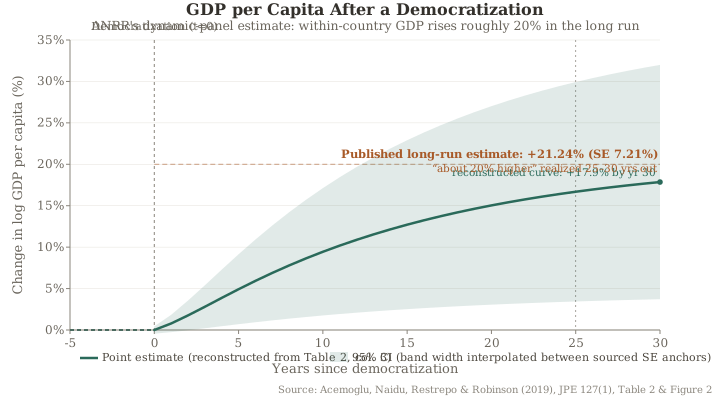
For thirty years the data wouldn’t confirm any of this, because of a single problem: rich countries become democratic (Lipset’s modernization thesis), so a positive democracy-growth correlation could just be growth causing democracy. In “Democracy Does Cause Growth” (Journal of Political Economy, 2019), Acemoglu, Naidu, Restrepo and Robinson attacked that confound. Their method: use within-country changes, a country’s own GDP path before and after it democratizes, rather than cross-country comparisons, and instrument each country’s democratization with democratization waves in its region to break the reverse-causation loop. The headline result is a roughly 20% higher GDP per capita in the long run for a country that democratizes.
Schematically, the estimating equation regresses the level of log GDP per capita on lagged democracy and its own lags, with country and year fixed effects:
$$\ln y_{ct} = \beta\, D_{ct} + \sum_{j=1}^{p}\gamma_j \ln y_{c,t-j} + \alpha_c + \delta_t + \varepsilon_{ct}$$Here $D_{ct}$ is the democracy indicator, $\alpha_c$ and $\delta_t$ absorb fixed country and year effects (so the effect is identified off within-country change), and the regional-democratization-wave instrument supplies variation in $D_{ct}$ that is plausibly unrelated to a country’s own growth shock. The long-run effect compounds $\beta$ through the persistence terms $\gamma_j$ to the ~20% figure.
Don’t compare democratic Denmark to autocratic Chad, they differ in a thousand ways besides regime type. Watch a single country cross from autocracy to democracy and trace what happens to its own growth afterward, and to rule out the “they only democratized because they were already getting rich” objection, lean on the way countries tend to democratize in regional waves a given economy didn’t cause. What’s left, ANRR argue, is the effect of the regime change: about a fifth more income per person, two decades out.
The institutions channel is the AJR extractive-vs-inclusive framework; its formal home is Ch 18 §18.3 (Institutions and Development: the AJR Framework), and the lineage from Veblen through North to Acemoglu sits in History of Economic Thought Ch.15 §15.4 (New Institutional Economics). Sen’s accountability-and-capabilities argument is its own development-thought current, History of Economic Thought Ch.16 §16.5 (Development as Freedom: Sen and the capabilities turn).
Does accountability prevent catastrophe?
Sen’s no-famine claim names democracy’s sharpest growth-relevant advantage: it truncates the worst outcomes. A free press and a removable government force error-correction that an unaccountable one can defer for a decade.
A measured effect vs. a contaminated correlation
“Democratizations increase GDP per capita by about 20% in the long run… democracy increases future GDP by encouraging investment, increasing schooling, inducing economic reforms, improving public good provision, and reducing social unrest.”
— Daron Acemoglu, Suresh Naidu, Pascual Restrepo & James A. Robinson, Journal of Political Economy, 2019
This is the result that shifted the modern consensus. ANRR’s contribution was an identification strategy that survived the endogeneity objection which had made every prior assertion suspect. By tracking countries across their own transitions and instrumenting with regional waves, they could argue the 20% is the effect of the regime change itself. And they name the channels — investment, schooling, reform, public goods, less unrest — so the effect is the institutions-and-accountability story given a number.
“The level of income has a strong positive effect on the survival of democracies… The observed correlation between democracy and development may be due to the fact that democracies are more likely to survive in developed countries, not that development is caused by democracy.”
— after Adam Przeworski & Fernando Limongi, Journal of Economic Perspectives, 1993
Przeworski and Limongi state the objection in its strongest form, and it held the field for a generation: the cross-country correlation between democracy and prosperity is real but its direction is unidentified, because income makes democracies survive (Lipset’s modernization), so the arrow may run growth→democracy. Until someone broke that confound, “democracy causes growth” was an article of faith. This is the live problem ANRR claim to have solved, and whether they actually did is the question Stage 3 takes up.
Where this leaves us
There is now a serious, modern, causally-framed case that democracy raises growth, through institutions, human capital, and above all the accountability that prevents catastrophe. The Sen channel is nearly clean; the ANRR estimate puts a credible number on the mean. But the edifice rests on one methodological bet: that within-country variation, instrumented by regional waves, isolates the real effect that cross-country comparisons could not. If that bet is right, the modern mainstream is right to have shifted toward “yes.” If it isn’t, we are back to a contaminated correlation. So the affirmative case can’t be banked yet, it has to survive its hardest test.
ANRR’s claim rests on a methodological bet: that within-country change isolates the effect. Critics had two replies. One was about the statistics: does the instrument really hold? The other was about a list of countries that grew like rockets while crushing dissent.
Identification and the counterexamples
“More political rights do not have an effect on growth… The first lesson is that democracy is not the key to economic growth.”
— Robert J. Barro, Determinants of Economic Growth, 1996/1997
This is the objection ANRR was built to overturn, and it stood for thirty years. Barro’s cross-country regressions found the democracy-growth relationship weak and nonlinear, an inverted-U at best, with the fastest growers often sitting at intermediate levels of political freedom. Behind the regression sat a list of names: Korea, Taiwan, Singapore, China, economies that grew faster than almost any democracy while tolerating no dissent. A clean affirmative case has to get past both the statistics and the list.
Two objections. The first is about identification. Barro’s cross-sectional inverted-U and ANRR’s within-country positive can both be true of different variation: compare countries to each other and you pick up all the ways rich democracies differ from poor autocracies; watch a country cross its own transition and you net those out. The question is which variation answers the causal question, and whether ANRR’s regional-wave instrument satisfies its exclusion restriction (does a democratization wave in your neighborhood affect your growth only through your own democratization, and not directly through trade, contagion, or a common regional shock?). That is a real, contestable assumption, and the effect-size estimate is hostage to it.
The second objection is the East Asian list. Korea under Park, Taiwan under the KMT, Singapore under Lee, China under Deng, these are genuine cases where high state capacity, secure property rights for investors, export discipline, and heavy human-capital investment were supplied without democracy, and the growth followed. They are real exceptions a verdict has to hold. The developmental-state institutional setup is documented in History Ch.14 §14.3 (The East Asian developmental state) and the Tigers’ export model in History Ch.17 §17.4; the developmental-state template comparison (Japan vs. Korea) and the industrial-policy question are companion walkthroughs’ territory.
Then comes variance. Autocracies do not, on average, grow slower than democracies. They grow more variably. The same unconstrained executive that lets Deng commit to a reform that pays off in twenty years lets Mao commit to the Great Leap Forward, which killed 30 to 45 million people, both under the identical one-party system, a generation apart. Democracies, hemmed in by accountability, produce fewer miracles and far fewer catastrophes; autocracies produce both tails. So the expected-value case for democracy is mostly about truncating the left tail, which is why Sen’s no-famine channel is the affirmative case’s sharpest, and why the headline effect is real but modest. The institutions-versus-regime-type distinction this rests on is Ch 18 §18.4 (Extractive vs. Inclusive Institutions).
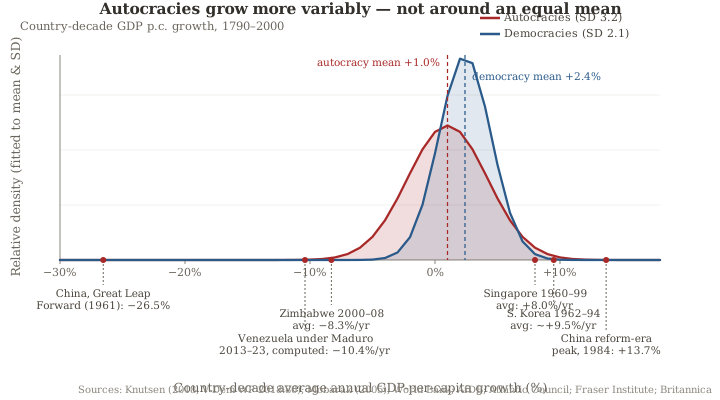
The variance point is sharp even when the means are equal. Let $g_D$ and $g_A$ be growth under democracy and autocracy. The empirical regularity is roughly $\mathbb{E}[g_D] \approx \mathbb{E}[g_A]$ but $\mathrm{Var}(g_A) \gg \mathrm{Var}(g_D)$. A risk-averse society maximizing $\mathbb{E}[\ln(\text{income})]$, which penalizes the catastrophic left tail heavily, prefers $g_D$ even at equal mean, because
$$\mathbb{E}[\ln(1+g)] \approx \mathbb{E}[g] - \tfrac{1}{2}\mathrm{Var}(g).$$The higher-variance regime is penalized by the second term. Democracy’s edge is the variance reduction.
Autocracies don’t grow slower, they grow wider. You get more Dengs and more Maos. If you care about avoiding disaster as much as about hitting the jackpot — and most societies do, because one famine erases a generation of gains — you prefer the regime that gives up a few miracles to avoid the catastrophes. That is democracy’s real growth advantage: it almost never blows up.
“Democracy is not the key to economic growth.”
— Robert J. Barro, Determinants of Economic Growth, 1996/1997
Do autocracies have more Maos and more Dengs?
The deepest objection is that regime type predicts the variance of growth more than the mean. Autocracies produce both tails. That reframes democracy’s advantage as catastrophe-avoidance.
The right objection vs. the credible answer
“Growth and democracy are analyzed for a panel of about 100 countries from 1960 to 1990… The favorable effects on growth include maintenance of the rule of law, free markets, small government consumption, and high human capital. Once these kinds of variables… are held constant, the overall effect of democracy on growth is weakly negative.”
— Robert J. Barro, Journal of Economic Growth, 1996
Barro’s framing is the skeptic’s strongest. It concedes that rule of law, secure markets, and human capital drive growth. It denies that democracy adds anything on top of those, once you hold institutional quality fixed, the regime label washes out. Read generously, this is the claim that institutions are the causal variable. That claim is half-right, and the half it gets right is what the verdict is built around, which is why the affirmative side has to answer it on its own terms.
“A potential concern is that democratizations are not random… We exploit the tendency for democratizations to come in regional waves to construct an instrument, and our estimates of the effect of democracy on growth are robust and if anything larger.”
— after Acemoglu, Naidu, Restrepo & Robinson, Journal of Political Economy, 2019
ANRR’s reply meets Barro on method. Where Barro held institutional quality fixed and found nothing left for democracy, ANRR point out that democracy is partly how a country acquires institutional quality, conditioning on it can absorb the channel through which the effect runs. Their within-country, instrumented design tries to capture democracy’s total effect, channels included, and recovers a positive number. The bottom line is a calibrated split: the within-country design is the more credible identification, so the mainstream is right to read the effect as real and positive, but the magnitude rides on an instrument the skeptics can contest, so the effect size stays live.
Where this leaves us
The endogeneity objection was the right one to raise, and ANRR’s within-country design is the most credible answer to it, which is why the modern mainstream reads the effect as real and positive. But three things survive the answer: the effect is modest; the East Asian developmental states are real exceptions that a verdict must hold; and the variance finding relocates democracy’s clearest edge from raising the mean to truncating the catastrophic tail. What remains is to say honestly what they add up to, and what it is, underneath the regime label, that does the causal work.
So: a real but modest effect, a credible-if-contested identification, a set of genuine authoritarian exceptions, and a variance story that reframes the advantage as catastrophe-avoidance. What is the synthesis, and what is the variable that does the work?
The verdict: institutional quality over regime type
The question that opened like a binary, democracy or authoritarianism?, doesn’t resolve into one side winning. It resolves into a different variable. After the counterexample, the affirmative case, and the identification debate, the answer is that what drives investment, innovation, and growth is institutional quality — rule of law, secure property rights, state capacity, constraints on the executive — and democracy’s effect runs substantially through how reliably it supplies those goods, plus the accountability that keeps the worst outcomes off the table.
Dissolving the binary is the move. Regime type is a noisier predictor than institutional quality because the mapping from form to content is loose at both ends: democracy usually but not always produces executive constraints and rule of law, and some autocracies, the East Asian developmental states, can supply the institutional goods too, for a period. So “institutional quality” screens off most of what “democracy” was picking up, which is Barro’s half-right point. What it does not screen off is the accountability channel, the error-correction that truncates the catastrophic left tail, which democracy supplies more reliably than any autocracy, and which is why the ANRR effect is real and positive.
This verdict is a special case of a deeper finding about state capacity: the form of a state determines whether its capacity enables broad-based growth or extracts from it, the North-to-Acemoglu institutionalist line that lands on inclusive-versus-extractive as the real fork. The cross-era version of that finding — how state economic capacity forms, and what makes it enable rather than extract — is the walkthrough on state formation; the fork taken up here is democracy versus autocracy. The lineage runs through History of Economic Thought Ch.15 §15.4 (North and the New Institutional Economics), and the apparatus is Ch 18 §18.4 (Extractive vs. Inclusive Institutions).
Regime type or institutional quality?
One residual frame-level disagreement remains.
The “regime type is the variable” reading says: democracy is causally load-bearing in its own right, the ANRR effect is the proof, and to call it “just institutions” is to launder away a real, measured, regime-level result. There is something to this: ANRR find the effect even controlling for a good deal, partly because democracy is how the institutions get built.
The “institutional quality is the variable” reading wins on reliability. Regime type predicts institutional quality only loosely — democracies sometimes fail to supply it, autocracies sometimes do — so institutional quality is the more direct and more reliable cause, and democracy’s effect operates substantially through it plus the accountability channel that no autocracy matches. That is a frame-level commitment: regime type matters, but it is the institutional content and the error-correction that carry the growth.
The verdict
Democracy helps growth modestly, mostly via the institutions and accountability it tends to produce, but it is institutional quality, not the regime label, that does the causal work. The best modern evidence supports a real, positive democracy→growth effect on the order of 20% higher GDP per capita in the long run, operating through institutions, human capital, and accountability. But the effect is modest; the East Asian developmental-state autocracies are real high-growth exceptions a verdict must hold; and democracy’s sharpest growth-relevant edge is catastrophe-avoidance, truncating the left tail of policy disaster. Autocracies have higher growth variance: more Dengs and more Maos.
Stated as the three layers an honest split requires: at the frame level, the commitment is that institutional quality is the more direct and reliable variable, and democracy’s effect runs substantially through it plus accountability, not “regime type is irrelevant,” and not “democracy is the master key.” At the method level, the load-bearing live dispute is identification: the within-country dynamic-panel design (ANRR) is the more credible answer to the endogeneity objection than the cross-sectional work (Barro), which is why the mainstream shifted toward “real and positive”, while the instrument’s validity stays contestable. At the parameter-magnitude level, the size of the effect (~20% versus smaller revisionist estimates), the share of the East Asian miracle attributable to authoritarian coordination rather than catch-up and liberalization, and how reliably autocracies can supply institutional quality all remain open; the verdict adopts modal current estimates without claiming to settle them.
This is the answer to whether democracy causes growth, the size and channels of the coefficient. It is not the answer to whether autocracies hold a distinct long-horizon planning advantage (a different question, with its own paired-converse walkthrough), nor to whether democracy is valuable for reasons beyond growth, which the growth lens does not adjudicate. Held to its own question, the answer is calibrated: a real, modest, institutionally-mediated yes, with the caveat that the regime label was always a proxy for the thing that mattered.
Where this leaves us
We started with the most uncomfortable case the democracy-and-growth consensus has to answer — China, poorer than Malawi in 1980, a superpower forty years later, under one-party rule — and the four stages each took something from the easy answers. (1) The counterexample is real but dissolves the binary: China supplied specific institutional goods under authoritarian rule, which reframes the question from “democracy or not?” to “what does democracy do that bears on growth?” (2) The affirmative case is now serious and modern: ANRR’s within-country identification put a credible ~20% number on the effect, and Sen’s no-famine channel names its sharpest mechanism. (3) The identification debate held the affirmative case to its hardest test, the endogeneity objection and the East Asian exceptions, and the variance finding relocated democracy’s edge from the mean to the tail. (4) The verdict calibrates: real, positive, modest, institutionally-mediated.
The honest answer lives in the calibration. Democracy’s clearest contribution is truncating the catastrophic left tail. The next time someone tells you “the China model proves democracy is unnecessary” or “of course democracy causes growth,” you have the tools to push past both: ask what institutional goods are being supplied, by what, and how reliably, and whether anyone is watching for the catastrophe.