Why do economies grow, and how did economists keep getting it wrong?
The founders of economics expected growth to end. The Industrial Revolution proved them wrong, and for two centuries the theory of growth has been a chain of models, each one breaking exactly where the data outran it and the next one reforming itself in response. This walkthrough follows that single strand, from Malthus’s population trap to the question of whether the idea engine itself is running down.
The stationary state
“The power of population is indefinitely greater than the power in the earth to produce subsistence for man. Population, when unchecked, increases in a geometrical ratio. Subsistence increases only in an arithmetical ratio.”
— Thomas Robert Malthus, An Essay on the Principle of Population, 1798
Malthus is making a prediction. Any gain in living standards will be eaten by the extra mouths it feeds, so wages return to subsistence and stay there forever. The unsettling part is that for almost the whole of human history before he wrote it, he was right. Real wages in 1800 were not obviously higher than in Roman times. The escape from that world is the puzzle the rest of this thread chases.
This walkthrough traces the theory of growth, how the models evolved and what each could explain. It does not adjudicate why one region (Britain, Europe) escaped the trap before others. That region-specific question belongs to Did Britain have to industrialize first? and its comparative siblings. Here the Industrial Revolution enters only as the fact that broke the stationary state.
The classical economists built a coherent theory of why growth must stop out of four parts that fit together cleanly. Adam Smith supplied the engine. The division of labor raises productivity, and the division of labor is limited only by the extent of the market, so a widening market drives growth. David Ricardo supplied the brake. As population pushes cultivation onto worse and worse land, the return to each additional worker on a fixed stock of land falls. John Stuart Mill supplied the destination. Once the brake overtakes the engine, the economy settles into a stationary state where net accumulation stops. And Malthus supplied the floor. Population expands to absorb any surplus, pinning wages at subsistence.
The load-bearing piece is Ricardo’s diminishing returns. Land is fixed; labor is not. Add workers to a finite stock of land and each one adds less output than the last. That single fact, the declining marginal product of a variable factor applied to a fixed one, makes the stationary state inevitable.
With land $T$ fixed and labor $L$ variable, output is $Q = F(T, L)$ with $\partial Q / \partial L > 0$ but $\partial^2 Q / \partial L^2 < 0$ — the marginal product of labor falls as $L$ rises. Wages are pinned near subsistence $\bar{w}$, so accumulation continues only while the marginal product of labor exceeds $\bar{w}$. As $L$ grows, $\partial Q / \partial L \to \bar{w}$, net investment goes to zero, and the economy halts at its stationary state. Ricardian rent, the surplus on better land over the marginal plot, rises throughout, transferring the gains from growth to landlords.
Picture more and more farmhands crowding onto the same finite field. The first few clear real gains. But each extra pair of hands has less unworked land to work, so each adds a little less than the one before. Keep going and the next hand barely earns their own keep, at which point there is no surplus left to invest, and growth grinds to a halt. That is exactly what you should expect when the one thing you cannot make more of is the thing that matters.
There was no separate “growth chapter” in classical economics; growth, distribution, and value were one analysis. The diminishing-returns tool itself is standard production theory, formalized today as the curvature of the production function. The full classical lineage, Smith’s division of labor, Ricardo’s rent and diminishing returns, Mill’s stationary state, Malthus’s population mechanism, is walked in History of Economic Thought Ch.3 (Classical political economy).
Take the stationary-state worldview at its full strength, because the modern instinct is to file it under “quaint nineteenth-century pessimism” and that instinct is wrong. For the world the classicals were modeling — an organic economy that ran on land, muscle, wind, water, and wood, with no sustained technical change — the theory was correct physics. Energy and materials came from the land, the land was fixed, and so the binding constraint on a growing population was real and unyielding. Every serious economist for fifty years believed the stationary state was coming because the data backed them: centuries of records showed living standards oscillating around subsistence, knocked down by plague and war, recovering, and never trending up. Given fixed land and no sustained productivity growth, Ricardo’s logic is airtight.
And then the premises stopped holding. The Industrial Revolution delivered the one outcome the stationary state declared impossible: sustained per-capita growth, on the order of one to two percent a year, century after century, with no sign of converging back to subsistence. The land ceased to be the binding factor once fossil energy and accelerating technical change broke the link between population and the soil’s carrying capacity. The historical record of that break, and the live debate over its causes, lives in Economic History Ch.6 (The Great Divergence) and Ch.7 (The Industrial Revolution). This walkthrough does not explain why the break happened where it did; for that, see Did Britain have to industrialize first? It takes the break as the brute fact the theory of growth then had to absorb.
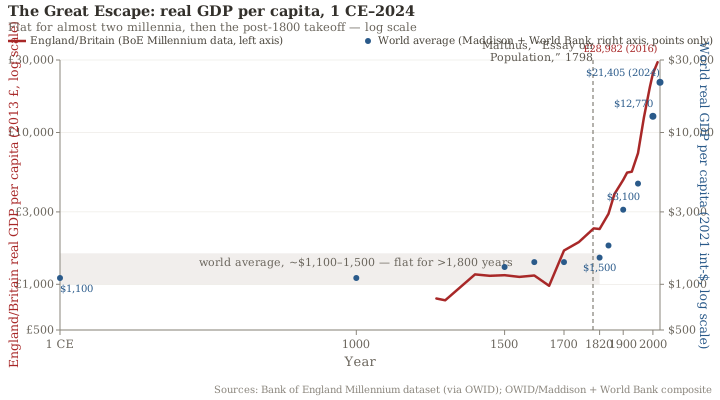
The neo-Malthusian revival re-imports the fixed constraint the Industrial Revolution removed
The Club of Rome’s Limits to Growth (1972) and the modern degrowth movement are Malthus’s living descendants: both argue that a finite planet caps growth and that the escape is temporary. The intuition has real force on specific resources, but it repeats the exact assumption the last two centuries falsified, that the binding constraint cannot be relaxed by substitution and new ideas. Whether climate is the constraint that finally makes Malthus right again is the open version of this question.
Where this leaves us
Settled, with reasons. The classical model was the right physics for the world it described and the wrong physics for the world that arrived. The world escaped the stationary state, and explaining the escape becomes the spine of everything that follows. What survived is the logic underneath it: diminishing returns to a single accumulable factor cannot, by themselves, sustain growth. The classicals applied that logic to land. A century later, Robert Solow would resurrect the same logic for capital and reach a structurally identical conclusion, that accumulation alone runs out. The classical insight changed which factor it was about.
If land was the binding constraint and the Industrial Revolution broke it, the next generation needed a model where growth could continue. Their first serious attempt at one nearly fell off a knife’s edge, and the model that fixed it would go on to humble its own creator.
The Solow revolution and the residual that ate it
“Gross output per man hour doubled over the interval [1909–1949], with 87½ per cent of the increase attributable to technical change and the remaining 12½ per cent to increased use of capital.”
— Robert Solow, “Technical Change and the Aggregate Production Function,” 1957
Read that number again. Solow built the model that won him the Nobel and reorganized the entire field around the accumulation of capital, and then his own arithmetic found that capital accumulation explained barely an eighth of the growth it was supposed to explain. The other seven-eighths he could only label “technical change”, a residual his model took as given and could not account for. Moses Abramovitz, wrestling with the same residual the year before, had already called it, “a measure of our ignorance” about the causes of economic growth. The most influential growth model of the century opens by confessing it cannot explain most of growth.
First, the knife-edge that Solow had to fix. Before Solow, the working model of growth was Harrod-Domar, and it asked the right question: can an economy stay on a steady growth path? Its answer was alarming. With a fixed capital-output ratio — capital and labor used in rigid proportion, no substitution allowed — the rate at which the economy needs to grow to keep capital fully employed and the rate at which it can grow given the labor force coincide only by accident. Off that razor’s edge, the economy spirals into either chronic unemployment or runaway shortage. A postwar boom that was conspicuously stable was the standing refutation of a model that predicted chronic instability.
Solow’s fix (1956) is one assumption. Let capital and labor substitute for each other smoothly. The moment they can, diminishing returns to capital reappear, the same logic the classicals used for land. As a country accumulates capital per worker, each additional machine adds less output than the last. Investment runs into depreciation, and the economy settles at a stable steady state. The knife-edge dissolves into a basin every economy is drawn toward. Two famous predictions fall out: conditional convergence, poorer countries grow faster toward their own steady state; and the second, that long-run per-capita growth cannot come from accumulating capital at all, because diminishing returns choke it off. In Solow’s model, sustained growth is driven entirely by technical progress, which the model leaves exogenous.
Steady-state output per worker $y^*$, where $s$ is the saving rate, $n$ population growth, $\delta$ depreciation, $\alpha$ capital’s output share, and $A$ the level of technology. A higher $s$ raises the level $y^*$ but not its long-run growth rate, which is governed entirely by the growth of $A$. You can save more and get richer once; you cannot save your way to permanently faster growth. The full derivation is in Economics Ch.9 §9.4.
Think of each country as filling a bathtub. Saving is the faucet pouring new capital in; depreciation and a growing population are the drain, wearing capital out and spreading it over more workers. The water level, capital per worker, settles where inflow equals outflow. Open the faucet wider and the level rises to a new resting point, but it still rests. To keep the level rising forever you would need something the faucet cannot supply: a steady improvement in how much output each unit of capital yields. That something is technology, and Solow’s model takes it as rain falling from outside the economy.
And then the model ate itself. Solow’s second move was to measure the thing his model left exogenous. Growth accounting decomposes measured output growth into a part you can attribute to more capital, a part you can attribute to more labor, and a leftover, the part neither input explains. That leftover is the Solow residual, and it is just $A$, the technology term. When Solow ran the numbers, the residual dominated. The majority of measured growth fell into the box the model could not open.
Two predecessors deserve a full hearing. First, Harrod-Domar. It is easy to mock the knife-edge in retrospect, but capital-fundamentalism was the right instinct for the world it addressed, a postwar reconstruction economy where capital was the binding constraint. Europe’s factories were rubble; the Marshall Plan logic, pour in capital and output follows, was approximately true for an economy short of exactly one thing. And Harrod-Domar gave the field its first dynamic growth equation, the object Solow then refined.
It is tempting to say Solow “failed to explain technology,” and that reading inverts what actually happened. Solow’s exogenous-technology assumption was a deliberate, productive black-boxing, and the single most useful thing he did. By refusing to model where $A$ comes from, he turned “technology matters” from a slogan into a number. The residual is the model’s greatest discovery, the first quantification of how much of human prosperity is “ideas” rather than “stuff.” A theory that had tried to model technology from the start would have produced a worse, more speculative answer and never delivered the clean measurement.
Where this leaves us
Settled, with reasons, and the reasons run straight back to Stage 1. One structural continuity runs through the whole thread. Diminishing returns to a single accumulable factor cannot sustain growth, whether the factor is land (classical) or capital (Solow). That conclusion is consensus. The Solow residual is the most important negative result in macroeconomics precisely because it is a confession of ignorance. By measuring exactly how much growth its own apparatus could not explain, it told the entire field where to dig. And the convergence prediction is confirmed, but only conditionally. Poor countries converge toward their own steady states, not toward the rich-country frontier, which means the interesting action has moved to what sets a country’s steady state. That question, what determines the parameters the model takes as given, is left open until Stage 4. The cross-country growth record that bears it out is mapped post-1945 in the GDP-per-capita map (the convergence-test data in motion).
Solow had found the engine of growth and then declared he could not open the hood. The next generation refused to accept that technology simply falls like manna from outside the economy. What if growth came from something people actually choose to produce?
Opening the black box

“A nonrival good has the property that its use by one firm or person in no way limits its use by another. The design for a transistor or the formula for a chemical can be used by an arbitrary number of people at the same time.”
— after Paul Romer’s account of nonrivalry, central to the endogenous-growth research honored by the 2018 Nobel Prize in Economics
This one observation cracks Solow’s black box open. Machines are rival — the loom you are using, I cannot use — which is exactly why they hit diminishing returns. But ideas are nonrival: the blueprint for a chip can be used by every chip-maker on Earth at once without being used up. A factor that is not depleted by use does not obey diminishing returns the way capital does. If the thing that drives long-run growth is nonrival ideas, then growth is the equilibrium outcome of people deciding to produce ideas, and that decision responds to incentives.
Endogenous growth is three moves on the same insight, each making technical progress something the economy produces.
1. Romer (1990). Because ideas are nonrival, they generate increasing returns at the level of the whole economy. You pay the fixed cost of inventing a design once, then everyone uses it freely forever. Growth becomes the equilibrium result of deliberate, profit-motivated research; firms invest in R&D because partial excludability (patents, secrecy, lead time) lets them capture some of the value of what they invent. The AK model is the precursor that makes the mechanism visible. Drop diminishing returns to broad capital and growth no longer chokes off.
where $g$ is the long-run growth rate of ideas (and so of income), $\delta_A$ is the productivity of the research sector, and $L_A$ is the number of researchers. More researchers means a permanently faster growth rate. Compare Solow, where more saving raised the level but never the growth rate. Here, effort applied to ideas moves the growth rate itself, which is exactly why technology stopped being exogenous. Full treatment in Economics Ch.13 §13.4.
A machine wears out and serves one user at a time, so piling up machines runs into diminishing returns. An idea never wears out and serves everyone at once, so piling up ideas does not. That asymmetry is the whole move. If you can put more people to work inventing ideas, and the ideas they find stay available forever, then the more inventors you have, the faster the stock of useful knowledge grows, with no built-in ceiling. Growth stops being weather you wait for and becomes a decision you make.
2. Lucas (1988). The accumulable factor that escapes Solow-style diminishing returns at the aggregate level is human capital, skills and knowledge embodied in people. Because educated workers make each other more productive, human capital can carry sustained growth where physical capital alone cannot. Lucas’s remark that once you start thinking about these questions “it is hard to think about anything else” marks the moment the profession turned its full attention to the engine Solow had left idling.
3. Aghion and Howitt (1992). The Schumpeterian move is to formalize creative destruction. Each new idea is a quality improvement that destroys the monopoly rents of the idea it replaces. Growth is the net result of this churn, new products killing old ones, the gale that never stops. Here a much older thread feeds in. Schumpeter’s mid-century vision of capitalism as a process of perpetual internal disruption becomes a tractable growth model with an innovation rate you can solve for.
The intellectual lineage of this turn sits with Schumpeter: History of Economic Thought Ch.7 (Schumpeter and creative destruction) carries the Romer–Aghion–Howitt revival, because formalizing creative destruction in endogenous-growth machinery is the direct descendant of Schumpeter’s vision. The Marx-versus-Schumpeter dispute over whether that churn is capitalism’s strength or its terminal disease is its own comparison; see Marx vs. Schumpeter: how does capitalism undo itself? This thread takes only the creative-destruction-as-growth-engine half of Schumpeter’s legacy.
The strongest counter here is Solow defending his own black box, which is why first-generation endogenous growth drew real fire. Maybe technology really is best left exogenous to an economic model. A great deal of technical progress comes from basic science, serendipity, and curiosity-driven research that does not respond cleanly to market incentives. The transistor, the laser, and the structure of DNA were not pulled into existence by R&D subsidies. To write down a smooth, well-behaved “idea-production function” that converts research spending into a predictable flow of growth may be false precision: it dresses up something uncertain and lumpy in the costume of an optimization problem. Solow could fairly say that black-boxing technology was an honest admission that the inside of the box is messier than any tractable model of it.
The response that wins is that the objection stops short. Nonrivalry is an observable property of ideas, true whether or not anyone writes it into a model. And the puzzle that forces the issue is concrete: if useful ideas were freely available the instant they were invented, poor countries would simply copy rich-country technology and converge fast. They mostly do not, because technology does not diffuse freely across borders. That stubborn fact is what a model of endogenous, partially excludable ideas is built to explain. It accounts for why the knowledge frontier moves, why it is costly to reach, and why being near it is worth so much. The black box could be left closed only as long as no one needed to explain its contents; the convergence data made that no longer an option.
“If ideas drive growth, R&D subsidies buy growth” is right in direction and treacherous in dosage
Endogenous growth seems to hand policymakers a lever. Nonrival ideas are underprovided by the market, so subsidize research and grow faster. The logic is real; knowledge spillovers are a textbook market failure. But the same theory that justifies the subsidy also warns that the idea-production function may not be the well-behaved machine the policy case assumes.
Where this leaves us
Settled at the frame level. That technical progress is endogenous, the result of choices people make about producing ideas, and that ideas are nonrival, is consensus. Endogenous growth completes Solow. He deliberately left the technology layer open and measured how big it was; endogenous growth fills that layer, making the residual the object of theory instead of a label for ignorance.
Contested at the magnitude level. Inside the locked frame there is a live dispute, the Romer-versus-Jones split. The first-generation (Romer) models imply a scale effect, where more researchers should mean a permanently higher growth rate. The long-run data embarrass that; the number of researchers has exploded while growth has, if anything, drifted down. Jones’s semi-endogenous variant fixes this by assuming ideas get harder to find. Research effort then sets the level of income, while the long-run growth rate falls back to depending on population growth. Both sides agree ideas are endogenous and nonrival. The split is a parameter-and-method dispute about the shape of the idea-production function, conducted entirely inside the frame both accept. And it is the dispute that detonates in Stage 4.
Endogenous growth made the engine a choice, but Jones’s footnote was a time bomb. If each new idea really is harder to find than the last, the engine might be quietly running down even as we throw more researchers at it. And there was a deeper question none of these models had answered, the one the whole thread had been stepping around since Stage 1. Why did growth ever start?
The modern frontier
“The number of researchers required today to achieve the famous doubling every two years of the density of computer chips is more than 18 times larger than the number required in the early 1970s. … Across a broad range of case studies at various levels of (dis)aggregation, we find that ideas, and in particular the exponential growth they imply, are getting harder and harder to find.”
— Bloom, Jones, Van Reenen & Webb, “Are Ideas Getting Harder to Find?” American Economic Review, 2020
This is Jones’s time bomb, measured. Maintaining Moore’s Law now takes eighteen times the research effort it once did. The same pattern shows up in agricultural yields, in drugs approved per dollar of pharmaceutical R&D, in the productivity of research itself. We are running harder to stand in roughly the same place. If that is the trend rather than a blip, the endogenous engine that Stage 3 celebrated may be structurally decelerating. The whole frontier of growth theory now organizes around this finding.
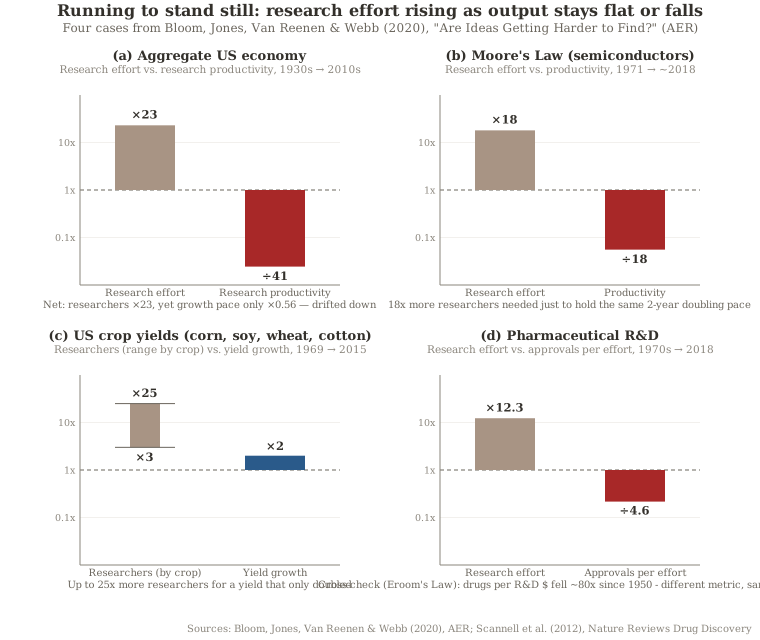
Stage 4 is the present asking what every earlier rung abstracted away. Three questions, each closing a gap carried since Stage 1.
1. Unified growth theory (Galor), the rung that finally explains Stage 1. Every model so far, classical through endogenous, took the same thing as given: that growth had started. None explained the transition out of the Malthusian world; they either lived inside it (the classicals) or assumed it was already over (Solow, Romer). Galor’s unified growth theory builds a single model with two regimes and an endogenous escape between them. In the trap, any productivity gain is converted into more children and dissipated, pure Malthus. But as the return to human capital rises, parents begin trading child quantity for child quality, investing in education instead of family size. Past a threshold, that quality-quantity switch tips the economy out of the trap and into self-sustaining growth. The escape Stage 1 treated as a brute fact becomes, here, a feature the model produces.
For most of history, a richer family had more surviving children, so any gain in income turned into more mouths and wages fell back to subsistence, the Malthusian floor. Galor’s switch is what happens when education starts to pay: a point arrives where parents would rather have fewer, better-schooled children than many. Once enough families make that trade, the population mechanism that always clawed back gains stops clawing, human capital compounds, and the economy lifts off the floor for good. The two-sector mathematics is technical depth; the regime-transition idea is the spine.
2. Institutions and growth (AJR), what sets the parameters. Solow’s conditional convergence (Stage 2) left a debt. Poor countries converge to their own steady states, so what determines a country’s steady state? The institutional turn — North, then Acemoglu, Johnson, and Robinson (the 2024 Nobel) — answers that the parameters the growth models treat as exogenous, the saving rate, the research intensity, whether ideas get used productively, are themselves downstream of institutions: secure property rights, constraints on expropriation, inclusive versus extractive rule. AJR enters here as the rung that asks what sets the parameters. Whether specific colonial histories caused specific divergences is a different question, owned by the Great Divergence walkthroughs; Did Britain have to industrialize first? takes that on directly.
3. Ideas getting harder (Jones, semi-endogenous), cashing Stage 3’s hook. The Bloom et al. finding is the empirical body for the semi-endogenous side of the Romer-versus-Jones split. If research productivity is falling everywhere, if each new idea is harder to find than the last, then in the semi-endogenous framework the long-run growth rate is set by how fast the pool of potential researchers grows. With population growth slowing across the rich world, that is not a reassuring place to land. The frontier’s central question is whether this points to genuine secular deceleration or whether rising research scale and new tools offset the falling per-researcher yield.
The lineage homes for these three rungs sit in the history of thought: the institutional tradition from Veblen and Commons through North to Acemoglu in History of Economic Thought Ch.15 (Institutional tradition); the development-as-growth lineage that carries Galor’s unified growth theory in Ch.16 (Development economics); and the secular-stagnation and ideas-getting-harder debate within the post-2008 pluralism in Ch.17 (Modern pluralism). The policy face of unified growth and the convergence-club empirics live in Economics Ch.20 §20.8 (Contemporary development).
The optimistic reading deserves a serious hearing against the stagnation story, because the pessimistic case is currently the fashionable one and fashion is not evidence. The falling research productivity is real; the optimist’s case is that the data do not settle the conclusion. Falling productivity per researcher is compatible with rising total output of ideas, as long as the number of researchers and the resources behind them keep climbing faster than the yield falls, which, historically, they have. The stock of human brains pointed at problems is still expanding as more of the world’s population reaches the research frontier. And there is a specific live candidate for a fresh idea-production multiplier. Artificial intelligence, if it augments or automates parts of research itself, could raise $\delta_A$ in a way no prior tool did, the first general-purpose technology aimed at the bottleneck the semi-endogenous model identifies. The historical record is brutal on confident decline forecasts. Every generation since Malthus has produced respectable economists certain the low-hanging fruit was gone, and every one so far has been wrong. That record is a strong prior against treating “we have run out of ideas” as the default reading of a productivity slowdown, though it proves nothing about this time.
“Slow growth is the new normal” mistakes a live, two-sided question for a settled verdict
Robert Gordon’s Rise and Fall of American Growth argues the great inventions were one-time events and the slowdown is permanent. The Bloom et al. ideas-getting-harder finding gives the stagnation case its sharpest empirical edge. But the same finding is compatible with offset by scale and by AI, which is why the frontier is open.
Where this leaves us
Here the thread stops being settled and becomes live. What is settled is real: the thread is cumulative; unified growth theory has turned the Stage-1 escape from a mystery into an explicandum the model can produce; and institutions matter for the parameters the growth models treat as given. Three things are open. First, whether ideas-getting-harder implies genuine secular deceleration or is offset by rising research scale and by AI as a new idea-production multiplier, the Gordon-versus-techno-optimist split, with the AI term still unwritten. Second, whether institutions are a deep cause of growth or a proximate channel for deeper geographic or historical forces, a dispute deliberately left unsettled here and routed to the Great Divergence comparatives. Third, whether unified growth theory’s specific mechanism is the explanation of the regime transition or merely an elegant one among candidates.
Naming where the field stands and what would move it is a calibrated answer in its own right. The region-specific half of the question is walked in Did Britain have to industrialize first?
The verdict
Five turning points, each forced by a concrete embarrassment its predecessor could not survive:
- The stationary state. Diminishing returns to land made growth halt, correct physics for the Malthusian world, broken by the Industrial Revolution’s sustained per-capita growth.
- The knife-edge. Harrod-Domar asked the right question, whether a growth path can be stable, with a production technology that made stability an accident, contradicted by a conspicuously stable postwar boom.
- Solow and the residual. Substitutable capital fixed the knife-edge and resurrected diminishing returns for capital, then growth accounting found that the model explained only a fraction of growth, shoving the rest into an exogenous black box it measured but could not open.
- Endogenous ideas. Romer, Lucas, and Aghion-Howitt opened the box by making nonrival ideas the object of deliberate investment, completing Solow’s layer, while Jones’s semi-endogenous variant planted the doubt that the engine might be running down.
- The frontier. Galor explained why growth ever started; AJR asked what sets the parameters; Bloom et al. asked whether the idea engine is decelerating, the live, unsettled edge of the thread.
Read end to end, growth theory is the cleanest cumulative lineage in macroeconomics. Each transition was forced by a specific failure, and each successor kept what worked. Modern growth economics runs a division of labor. Solow remains the workhorse for short-to-medium-run analysis and for organizing the data; its exogenous-technology assumption was the productive simplification that let the field measure how much of prosperity lived in the residual. Endogenous-growth theory explains the long-run engine Solow assumed away, completing his layer. And the frontier grapples with everything the earlier rungs took for granted: why growth started, what determines the parameters, and whether the engine itself is slowing.
The cumulative story is real and Whiggish in the good way through Stage 3; the field got less wrong, for reasons you can point to. The frontier is where the thread stops being cumulative and starts being live. The honest place to stand is holding the map, which shows how the theory of growth got from Smith’s stationary state to ideas-getting-harder, what each rung settled, and where the field is still arguing and why.