Mass migration 1850–1914
Fifty-five million Europeans crossed to the New World in two generations, the first globalization’s labor thread. It produced a measured convergence of wages between the Old World and the New, a backlash that slammed the door shut in 1924, and a reopening after 1965 that re-ran the whole sequence. Today’s immigration debate is the same movie, with the same economics and the same politics, that played once already.
See the marginalist lineage graphThe great wave
“The new immigration has been largely a movement of the unskilled… They have congested in cities, lowered the standard of living, and shown little disposition to assimilate.”
— after the United States Immigration Commission (the Dillingham Commission), Reports, 1911
They’re unskilled, they undercut wages, they crowd the cities, they won’t assimilate. Every word of it is alive in 2024. It was written in 1911, about Italians and Poles and Jews, by a congressional commission that ran to forty-one volumes. Behind the complaint stood the largest voluntary migration in human history to that point: roughly fifty-five million Europeans crossing to the New World between 1850 and 1914, more than one million through Ellis Island in the peak year of 1907 alone. The commission never honestly asked the first question: why did they come?
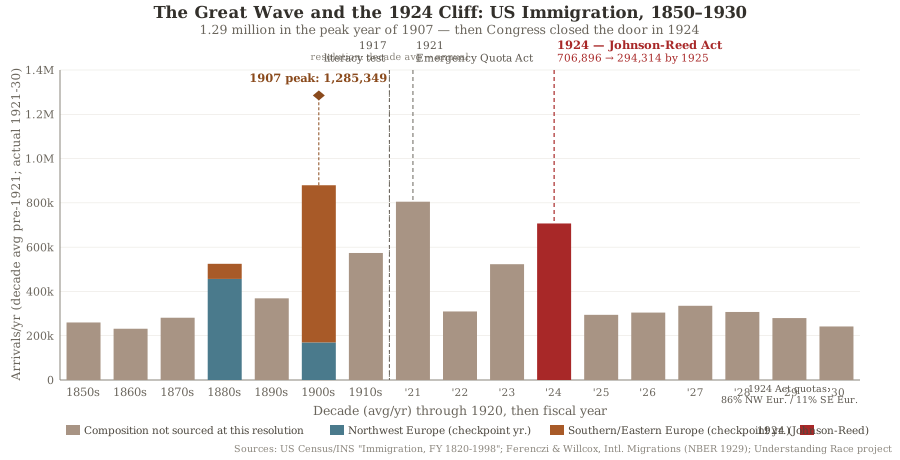
They came because the New World paid more, and because by mid-century they finally could. Timothy Hatton and Jeffrey Williamson, in The Age of Mass Migration (1998), reconstructed the determinants from a century of data, and the picture is a labor market. The wage gap was enormous, an American laborer earned multiples of his counterpart in Ireland or Calabria. Europe’s population was booming, pushing young workers off land that could not hold them. Steamships cut the Atlantic crossing from weeks to days and from a near-fortune to a few weeks’ wages. And every emigrant who landed lowered the cost and risk for the next: the letter home, the prepaid ticket, the cousin with a job already lined up. Chain migration was the dominant mechanism.
Emigration did not fall as a country got richer, it rose first, then fell, an inverted U against origin income. The poorest could not afford to leave; the passage cost money the destitute did not have. Development relaxed that budget constraint before it removed the reason to go, so emigration climbed as a poor country began to grow and only declined once home wages caught up enough to keep people home. This emigration life-cycle is why the sending countries shifted over the period from Britain and Germany to Italy, Poland, and the Russian Empire: each region entered the wave as it crossed the threshold that made leaving affordable.
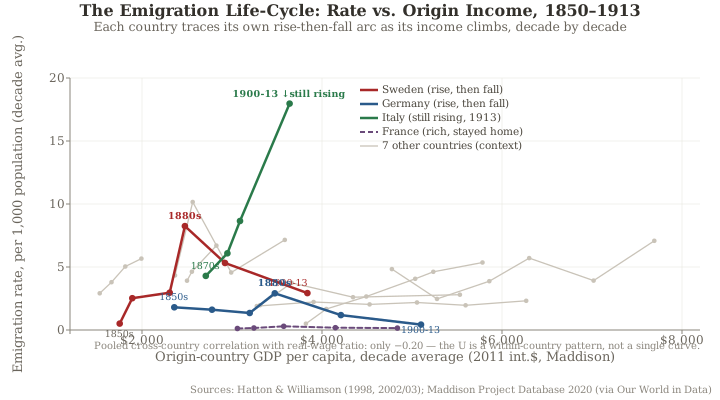
The emigration rate $m$ rises and then falls in origin income $y$ — an inverted-U life-cycle:
$$m = \alpha (w^* - w) - \beta\, c(y), \qquad c'(y) < 0$$where $w^* - w$ is the destination-minus-origin wage gap pulling people out and $c(y)$ is the financing cost of the passage, falling as origin income $y$ rises. At very low $y$ the cost term dominates and few can leave; as $y$ rises the constraint relaxes faster than the gap closes, so $m$ climbs; only once $w$ approaches $w^*$ does the gap collapse and $m$ fall.
You have to get rich enough to afford to leave before leaving gets easy. The very poorest village did not empty out; it could not pay for the tickets. Emigration surged once a place was poor-but-rising — income enough for the fare, reasons enough to use it — and then dried up only when wages at home finally caught up with wages abroad.
The migration decision is a labor-supply problem, the worker weighing the return to selling labor here against selling it there, net of the cost of moving. That apparatus, the modern labor-supply model the whole thread leans on, lives in Economics Ch.21 (Labor Economics); the population-and-human-capital channel that the inflow fed into the receiving economies is in Ch.13 (Growth Theory).
The people living through the wave understood what they were seeing. To a nineteenth-century European observer, emigration was a safety valve. The Continent had a Malthusian problem, too many people on too little land, agrarian distress sharpening into famine in Ireland in the 1840s and into chronic rural misery across southern Italy and the Habsburg lands. The New World had the opposite problem: endless land, a labor-hungry frontier, settler economies that could absorb workers as fast as ships could carry them. Emigration was the mechanism that married the two. It drained the demographic pressure that might otherwise have erupted into revolution, and it peopled the Americas, Argentina, and Australia with the labor that built them.
The push: the failed harvest, the partible inheritance that left each son a sliver of land, the conscription notice, the pogrom. The pull: cheap or free land under the Homestead Act, factory wages in Pennsylvania and Sao Paulo, the cousin’s letter describing meat on the table every day. Argentina took in roughly four million European immigrants between 1880 and 1913, the second-largest absolute inflow on earth after the United States; Italian and Spanish workers built the industrial base of Sao Paulo and the wheat economy of the pampas. Economic History Ch.10 (Imperialism and Colonial Economies) carries this record, the Latin American export economies and the settler-colonial path, alongside the other half of the era’s labor reorganization, the indentured Indian and Chinese workers moved across the British and French empires. The wave was a coherent labor-market phenomenon, legible to the people inside it.
The great wave is well-explained. Push-pull plus the emigration life-cycle accounts for who moved and when, and the framework has held up against a century of data. The migration was a labor flow with knowable economics, and the Dillingham Commission’s complaint that the newcomers were a degenerate tide gets the most basic fact wrong, they were workers responding to wages, exactly as workers do. But explaining why people moved leaves the larger question untouched. Move fifty-five million workers from labor-abundant Europe to labor-scarce America, and something has to happen to wages on both sides of the ocean. What?
Basic economics predicts that the wage gap should close. In the 1990s, two economists put numbers on exactly how much it closed, and the answer rewrote the history of the first globalization.
The convergence it produced
“Mass migration was the central force driving the convergence of real wages between the Old World and the New between 1870 and 1913. Where the emigration rate was highest, the catch-up was fastest.”
— after Kevin O’Rourke & Jeffrey Williamson, Globalization and History, 1999
Swedish real wages stood at roughly a quarter of US levels in 1870. By 1913 they had climbed past half. Irish and Italian wages tracked the same path, the economies that sent the most people abroad saw the sharpest catch-up, exactly where the theory says the effect should be largest. The gap between the Old World and the New closed, and migration was the main reason why.
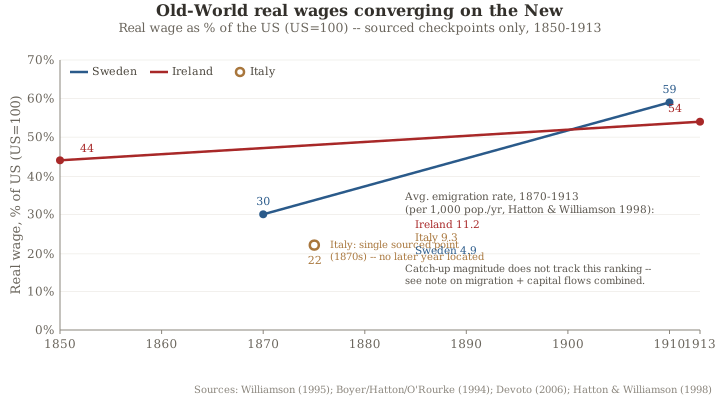
The mechanism is factor-price equalization, and it is almost arithmetic. Pull workers out of labor-abundant Europe and labor there becomes scarcer, so European wages rise. Push them into labor-scarce America and labor there becomes more plentiful, so American wage growth is restrained. The convergence O’Rourke and Williamson measured is what that mechanism looks like when forty years of it accumulate. (Capital complicated the picture by flowing toward the New World alongside the workers rather than away from it, which is why the exact share of convergence attributable to migration versus trade versus capital is the one number economists still argue over.)
Migration and trade are substitutes. The Heckscher-Ohlin framework says a labor-abundant country can equalize factor prices with a labor-scarce one in two different ways: it can export labor-intensive goods, or it can export labor itself. Both push wages toward equality. Ship the textiles or send the weavers, either way, the wage gap narrows. This is why the migration thread and the goods-trade thread are mirror images of one structure: trade moves the products of labor, migration moves the labor. The formal apparatus, the Heckscher-Ohlin factor-endowment model, the conditions for factor-price equalization, and the Stolper-Samuelson result on who wins and loses, lives in Economics Ch.22 (Trade Theory Formalism), §22.2–§22.3; the open-economy treatment of factor mobility is in Ch.17 (Open Economy Macro), and the intro-level trade diagram in Ch.2 §2.6.
Factor-price equalization: with two factors (labor $L$, capital $K$) and two regions, moving labor from the abundant region (wage $w$) to the scarce region (wage $w^*$, with $w^* > w$) raises $w$ and lowers $w^*$ until, in the frictionless limit,
$$w \to w^*.$$Stolper-Samuelson then names the distributional flip side: the same inflow that lifts aggregate New-World income lowers the real return to the abundant New-World factor, unskilled labor, relative to capital and land. Convergence at the level of nations is wage compression at the level of the receiving country’s workers.
Water finds its level. Open a channel between a high tank and a low one and the water flows until the surfaces match, it does not matter whether the channel carries cloth or carries the people who weave it. The first globalization opened both channels at once, and the wage gap drained accordingly.
The goods-trade side of the first globalization reaches that same equilibrium from the opposite direction: this thread follows the labor factor, its mirror follows the goods. The formalization itself has a lineage — Heckscher and Ohlin in the 1920s and 1930s, Samuelson in the 1940s closing the factor-price-equalization result — that sits inside the broader marginalist formalization of value and distribution in History of Economic Thought Ch.5 (Marginalist Revolution and Formalization).
Take the convergence story at its full strength, as a genuine and measured triumph of the first globalization. The aggregate picture is large. An integrated Atlantic economy formed: workers, capital, and goods all flowing toward where their return was highest, and the gaps between regions narrowing as a result. The settler economies industrialized on European labor and European savings, global output rose, and the poorest corners of Europe saw their wages climb toward the frontier for the first time in recorded history. O’Rourke and Williamson’s reconstruction is one of the cleanest demonstrations economics possesses that factor mobility produces convergence, visible in the wage series, country by country, decade by decade.
The catch-up happened, which is exactly why the conflict it created was a conflict over who captured the gains. You can watch the convergence on the GDP-per-capita map, in the 1870–1913 frame, Argentina and the other settler economies climb toward the rich-world frontier, Argentina drawing nearly level with parts of Western Europe by 1900 before the post-1914 reversal sets in. The historical record of those settler trajectories, with Williamson’s reconstruction of nineteenth-century factor markets, sits in Economic History Ch.10 §10.5 (Settler-Colonial Economies as a Distinct Path). The first globalization delivered.
The convergence was real and substantial, and migration was its main driver. That much is consensus, the existence and direction of the catch-up are not in dispute, only the exact share migration drove relative to trade and capital, which is a magnitude question inside an agreed frame. The factor-price-equalization mechanism is the apparatus, and it carries a barb the convergence story keeps quiet. Stolper-Samuelson says the inflow that raised New-World aggregate income lowered the relative return to New-World abundant labor. The unskilled American worker competing for a job against the arriving European faced exactly the wage pressure the theorem predicts, the model working as designed. That distributional fact, sitting underneath the triumphant aggregate, is what eventually closed the door.
The convergence that made the first globalization a success story also created losers, the New-World workers whose wages the arriving labor held down. By the 1880s those workers had a grievance, and by the 1920s they had the votes. The door that had stood open for seventy years slammed shut, and the way it slammed tells you what the backlash was about.
The backlash and closure
“The day of unalloyed welcome to all peoples, the day of indiscriminate acceptance of all races, has definitely ended… The need of the hour is for a continued and stricter policy of selection and restriction.”
— Representative Albert Johnson, co-author of the Immigration Act of 1924 (the Johnson-Reed Act)
In May 1924 the United States closed the door that had stood open for seventy years. The Johnson-Reed Act capped total immigration and assigned each nationality a quota pegged to its share of the US population in 1890, a base year chosen precisely because it predated the southern and eastern European wave, throttling Italians and Poles and Jews to a trickle while leaving British and German slots barely touched. It was the culmination of a forty-year restriction campaign: literacy tests, the 1882 Chinese Exclusion Act before it, the 1917 and 1921 quota acts building toward it. The question is why a flow with real aggregate gains got shut down, and whether the closure was about the gains it cost or about something else entirely.
The restriction campaign was reacting to real economics. The distributional barb inside the convergence, the one Stolper-Samuelson named a stage ago, pays off now: a labor-supply shock to a receiving economy lowers the wage of the workers most substitutable for the arrivals. The arriving European labor competed most directly with native unskilled workers — the same factory floors, the same construction sites, the same urban trades — and held their wages down relative to the trend they would otherwise have followed. The aggregate gains were real; so was the compression at the bottom of the native wage distribution. This is the identical labor-supply-shock apparatus the contemporary immigration debate runs on, here applied to the historical record.
Why did that compression translate into closure rather than into compensation? The political economy is the standard shape of a policy with diffuse gains and concentrated losses. The winners — consumers enjoying cheaper goods and services, the employers of immigrant labor, the migrants themselves — were spread thin, or could not vote, or were not yet citizens. The losers were concentrated, organized, and enfranchised: native-born unskilled workers and the unions that spoke for them. The textbook case for migration assumes the winners could compensate the losers; the political system never built the channel to make them, then any more than now. So the grievance found the only instrument on offer, restriction.
A labor-supply shift $\Delta L > 0$ along a downward-sloping demand curve for the substitutable labor type lowers its wage:
$$\frac{\partial w_{\text{unskilled}}}{\partial L} = \frac{1}{\eta} < 0,$$with $\eta$ the (negative) elasticity of labor demand. The aggregate surplus rises, the gains to employers and consumers exceed the wage loss, but the loss is concentrated on one identifiable, enfranchised group while the gain is dispersed across many. The arithmetic that makes the policy positive-sum is exactly the arithmetic that makes it politically fragile.
The gains were spread across everyone, a little cheaper, a little richer, for millions of consumers and employers. The losses landed on one group: the native workers who competed head-on with the arrivals. And that group could vote. Diffuse winners rarely organize; concentrated losers always do. The door closed because the people it hurt were the ones holding the ballots.
The wage-incidence apparatus, how a labor-supply shock distributes across worker types, lives in Economics Ch.21 (Labor Economics), the same chapter the contemporary debate draws on.
The 1920s restrictionist case is easy to wave away as pure bigotry, and waving it away gets the history wrong. The distributional grievance was true. A native-born unskilled worker in 1910 was not imagining the wage pressure, the convergence economics that lifted the national aggregate ran straight through his paycheck, holding it below where it would otherwise have climbed, exactly as the Stolper-Samuelson theorem says it must. That pressure was the cost side of a real adjustment, borne by the people least equipped to absorb it.
And the labor case was a left case. Samuel Gompers, an immigrant himself and the founding president of the American Federation of Labor, was among the most forceful advocates of restriction, on the structural ground that an unlimited supply of new workers transferred income from native labor to capital and undercut every gain organized workers fought for. This is the argument a modern left-populist makes about immigration today: that open labor flows discipline wages downward and serve employers. Add the absorption-capacity concern — tenement overcrowding, strained urban services, schools and sanitation systems buckling under arrival rates of a million-plus a year — and the restrictionist had a real case to make about wages, about bargaining power, and about the physical capacity of cities to absorb the inflow at the pace it was coming.
What cannot be defended is the form the closure actually took. The 1924 act did not set a wage floor, fund the cities, or build a transition for displaced workers. It assigned quotas by national origin, on an explicitly racial hierarchy — Nordic and Anglo-Saxon stock at the top, southern and eastern Europeans graded down, Asians excluded outright — justified by the eugenic pseudo-science of the Dillingham Commission and its intellectual heirs. A wage problem does not have a racial solution.
So the closure had two layers. Underneath: a real distributional grievance, consensus economics, the wage compression the theorem predicts. On top: an illegitimate racial logic the 1924 act actually encoded. The restrictionists were right that there was a cost and wrong about the remedy. Closure destroyed the aggregate gains when compensation could have preserved them, the same failure that recurs whenever the political system refuses to build the channel the efficiency case assumes. And the shape of the closure gives the game away. A policy aimed squarely at the wage grievance would have looked like a wage floor or relocation support; this one looked like a racial sorting machine. That tells you the distributional cost was the occasion; identity was load-bearing too. Real economic grievance plus identity-driven politics, fused into a single instrument: that dual structure is the pattern.
The door stayed mostly shut for forty years. When it reopened in 1965, the second great migration began, and with it, beat for beat, the same debate the 1920s had: aggregate gains, concentrated distributional losers, and a backlash that talks about the economy but votes on identity.
The modern echo
“We will carry out the largest deportation operation in American history… the most spectacular migration crackdown.”
— after Stephen Miller’s public statements on the 2025 immigration agenda
Read that line next to Albert Johnson’s in 1924 and the recognition is immediate: we have seen this exact movie before. The 1850–1914 thread closed in 1924, stayed shut through the Depression and the war, and reopened in 1965 when the Hart-Celler Act abolished the national-origins quotas and the second great migration began. Everything since — the magnitude, the backlash, the rhetoric — rhymes with what came before. The question is what the historical thread actually teaches about the debate raging now.
The apparatus for the modern echo is the apparatus the thread already built. The post-1965 wave produced the same convergence economics: the place-premium logic, in which the same worker earns multiples more in a rich economy than a poor one because of the institutions and capital around the work, is just factor-price equalization restated for a world where the gaps are now between hemispheres. And it produced the same distributional incidence: concentrated wage pressure on the native workers most substitutable for the arrivals, diffuse gains everywhere else.
The live contemporary debate over how large those modern wage effects are, the Card-versus-Borjas fight over the Mariel boatlift, Clemens’s trillion-dollar-bills estimate of the global gains, the present-day US policy call, is the territory of the controversial-question walkthrough Does immigration help the economy? That walkthrough argues it on evidence this page does not weigh, and the place-premium apparatus lives in its Stage 3.
The modern restrictionist case deserves the same hearing, because it has exactly the dual structure the 1920s case had. The real distributional grievance is there: the post-2017 wage findings on the bottom decile, George Borjas’s reading that low-skilled native workers bear a measurable wage cost from competing inflows, are the modern Stolper-Samuelson channel showing up in modern data. The labor-protectionist case is there: Bernie Sanders in 2015 called open borders “a Koch brothers proposal” that would “make everybody in America poorer”, structurally the same argument Gompers made in 1910, that unlimited labor inflows discipline native wages downward and serve capital. And the absorption-capacity concern is there: the strain on local services in a town like Springfield, Ohio, in 2024 is the tenement-overcrowding worry of 1910 in a new setting.
So the strongest case for the modern restrictionist is the strongest case for the 1920s restrictionist, updated, real wage grievance plus identity-driven politics. And the modern version carries the same tell. When the rhetoric shifts from “protect native wages” to “protect national character,” from a transfer to displaced workers toward a deportation operation, the identity layer is doing work the wage grievance cannot explain, just as the racial quotas of 1924 did work the wage compression could not. The recurrence is the same machine running again.
The historical thread illuminates the present. The economics of mass migration is well-understood and cumulative, the great wave is well-explained by Hatton-Williamson, the convergence is well-measured by O’Rourke-Williamson, and the proposition that migration produces aggregate gains alongside real, concentrated distributional costs is the discipline’s settled account. The modern wage-effect magnitude, how big the bottom-decile cost actually is, is a genuine parameter dispute inside that frame, and it belongs to the contemporary-policy walkthrough.
What the thread itself commits to is the pattern: today’s immigration debate has a direct nineteenth-century precedent, the same convergence economics, the same backlash politics. The economics was broadly positive-sum then and is now; the politics was distributional plus identity-driven then and is now. This is not the claim that the flows are identical, the welfare-state context, the skill composition, and the explicit racial logic of 1924 versus the framings of today are all genuinely different. It is the claim that the structure repeats: aggregate gains, concentrated losses on the most-substitutable workers, a backlash that speaks the language of the economy and acts on the grammar of identity. The lesson the thread hands the present is that the backlash is predictable — it is the distributional incidence the theory forecasts, politically mobilized — and that the policy failure is the same one twice: closing the door instead of compensating the losers, in 1924 and again now.
The thread, whole
Trace the arc in one line. The great wave, fifty-five million Europeans, pulled by wages and pushed by demographic pressure, moving once the emigration life-cycle made leaving affordable. The convergence, Old-World and New-World wages closing across 1870–1913 through factor-price equalization, with migration and trade revealed as two routes to one equilibrium. The distributional conflict, the same convergence holding down the wages of the native workers most substitutable for the arrivals. The closure, a real grievance fused to a racial logic and shut behind the 1924 quotas. The reopening, 1965, and the second great migration. The modern re-run, the identical economics and the identical politics, playing again. The era-organized books carry these as fragments in three different chapters and two separate interactives; the thread is what connects them.
The lesson is obvious, which is exactly why it keeps getting missed. The economics of mass migration is broadly positive-sum — convergence, aggregate gains, a richer integrated economy — and the politics is distributional and identity-driven, because the gains are diffuse and the losses are concentrated on people who can vote and who reach, every time, for the only instrument the political system bothers to build: the blunt one. That was true of the Italian arriving at Ellis Island in 1907 and it is true of the migrant arriving at the southern border in 2024. The post-1965 record where the modern wave sits is in Economic History Ch.16 (Stagflation and the Neoliberal Turn) and Ch.18 (Globalization and the Great Moderation); the deglobalization that followed the 1924 closure is in Ch.12 (Interwar Monetary Collapse).
For the live contemporary debate — does immigration help the economy, here and now — the pattern this thread surfaces is the evidence, and the verdict is delivered next door. For the goods-trade mirror of this labor thread, and the modern free-movement backlash the closure pattern keeps producing, follow the threads below.