Did 2008 break macroeconomics?

A Nobel laureate said the field mistook beauty for truth. The Queen asked why nobody saw it coming. And the people who built the models said: nothing was broken — we just bolted on the part we’d left out.

以辩论图谱查看
Stage 1 of 5

The consensus, on its own terms

“Macroeconomics in this original sense has succeeded: its central problem of depression prevention has been solved, for all practical purposes, and has in fact been solved for many decades.”

— Robert Lucas, AEA Presidential Address, January 2003

Five years before Lehman, the most influential macroeconomist of his generation announced the problem solved. The easy move is to laugh. The harder, more useful move is to ask what the framework behind that sentence actually looked like — because in 2003, Lucas was describing something real.

By the mid-2000s, macroeconomics had a workhorse, and it was the same workhorse almost everywhere. The European Central Bank ran it; the Federal Reserve ran a cousin of it; graduate programs taught it as the thing you had to know. It was a dynamic stochastic general equilibrium model — DSGE — and it was the product of two decades of convergence that had genuinely settled arguments people once thought unsettleable.

The backbone came from real business cycle theory: a representative household optimizing consumption and labor across time, an economy buffeted by technology shocks, everything derived from explicit preferences and a production function rather than the ad-hoc behavioral equations the older Keynesian models had used. Onto that backbone the New Keynesians grafted frictions — sticky prices via Calvo’s staggered-contract device, monopolistic competition so firms had prices to set — which is what gives monetary policy short-run traction. A Taylor rule closed the system: the central bank moves the interest rate in response to inflation and the output gap. The whole thing was estimated against the macro time series with Bayesian methods. The canonical specification was Smets and Wouters, and it was not a toy. It forecast as well as anything the profession had built, and it forecast better than the structural Keynesian models it replaced.

Stripped to its spine, the workhorse is three equations. A dynamic IS curve linking today’s output gap to expected future output and the real rate; a forward-looking Phillips curve linking inflation to the output gap and expected inflation; and a policy rule for the nominal rate:

$$\tilde{y}_t = \mathbb{E}_t \tilde{y}_{t+1} - \tfrac{1}{\sigma}\left(i_t - \mathbb{E}_t \pi_{t+1} - r_t^n\right)$$ $$\pi_t = \beta\,\mathbb{E}_t \pi_{t+1} + \kappa\,\tilde{y}_t$$ $$i_t = r_t^n + \phi_\pi \pi_t + \phi_y \tilde{y}_t$$

Notice what is not in these equations: a bank, a balance sheet, a default, a financial sector of any kind. The frictions are nominal. The financial system is a frictionless veil.

直觉模式

The consensus was that you could describe the whole economy as one patient household optimizing across time, hit by technology and policy shocks, with sticky prices as the one friction that lets the central bank do anything. Set the interest rate by a rule, estimate the parameters against the data, and you have a machine that both explains the past and tells you what to do next. There was no banking system in the machine because, in two decades of low-volatility data, the banking system had never visibly mattered.

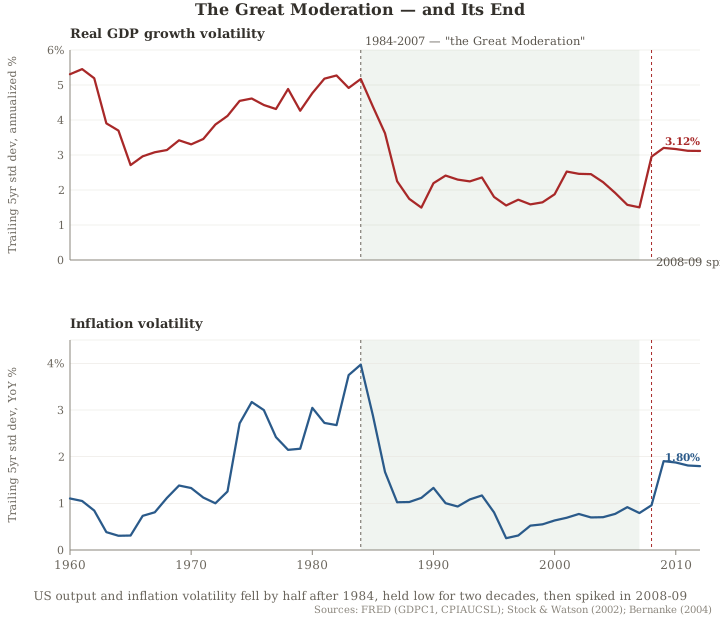
The confidence had an empirical anchor. From the mid-1980s the volatility of output and inflation in the United States had fallen sharply and stayed low — Stock and Watson documented it, and in a 2004 speech Bernanke gave it a name, the Great Moderation, and read it as a deep structural stabilization rather than luck. The economic-history spine of that era — globalization, financialization, the long calm — is History Ch.18 (Globalization and the Great Moderation). If you had been watching the data for twenty years, the policy framework looked like it worked.

观点

“Its central problem of depression prevention has been solved, for all practical purposes.”

— Robert Lucas, AEA Presidential Address, 2003

“Depression prevention has been solved”

The line became the epitaph for a discipline’s hubris. But what the consensus actually claimed is narrower — and more defensible — than what its critics later said it claimed.

Where this leaves us

The pre-2008 consensus was not the cartoon its critics later painted. It was internally consistent, empirically successful by its own measures, and the product of genuine theoretical and methodological progress — the Friedman-to-Lucas-to-Kydland-Prescott counter-revolution feeding into the New Keynesian synthesis, a lineage the History of Economic Thought Ch.10 (Counter-revolution) traces in full. If the synthesis this walkthrough is building is going to mean anything, it has to run against that framework at full strength, not against a weakened version that lets the post-crisis story win by default. The question for everything that follows is not whether the consensus was confident. It was. The question is whether it was adequate.

The framework was coherent; the framework was confident; and then in the autumn of 2008 the framework’s missing object — the financial system — did something the framework had no way to represent. The discipline’s first response was not to throw the framework out. It was to start building the missing part.

Stage 2 of 5

The patches that landed

“The recent financial crisis and recession have challenged the profession to think afresh about how financial and economic crises arise and how they should be managed… the analysis of financial frictions and their incorporation into macroeconomic models has accelerated.”

— Ben Bernanke, “Macroeconomic Research After the Crisis,” Federal Reserve Bank of Boston, October 2010

Two years after Lehman, the Fed Chair gave a speech that read less like a defense and more like a research agenda. Bernanke was not announcing the framework’s collapse. He was announcing what was being built into it next.

The post-2008 macro toolkit looks like the pre-2008 toolkit with parts added. The additions were not random repairs; they cohere into a research program with a clear organizing idea — put back into the workhorse the things the crisis proved it could not do without. Four of those additions are load-bearing today.

The first and largest is financial frictions. Bernanke, Gertler, and Gilchrist had a financial-accelerator model back in 1999, but before the crisis it lived on the periphery; the workhorse ran without it. After 2008 the financial block moved to the center. Christiano, Motto, and Rostagno built entrepreneurial net worth and a credit channel into an estimated DSGE; Gertler and Karadi built bank leverage and a tool for analyzing unconventional monetary policy. The policy menu now ships with these blocks as standard rather than as optional extras. The second addition is heterogeneity. Kaplan, Moll, and Violante’s HANK models showed that the distribution of wealth — specifically the share of hand-to-mouth households — changes what monetary and fiscal policy actually do. The representative agent had been doing load-bearing work it should never have been trusted with, and HANK gave the distributional structure a home inside the model rather than as an afterthought outside it. The third is occasionally-binding constraints: once the interest rate hits zero, the standard linearized solution methods break, and the post-crisis literature built machinery (Guerrieri and Iacoviello’s OccBin and its descendants) that lets the model handle the zero-rate regime without leaving the framework. The fourth is narrative and microdata-driven evidence — Romer-and-Romer-style identification of policy shocks, Mian and Sufi on household balance sheets — which began disciplining the structural estimates with evidence the time series alone could not provide.

What “financial frictions in DSGE” concretely adds is an external-finance premium: the rate a borrower pays rises as its net worth $n_t$ falls relative to the assets $q_t k_t$ it wants to hold. In the simplest accelerator form,

$$\mathbb{E}_t\!\left[\frac{R^k_{t+1}}{R_{t+1}}\right] = s\!\left(\frac{n_t}{q_t k_t}\right), \qquad s'(\cdot) < 0$$

When asset prices fall, net worth falls, the premium rises, borrowing contracts, and the contraction feeds back into asset prices. That feedback loop — the financial accelerator — is exactly the dynamic the frictionless workhorse could not generate.

直觉模式

The post-2008 workhorse is the pre-2008 workhorse with a banking system bolted on, the wealth distribution tracked instead of averaged away, and the policy menu extended to cover the zero-rate world. None of it required tearing down the building. Each piece was a room added onto a structure that was already standing.

The policy chronology these patches were designed against — the QE rounds, the fiscal stimulus, the emergency lending facilities, Basel III and stress testing — is the spine of History Ch.19 (The 2008 crisis and after). The models were not built in a vacuum; they were built to make sense of decisions central banks had already been forced to make.

The intellectual home of this post-2008 retrofit — how the New Keynesian consensus absorbed financial frictions and confronted what 2008 exposed — is History of Economic Thought Ch.12 §12.7 (The reckoning: what 2008 exposed and what survived).

观点

“The financial accelerator… allows us to capture the role of credit-market frictions in amplifying and propagating shocks to the macroeconomy.”

— Christiano, Motto & Rostagno, “Risk Shocks,” American Economic Review, 2014

“DSGE absorbed the lessons of 2008”

The technical core’s claim: the framework was extensible, the missing pieces were added, and the extended models do work the old ones couldn’t. Is the absorption real, or is it repair work papering over a deeper failure?

Where this leaves us

The patches are real, load-bearing, and operationally deployed in policy DSGE today. Financial frictions are in the workhorse. HANK is in the workhorse periphery and moving toward its core. Occasionally-binding constraints handle the zero-rate regime. Narrative methods discipline the structural estimates. None of this is establishment-defense rhetoric — it is a technically accurate description of what is in the post-2008 toolkit. The companion walkthrough Did economics cause 2008? works the same retrofit territory from the other side, asking how far the Minsky tradition was absorbed; here the question is narrower — what is in the toolkit now. And the next question is sharper still: whether the patches closed the gaps that actually mattered, fixed the wrong things, or fixed the right things while leaving new gaps behind.

The patches landed. The next question is whether they closed the gaps that mattered — or fixed the right things at the wrong layer, or the right things while leaving a new and harder set of gaps behind.

Stage 3 of 5

The gaps that did not close

“The Committee decided today to establish a target range for the federal funds rate of 0 to 1/4 percent.”

— Federal Open Market Committee statement, December 16, 2008

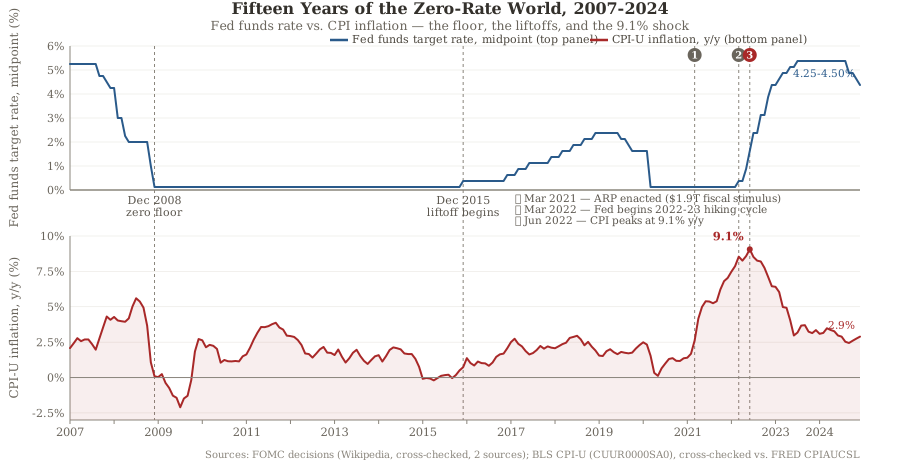
The rate hit zero in December 2008 and stayed at or near zero for seven years. The 2015 normalization was partial; the 2020 pandemic sent it straight back down; the 2022 tightening was the first full normalization in fifteen years. The zero-rate world was not a brief detour from the pre-2008 framework. It was a new policy environment the discipline has been reasoning its way through ever since — mostly by hand, because the first-principles machinery never quite caught up.

The post-2008 patches fixed real things. They also left a different set of gaps open — and these are not the pre-2008 gaps shrunk down, they are structurally new problems. Three of them are doing the most work.

Start with the unconventional-policy regime. The workhorse can now sit the economy at the zero lower bound through occasionally-binding-constraint machinery. But the tools that actually operated during the zero-rate years — large-scale asset purchases, forward guidance, yield-curve control, the alphabet soup of emergency liquidity facilities — are reasoned about episode by episode rather than derived from first principles. There is no canonical DSGE treatment of quantitative easing that the field agrees on; the empirical literature on whether and how much QE works is large, sophisticated, and unresolved. Fifteen years in, the discipline still cannot tell you, from inside a single agreed model, what a given unconventional move will do.

Then there is secular stagnation. In 2014 Summers revived Hansen’s 1939 hypothesis: maybe the neutral real interest rate is now structurally low — demographic drag, capital-light technology, a global savings glut — so the economy keeps wanting to sit at the zero bound. The alternative reading is that the long stretch of low rates was a transient overhang from the crisis, not a new normal. The discipline has not settled which. Then the 2021–2023 inflation surge and the sharp tightening that followed complicated both stories at once, and the neutral rate’s post-pandemic level is now itself contested. The third gap is that macro-finance integration is one-sided. The financial-frictions absorption is concentrated at the back end of the cycle — fire-sale dynamics, balance-sheet constraints under stress. The front end — how stable conditions generate the leverage build that eventually destabilizes, the endogenous-instability story associated with Minsky and developed in the BIS financial-cycle work of Borio and colleagues — is not in the workhorse. The discipline has absorbed the response to financial stress. It has not absorbed the generation of it.

One reason the zero-bound regime is hard to model cleanly: with the policy rate stuck, the price level can become indeterminate under a pure interest-rate rule, and the fiscal side has to pin it down. The fiscal theory of the price level makes that explicit — the price level adjusts so that the real value of government debt equals the present value of expected surpluses:

$$\frac{B_t}{P_t} = \mathbb{E}_t \sum_{j=0}^{\infty} \frac{s_{t+j}}{\textstyle\prod_{k=1}^{j} R_{t+k}}$$

Whether you find this reassuring or alarming, it is a sign of the terrain: at the zero bound, questions the pre-2008 framework treated as settled — what even determines the price level — reopen.

直觉模式

The post-2008 toolkit is good at the moment a crisis breaks — how the damage spreads, how balance sheets seize up, how policy can lean against the spiral. It is much weaker at the slow build-up that produces the crisis, and it has no settled account of what the central bank’s newest tools actually do or whether rates are low for a decade or for a generation. The patches handle the fire. They do not yet model the long dry season that made the fire possible.

The live test of all this is the record itself: the 2008–2015 zero-rate years, then the 2021–2023 inflation surge and tightening cycle, all charted in History Ch.19 (The 2008 crisis and after). The post-2008 reckoning as a structural shift in what the discipline takes seriously — the macro-finance push, the secular-stagnation revival, the fragmentation-or-convergence question — is the subject of History of Economic Thought Ch.17 §17.5 (The expanding frontier).

观点

“We may well need, in the years ahead, to think about how we manage an economy in which the zero nominal interest rate is a chronic and systemic inhibitor of economic activity.”

— Lawrence Summers, IMF Economic Forum / “Reflections on the New Secular Stagnation Hypothesis,” 2014

“The post-2008 regime is the live experiment”

Summers said the zero bound might be chronic, not temporary. A decade of low rates seemed to confirm it — then 2022’s inflation surge threw the question back open. Is the discipline reasoning about the new regime, or just narrating it?

Where this leaves us

The post-2008 toolkit has different gaps than the pre-2008 toolkit had. The old gaps — no financial sector, no heterogeneity, no zero-bound machinery — are substantially addressed. The new gaps — no first-principles account of unconventional policy, no settled secular-stagnation diagnosis, no endogenous-instability workhorse — are real and active. The toolkit is in a different place. Not a uniformly better place; a different one, with harder problems where the easy ones used to be. The central-bank side of this story — what the zero bound did to monetary policy’s reach — is carried at depth in Can central banks control the economy?, and the deeper Minsky-and-Borio absorption argument runs in Did economics cause 2008?. Whether the new gaps are smaller than the old ones, larger, or just structurally different is the synthesis question this walkthrough still owes you.

Patches landed; gaps shifted. There is a third thread the synthesis has to surface before it can integrate — a methodological turn that ran in parallel with the modeling work and may matter more, in the long run, than either the patches or the persistent gaps.

Stage 4 of 5

The empirical turn

“Empirical work in economics has become more compelling and credible as a result of careful attention to research design… the rising empirical standards have spread from labor economics to most other applied fields.”

— Joshua Angrist & Jörn-Steffen Pischke, “The Credibility Revolution in Empirical Economics,” Journal of Economic Perspectives, 2010

Two years after Lehman, the canonical statement of the credibility-revolution program landed in the JEP — not as a response to the crisis, but as a summary of a methodological shift that had been building since Card and Krueger’s minimum-wage study in 1994. Its relevance to macro is the part that accelerated after 2008.

While the structural-modeling response was building financial-friction patches, a second response was building too, on a different axis. The credibility revolution put identification — the question of what actually lets you read a causal effect off the data — at the center of empirical work. It started in micro: Card and Krueger’s natural experiment, Angrist and Krueger’s draft-lottery instruments, a general insistence that a credible research design beats a clever model fit. After 2008 it moved into macro with force. Romer and Romer identified monetary-policy shocks from the narrative record of FOMC decisions; Ramey used the timing of defense-spending news to identify fiscal multipliers; Mian and Sufi traced the Great Recession’s consumption collapse through household balance sheets in regional microdata; Nakamura and Steinsson made cross-region variation a workhorse for identifying monetary effects. What changed for macro is concrete: a paper now has to defend its identification strategy out loud, structural estimates are judged against quasi-experimental ones, and “we calibrated the model to match the time series” stopped being sufficient on its own.

This turn is not a historical episode the way the policy-chronology threads are, so it has no economic-history chapter of its own. Its place in the lineage is as one of the named structural shifts of the modern-pluralism era — the empirical, microdata-driven temper that now runs alongside the structural-modeling tradition — charted in History of Economic Thought Ch.17 §17.4 (Institutions and inequality — the empirical turn).

观点

“Recent decades have seen a dramatic improvement in the standards of empirical work in macroeconomics… identifying causal effects in macroeconomics is hard, but it is not hopeless.”

— Emi Nakamura & Jón Steinsson, “Identification in Macroeconomics,” Journal of Economic Perspectives, 2018

“Macro got identification religion”

The empirical turn reached macro late and then hard. Is it a complement to structural modeling — both layers running together — or a vote of no confidence in the structural tradition?

Where this leaves us

The empirical turn is a real piece of what post-2008 macroeconomics is, and it sits alongside the structural-modeling response rather than displacing it. The discipline runs both layers now — extended DSGE on the structural side, microdata-driven identification on the empirical side. The pre-2008 confidence in pure structural macro is gone; the structural tradition itself is not. Whether that counts as breakage (the old confidence is gone), extension (both are additions to what was there), or a reweighting that is neither — that is precisely what the integration has to resolve.

Four threads now in view: the consensus that worked on its own terms, the patches that landed, the gaps that did not close, the methodology turn that ran in parallel. The synthesis is what these aggregate to — and whether that aggregate reads as a broken framework, an extended one, or something the framing itself does not quite fit.

Stage 5 of 5

“Nothing was broken,” and the integration

“As I see it, the economics profession went astray because economists, as a group, mistook beauty, clad in impressive-looking mathematics, for truth.”

— Paul Krugman, “How Did Economists Get It So Wrong?” New York Times Magazine, September 6, 2009

A year after Lehman, a Nobel laureate’s essay in the NYT Magazine became the canonical public statement of the broken-claim frame. It has held up well in places — the financial-sector-absent workhorse was a real problem, and reading the Great Moderation as deep stability was a real error. It has held up poorly in others: DSGE was not abandoned, and most of the extensions Krugman called for actually happened. The synthesis runs against this as the strongest version of the frame it is calibrating.

Here is the toolkit as it actually stands. Micro-founded DSGE with financial-friction blocks is standard in policy specifications; HANK sits in the workhorse periphery and is migrating toward its core; occasionally-binding constraints handle the zero-rate regime inside the model; narrative-identified evidence complements structural estimation; the credibility-revolution methods that conquered micro are now established in macro; the policy menu includes quantitative easing, forward guidance, lender-of-last-resort facilities, and macroprudential regulation. And the journal record is unambiguous on one point: most top-five macro papers still use some variant of micro-founded DSGE plus Bayesian estimation plus empirical-microdata identification. The structural backbone survived. The empirical overlay accelerated. The policy applications extended. That description is not in dispute across the two frames. What the frames dispute is what it means — and to see why a single description supports two readings, you have to look at the strongest version of the “nothing was broken” case. The full lineage of this consensus — from the New Keynesian synthesis through to the post-2008 reckoning — lives in History of Economic Thought Ch.12 §12.7 and the modern-pluralism map in Ch.17 §17.6 (Convergence or fragmentation?).

观点

“DSGE models have been the workhorse of monetary and fiscal policy analysis for some time… they have continued to be modified and extended in response to the crisis.”

— Lawrence Christiano, Martin Eichenbaum & Mathias Trabandt, “On DSGE Models,” Journal of Economic Perspectives, 2018

“Nothing was broken — the framework was extended”

The technical core’s answer to Krugman, argued at full strength: the framework was extensible, the extensions worked, and every alternative gives up something the policy DSGE machinery delivers. Is that a defense, or a description?

The integration

Start with what kind of disagreement this is, because it is not the usual kind. Most arguments in economics are about a number inside a shared frame — how big is the fiscal multiplier, how fast does trade adjustment happen — and they get settled, or narrowed, by better data. This one is not about a number. “Broken” and “extended” are two frames laid over the same agreed facts. The broken-frame reads the absent pre-2008 financial sector, the missed Great-Recession dynamics, and the collapse of the old confidence as evidence that the framework was the wrong framework, repaired rather than rethought. The extended-frame reads the identical facts as a framework absorbing an anomaly the way healthy frameworks do: the gap got patched, the patch worked operationally, the machine kept running. Both readings are internally correct. The empirical record — journal output share, citations into pre- versus post-2008 model classes, what graduate macro programs teach — is consistent with both, because it is consistent with “the core survived and was extended,” and that single sentence is exactly the thing the two frames interpret in opposite directions. When a disagreement persists after the facts are in, the disagreement is at the frame layer, and no amount of additional data resolves it — because the data were never what the two sides were fighting about.

This walkthrough leans extended rather than broken — with substantively different gaps than the pre-2008 toolkit had. The methodological core survived and still dominates; financial frictions, HANK, occasionally-binding constraints, and narrative methods are additions to the workhorse, not replacements of it; the empirical turn is a parallel layer the discipline now runs alongside the structural one. The reason for the lean is the differential-gap reading developed across Stages 2 and 3. What is missing now is not what was missing before. The pre-2008 gaps — no financial sector, no heterogeneity, no zero-bound machinery — are substantially closed. The post-2008 gaps — no first-principles unconventional-policy machinery, no settled secular-stagnation diagnosis, no endogenous-instability workhorse — are real and structurally different. A framework that has changed which gaps it has has extended, not broken. And yet the differential-gap reading sits uneasily inside either pure frame: it is hard to square with “broken,” since a broken framework does not advance to a harder class of open problems, and it is hard to square with “extended” in the word’s ordinary sense, since the toolkit did not merely add capabilities — it changed what it cannot yet do. That awkwardness is the point. It is why the honest answer is a lean rather than a verdict.

So the aggregate posture has to hold two things at once. Defend the post-2008 work against the “nothing really changed” dismissal — Christiano, Trabandt, and Walentin are technically right about model content, the extensions are real, and the alternatives are worse for policy analysis. And keep the structural humility the broken-claim critics are right to demand — the post-2008 gaps are genuine and different, and treating the extended framework as adequate would repeat the pre-2008 mistake one level up, mistaking “we patched the last hole” for “we have no holes.” The frame-level disagreement will not be settled at the frame level, and probably should not be; what the apparatus can settle — what is in the toolkit and what is not — is broadly agreed, and that agreement is where the useful work is. This walkthrough’s job is to make the differential-gap reading legible, so the next reader does not have to re-litigate “broken versus extended” from scratch — and can instead spend the argument on the part that is still live: whether the gaps that remain are the ones the next crisis will exploit. That last question is deliberately left open. It is the territory of Did economics cause 2008? — which calibrates whether the discipline caused the crisis, a different axis from this walkthrough’s question of whether the discipline is in a substantially different place now — and of the efficient-markets reckoning carried in Are markets efficient?.

Where this leaves us

Four threads, surfaced one at a time before being integrated: (1) the pre-2008 consensus, a coherent and empirically successful framework with no financial sector in it; (2) the patches that landed — financial frictions, HANK, occasionally-binding constraints, narrative methods — real model content, operationally deployed; (3) the gaps that did not close — no first-principles unconventional-policy machinery, no settled secular-stagnation diagnosis, no endogenous-instability workhorse; and (4) the empirical turn, a credibility-revolution layer the discipline now runs alongside the structural one. Each thread is a distinct piece of the discipline-as-state, and the answer is what they make together, not any one of them alone.

Did 2008 break macroeconomics? The honest answer is a lean, not a verdict: extended rather than broken, with substantively different gaps than the toolkit had in 2007. The methodological core survived and still dominates; the load-bearing additions are real but are additions, not replacements; and the gaps that remain are not the old gaps shrunk down but a new and harder class of problems the old framework never had to face. “Broken” and “extended” are two frames over one agreed set of facts, and the disagreement between them is not the kind that more data resolves. What the next reader should take from here is not which slogan to chant but the differential-gap reading itself — that the discipline is in a different place than it was in 2007, neither the same nor simply better, and that complacency about the extended framework would repeat the original mistake one level up. The live question is no longer “broken or extended.” It is whether the gaps that remain are the ones the next crisis will find.