Is healthcare a market?
In December 2024, a UnitedHealthcare CEO was shot in Midtown Manhattan with “delay,” “deny,” and “depose” engraved on the bullets. A plurality of younger Americans called the killing acceptable. The temperature of the argument has moved past policy. The question underneath: is this a market that needs better rules, or a category of human life that should never have been priced at all?
以辩论图谱查看Delay, deny, depose
“The words ‘delay,’ ‘deny,’ and ‘depose’ were inscribed on the cartridge cases used in the shooting—echoing ‘delay, deny, defend,’ the phrase trial lawyers use to describe how insurers fight paying claims, and the title of a 2010 book critical of the industry.”
— NYPD evidence summary, via reporting on the killing of Brian Thompson, December 2024
The phrase came from a legal-industry handbook on how insurers fight claims. The shooter wrote it on his ammunition. A sizable share of the public read the inscription and felt it described something they had personally experienced. The walkthrough doesn’t need to endorse the act to take the cultural signal seriously: when claim denial reads as physical violence to a plurality of voters, the dispute is no longer about copays.
Stand back from the cartridges and ask the prior question. What kind of object is healthcare? An economics textbook would have you sort it into one of three boxes: a normal good (you buy as much as you want at the going price), a public good (non-rival, non-excludable, the state provides it), or a market with frictions serious enough that the standard supply-and-demand picture lies to you. Healthcare doesn’t sit in the first box. You don’t comparison-shop for ambulances. It isn’t in the second. Your appendectomy is rival; the operating room is excludable. So the question is just which frictions and how much they distort what the textbook predicts.
That’s the apparatus reading. Two other readings are loose in the discourse, and both refuse the question. The first says healthcare is categorically not a market good and the entire framing is the disease—Bernie Sanders’s position, articulated below. The second says healthcare is a normal market that has been over-regulated into dysfunction—the libertarian framing, which we’ll engage when it gets specific. The middle reading, the one the mainstream apparatus implicitly takes, is that healthcare is a market with severe and named failures, and the policy question is which combination of market design, regulation, and public provision contains the failures best.
Healthcare as a human right
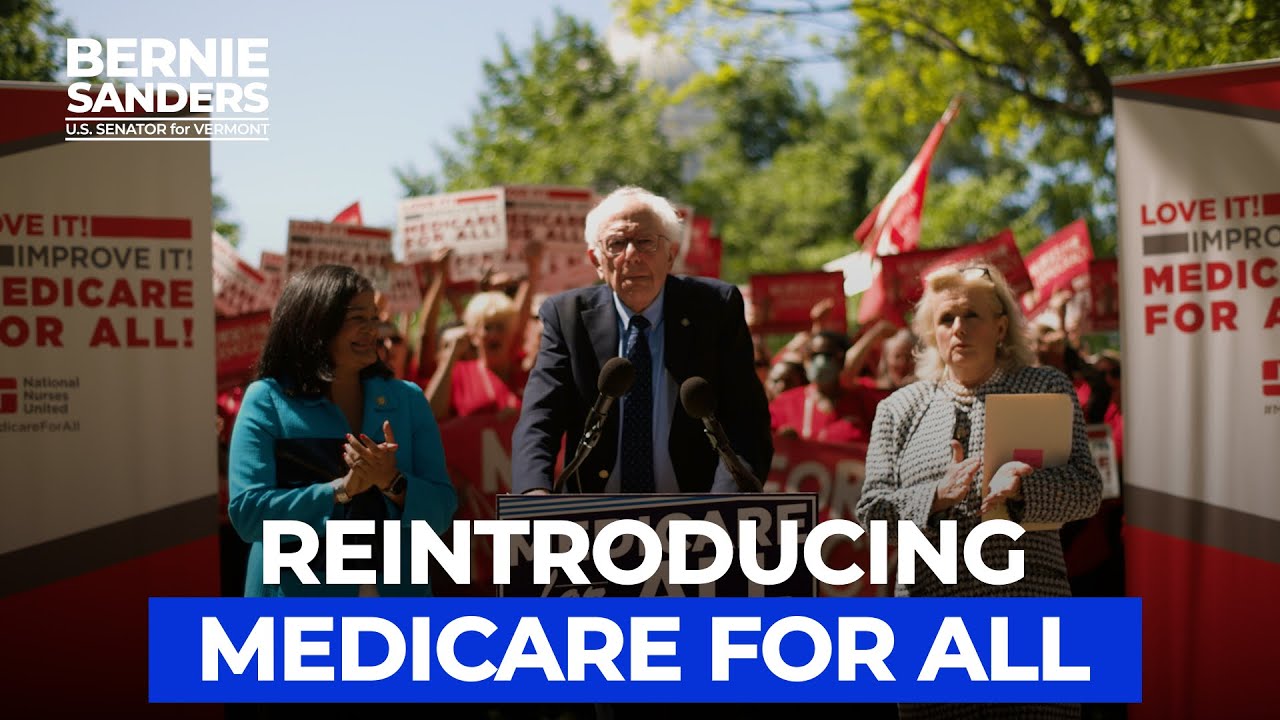
“The function of a rational and humane health care system is to provide quality care for all as a human right. It is not to make tens of billions of dollars every year for the insurance companies and the drug companies.”
— Senator Bernie Sanders, “Health care is a human right,” May 2024
Sanders’s framing isn’t a hedge: the function of the system is care, not profit. Pricing care is what produces denial, denial is what produces the cartridge inscription, and the system’s defenders keep trying to fix it with more market—narrower networks, higher deductibles, ACOs, Medicare Advantage privatization—and a half-century of those experiments has produced costs twice the OECD average and life expectancy nearly three years lower. The framing argues that the categorical mistake was made in 1942 when employer-sponsored insurance became the wartime workaround to wage controls (the wartime-economy chronology is in B-Ch.13: WWII and the Bretton Woods order), and that every subsequent fix has been a patch on a category error.
“Nobody spends somebody else’s money as wisely or as frugally as he spends his own.”
— Milton Friedman, “How to Cure Health Care,” The Public Interest, Winter 2001
Friedman’s framing flips the categorical-mistake claim. The mistake in 1942 wasn’t pricing care; it was severing the price signal from the patient. Tie medical spending to a third party—employer, insurer, government—and the buyer stops shopping, the seller stops competing, and the price drifts upward without resistance. Every subsequent “patch” Sanders criticizes—HMOs, deductibles, ACOs, Medicare Advantage—is downstream of the third-party-payment distortion, not downstream of pricing care per se. The libertarian prescription Friedman defended is direct-pay restoration: high-deductible insurance for the catastrophic tail, medical savings accounts for routine spending, and removal of the employer-tax-distortion that locked the third-party arrangement in. On this reading, the OECD comparators don’t prove that markets fail in healthcare; they prove that regulated price-controlled multi-payer arrangements with mandatory participation outperform US-style third-party employer-funded coverage. That conclusion narrows the dispute differently than Sanders’s does.
What the temperature signals
The cultural moment of December 2024 isn’t signaling a tweak-the-deductibles dispute. The bullets and the polling tell you the public has stopped arguing about parameters and started arguing about frames: is this a kind of object that should be priced at all? Sanders’s position is the strong form of one frame; the mainstream-apparatus answer is a different one. Both deserve serious engagement, not the “some say X, some say Y” dodge. The interesting fact, and the one most readers don’t know, is that mainstream economics already had a precise answer to the kind-of-object question. It published the answer in 1963.
The mainstream didn’t wait for the cartridges to admit healthcare wasn’t a normal market. The admission has been on the record for sixty years, in a paper by an economist who would later win the Nobel Prize. The question isn’t whether Kenneth Arrow was right about market failure. The question is what follows from Arrow being right.
Arrow’s admission
“The special economic problems of medical care can be explained as adaptations to the existence of uncertainty in the incidence of disease and in the efficacy of treatment.”
— Kenneth Arrow, “Uncertainty and the Welfare Economics of Medical Care,” American Economic Review, 1963
A decade after proving the welfare theorems that made competitive markets the textbook ideal, Arrow wrote the paper conceding healthcare violates the theorems’ conditions on every front. Not a heterodox critique. The founding admission, from inside.
Arrow walked through the violations one by one. Information asymmetry: your oncologist knows things about your tumor that you cannot evaluate, no matter how many WebMD tabs you open. The doctor is both diagnostician and seller, which means the seller decides how much you buy. Moral hazard: once you have insurance, the marginal cost of seeing a doctor falls to your copay, which is far below the marginal social cost of the visit. Consumption rises above the efficient level. Adverse selection: the people most eager to buy insurance are the people most likely to need it, which pushes premiums up, which drives healthy people out, which pushes premiums up again. Demand inelasticity in emergencies: you do not shop for an ambulance. Price signals don’t discipline a buyer who cannot walk away.
Each violates a condition of the first welfare theorem. Take all four together, as Arrow did, and the mainstream framework itself tells you healthcare is the textbook case where unmodified markets fail.
The Akerlof (1970) lemons model formalizes adverse selection in insurance. Willingness to pay rises with expected loss $E[L_i]$; competitive premiums equal expected payout in the pool. If insurers can’t observe $L_i$, equilibrium premium $p$ solves:
$$p = E[L_i \mid \text{type } i \text{ buys at premium } p]$$As $p$ rises, low-$L$ types drop out, raising the conditional expectation, raising $p$. Stable full-coverage equilibria may not exist. The Rothschild-Stiglitz extension shows pooled contracts are unstable and separating equilibria can fail to exist. This is one node in a longer arc—Arrow 1963 opens the line, Akerlof 1970 formalizes adverse selection, Spence 1973 adds signaling, Rothschild-Stiglitz 1976 carries it into insurance markets, and mechanism design closes it—traced as intellectual history in History of Economic Thought Ch.11 §11.3: The lemons and the signal.
Insurers can’t tell who’s sick before signing them up, so they price at average risk. The healthiest customers look at the average-risk price, decide it isn’t worth it, and don’t buy. The pool gets sicker, the price rises, the next layer of healthy customers drops out. Run the cycle and only the chronically ill remain—exactly the people insurance is supposed to spread risk across. Universal participation breaks the spiral, which is why every functioning insurance system mandates it.
For the full formal treatment, see Chapter 4 of Economics: Market Failures.
What follows from Arrow being right
“Recognition that medical care does not satisfy the assumptions of a competitive model justifies departures from the competitive norm.”
— Arrow, “Uncertainty and the Welfare Economics of Medical Care,” 1963
The Sanders frame from Stage 1 reads Arrow as endorsement: the mainstream itself concedes the market fails, so the frame-level rejection is justified. That reading lands a real blow. If you grant Arrow, you grant that the textbook competitive-market case for healthcare is gone. What you do not grant is that the only remaining option is single-payer. Arrow concluded that institutions emerge to handle the failures—professional licensing, insurance pools, regulated provider relationships, government provision—and that the design question is which mix produces the best outcomes. The categorical refusal of markets is one possible answer to that design question, but it isn’t the only one Arrow’s argument permits.
The dispute, narrowed
The frame question has an answer, and it’s been on the record since 1963: healthcare is not a textbook market. The argument that “the market” will discipline costs through consumer choice is not a defensible position inside mainstream economics—it’s a position the mainstream rejected sixty years ago. What’s genuinely contested, and where reasonable mainstream economists disagree, is which combination of single-payer monopsony, all-payer rate-setting, regulated competition, and public provision handles the named failures best. That’s the dispute the next three stages live inside.
Granting Arrow narrows the question to design. So pick a specific design failure and look at the evidence. The US spends twice the OECD average per capita and gets nearly three fewer years of life. Where does the money go? A 2019 paper in the Quarterly Journal of Economics put a number on a big piece of it, and the number isn’t small.
The 15.3% markup
“Hospital prices in monopoly markets are 15.3 percent higher than those in markets with four or more hospitals... Half of the spending variation across US regions is driven by price variation across regions and half by quantity variation.”
— Cooper, Craig, Gaynor, and Van Reenen, Quarterly Journal of Economics, 2019
A peer-reviewed paper at the top of the field putting a clean number on one of Arrow’s failures. Where the local hospital is a monopoly, it charges 15 percent more than where four or more hospitals compete. That’s not the whole US-versus-OECD gap, but it’s a measurable piece of it, and the mechanism has a name: bargaining power extracted by concentrated providers from fragmented insurers.
Market structure is the relevant apparatus—the part of microeconomics that asks what happens to prices and quantities when the number of sellers shrinks. The benchmark is perfect competition (many sellers, identical product, zero markup over marginal cost). The opposite pole is monopoly (one seller, markup determined by demand elasticity). The space between has names: Cournot oligopoly, Bertrand price competition, monopolistic competition, bilateral oligopoly. US hospital markets sit closer to the monopoly end than to the competitive end, and the closer they sit, the more they can charge insurers without losing volume.
The Cooper et al. result is the empirical version of the textbook prediction. They built a dataset of private-insurer claims, measured local hospital concentration using the Herfindahl-Hirschman Index, and identified the markup off the cross-region variation. A monopoly-market hospital charges 15.3 percent more than a four-plus-hospital-market peer for the same procedure. The number controls for case mix, quality, and a long list of confounders. It is the cleanest available estimate of how much US healthcare spending is rent extracted by concentrated providers, as distinct from spending that buys real care.
For the apparatus on concentration, oligopoly, and antitrust measurement, see Chapter 6: Market Structures and Game Theory. The HHI definition, the Cournot-Nash result, and the bilateral-oligopoly model all live there.
“This is literally the easiest industry to interrupt, to disintermediate, that I’ve ever been involved with... The dominant three PBMs put stock price over health.”
— Mark Cuban, STAT First Opinion Podcast, October 2024
The fix for the hospital markup isn’t less market. It’s more.
Cost Plus Drugs sells common generics at 15 percent margin and beats PBM-mediated prices by 50–90 percent. The hospital markup is the symptom of insufficient competition, not of competition per se. The mainstream design answer here points at antitrust and transparency, not at single-payer.
A measurable piece of the gap
A meaningful share of the US-versus-OECD spending gap is rent extracted by concentrated providers and PBM intermediaries, not real care delivered. The Cooper et al. result puts a number on the hospital portion. The Cost Plus Drugs data puts a number on the generics portion. Together they sketch a system where the market-design problem is identifiable and, in principle, fixable inside the apparatus mainstream economics already has. This is the strongest case for the “more market, better designed” reading. It is not the whole story, because rents don’t explain the whole gap, and the parts of healthcare where competition fails the worst aren’t the parts where Cost Plus Drugs has a chance.
If rents explain the whole gap, the answer is antitrust plus disintermediation and we’re done. They don’t. The OECD-comparator countries that match US life expectancy at half the cost aren’t doing better antitrust on hospital chains; they’re running structurally different insurance arrangements. So the frame-level question returns: maybe Sanders has the better read after all.
The single-payer case at full strength
“Kidney exchange is a market without money. Most of what market design tries to do is figure out which markets need money and which work better without it.”
— Alvin Roth, 2012 Nobel laureate in economics, on market design and kidney exchange
Stage 1 set up the Sanders / Friedman frame dispute. Stage 4 enters the mechanism-design corner of the same fight. Roth’s sentence is the apparatus answer to the question Friedman’s and Sanders’s framings both press: which sub-markets of healthcare benefit from money-mediated prices, and which work better through a different allocation rule? Roth and his collaborators designed the working US kidney-exchange clearinghouse without using money at all, and the design has saved thousands of lives. That existence proof reframes the question. The argument isn’t “Bernie says X” or “Milton says Y.” The argument is that every other rich democracy ran the institutional experiment, and the experimental results favor a structurally different arrangement than the US runs.
The relevant apparatus is the mechanism-design question: given Arrow’s market failures, which institutional arrangement produces the best welfare outcome? The candidates are single-payer monopsony (one buyer, usually the state, negotiates prices on behalf of the whole population—Canada, the UK), all-payer rate-setting (multiple insurers but uniform regulated prices—Maryland, France), regulated competition with universal mandate (Germany, Switzerland, the Netherlands), compulsory medical savings (Singapore Medisave—Phua Kai Hong and the Singapore MOH frame it as a personal-responsibility-plus-catastrophic-coverage scheme designed to detach healthcare financing from the budget cycle), and public option layered on private markets (the current US system plus a Medicare-for-all-who-want-it overlay). Most of these are postwar inventions; the social-insurance maturation in Bismarck Germany and the founding of the UK National Health Service in 1948 sit inside the postwar welfare-state setup chronicled in B-Ch.14: The postwar golden age and decolonization.
The mechanism-design lens reveals what’s actually at stake. Each arrangement is a different way of handling Arrow’s four failures. Single-payer addresses adverse selection by mandating universal participation; it addresses the hospital-markup problem by giving the state monopsony bargaining power against providers. All-payer rate-setting addresses the same problems through price regulation rather than monopsony. Regulated competition keeps multiple insurers but neutralizes adverse selection through community rating and individual mandates. Compulsory medical savings substitutes a forced-savings-plus-catastrophic-insurance pair for risk pooling and uses heavy government provision on the catastrophic tail. The empirical record across these designs is decades long and reasonably consistent: all of them produce OECD-average spending of roughly half the US level, with life expectancy two to three years higher. The US went the opposite way after the 1970s; that divergence is part of the post-1971 deregulation arc traced in B-Ch.16: Stagflation and the neoliberal turn.
The deeper apparatus question—which allocation mechanism is right for which sub-market—is what the field of mechanism design and market design exists to answer. Roth and his collaborators built the working US kidney-exchange clearinghouse on this apparatus; Hurwicz, Maskin, and Myerson built the formal foundation. For the toolkit (incentive compatibility, the revelation principle, VCG mechanisms, matching markets), see Chapter 12: Mechanism Design and Market Design. The intellectual arc that runs from Arrow’s 1963 market-failure admission through Akerlof, Spence, and Rothschild-Stiglitz to mechanism design as its culmination is the spine of History of Economic Thought Ch.11 §11.4: Inverting the problem — mechanism design. For the institutional-economics framework that makes sense of how these different arrangements emerged and persisted, see Chapter 18: Institutional Economics. For the market-failure foundation, the relevant chapter is again Chapter 4.
The empirical record, steel-manned
Here’s the strongest form of the single-payer case, on the apparatus’s own terms. Arrow showed in 1963 that healthcare violates every condition of the welfare theorems. Every other rich democracy took Arrow seriously and built systems that either eliminate the private insurance market or regulate it so heavily it ceases to function as a market in the textbook sense. Those systems achieve, on average, \$6,000 per capita spending versus the US’s \$13,000, and 81-year life expectancy versus 78. The comparison is across systems we observe, not models we estimate.
The mainstream-defender response that “single-payer can’t pass politically” evades the question. Sanders’s argument is that treating healthcare as a market produces the categories of harm—denied claims, surprise bills, medical bankruptcy—that no amount of better market design eliminates, and that December 2024 reflects voters reaching the same conclusion. The political constraint describes the obstacle, not a refutation of the argument.
There’s a dimension the mainstream-apparatus answer chronically under-weights: the dignity cost of pricing care. Two patients with identical conditions and outcomes have categorically different experiences if one received treatment without seeing a bill and the other spent six months negotiating with an insurer. The mainstream framework can absorb this as a non-pecuniary externality, but the absorption is a hedge—it converts a moral claim into a footnote in the welfare calculation. The Sanders frame doesn’t treat it as a footnote.
Frame matters
The mainstream-apparatus answer is partial. It captures the rent-extraction story precisely, prices the welfare losses from market failures cleanly, and identifies which design choices fix which failures. It under-weights two things: the political-feasibility constraint that single-payer advocates point at when they say “then build it” and the dignity dimension that voters in December 2024 are reacting to. A complete answer carries the mechanism-design rigor of the mainstream framework and acknowledges that the framing question—market versus right—isn’t a strict either-or. Some sub-markets of healthcare should be priced and competed; others shouldn’t. The next stage gets concrete about which.
A “single-payer for everything” system has the same problem in reverse: it treats the parts of healthcare where market discipline does work (generic drugs, routine outpatient care) the same as the parts where it doesn’t (emergency care, oncology). The right design is calibrated. One famous example of that calibration arrived in 2023 with a drug whose marginal cost of production is roughly two dollars.
The calibrated hybrid
“Last year, I signed a law to cap insulin at $35 for seniors and I called on pharma companies to bring prices down for everyone on their own. Today, Eli Lilly did that. It’s a big deal, and it’s time for other manufacturers to follow.”
— President Biden, March 2023, on Eli Lilly capping insulin at \$35/month and cutting Humalog list price from \$274.70 to \$66.40
A drug whose marginal production cost is roughly two dollars, listed at $274 for a century via patent extension and formulation tweaks, cut to \$66 in a single press release after legislative pressure plus public shaming. The cleanest available example of what legislative intervention can do to a sub-market the textbook market framework has failed for a hundred years.
The apparatus reading: insulin is a sub-market where every condition for competitive pricing fails. Demand is perfectly inelastic for the chronically diabetic. Patent extension via formulation tweaks (insulin glargine, insulin lispro) kept entry barriers up for decades after the original patents expired. PBM rebate structures made price transparency impossible at retail. The market structure was effectively a regulated oligopoly extracting maximum surplus from an inelastic-demand population that couldn’t exit. The textbook prediction is exactly the observed outcome: prices far above marginal cost, persistent over time, captured rent for the producer.
The Inflation Reduction Act’s Medicare price-negotiation provision and the Biden administration’s public pressure changed the institutional environment without changing the apparatus. Eli Lilly didn’t suddenly discover a cheaper way to make insulin. The political cost of holding the \$274 list price exceeded the foregone revenue from cutting it. The IRA provision itself is a partial reversal of the 2003 Medicare Modernization Act’s non-interference clause, the Bush-era continuation of the post-1970s deregulation arc traced in B-Ch.16: Stagflation and the neoliberal turn. The relevant economics here is not about supply and demand in the textbook sense; it’s about which institutions decide what prices clear. A century of letting the manufacturer decide produced \$274. One year of public shaming plus the threat of Medicare negotiation produced \$66.
This is the design lesson. Sub-markets where producers extract monopoly rent from inelastic demand are not parts of healthcare where “more competition” helps—there isn’t any meaningful competition to introduce, and Cost Plus Drugs’s success at generic distribution doesn’t scale to patented drugs with extended exclusivity. The right tool is direct price intervention. Pigouvian logic doesn’t quite apply (no externality to internalize) but the logic of countervailing monopsony power does, and so does basic political economy: when the producer’s market power is total, the regulator’s leverage is what determines the price.
“The costs of healthcare are borne by us as a society. We’re going to have to live with the ill effects of a consolidated market once we let hospitals merge, so they deserve additional scrutiny... [Private equity’s] short-term, high-risk, and low-consequence ownership can encourage a ‘flip and strip’ approach.”
— Lina Khan, FTC Chair, Private Capital, Public Impact Workshop, March 2024
Antitrust was the right tool. The country had it for four years, then lost it.
Khan was the most aggressive antitrust enforcer of a generation. She named private-equity rollups in hospital chains as “flip and strip.” She departed under the Trump administration in 2025. The market-design answer to the hospital markup requires institutional commitment, and the commitment proved fragile.
The position
Healthcare is a market in some places and not in others. In the places where buyers can shop and sellers can enter—generic drugs, routine outpatient care, lab work, much of dental and vision—market discipline plus serious antitrust produces good outcomes, and the country should run more of that, not less. In the places where information asymmetry and demand inelasticity dominate—emergency care, oncology, complex surgery, mental-health acute care—competition is the wrong tool, and the mainstream apparatus points at regulated rate-setting or monopsony bargaining. Insurance pooling specifically is a sub-market where adverse selection makes private competitive insurance structurally fragile, and the rest of the OECD figured out that universal participation plus regulated or monopsony bargaining is the workable design. The right verdict for the US is a calibrated hybrid: single-payer or all-payer for insurance and price-setting in the inelastic-demand sub-markets, market discipline for delivery innovation and the elastic-demand sub-markets, structural commitment built in so the design doesn’t require an FTC chair willing to bring cases every year. The walkthrough takes this position and acknowledges the caveats: the political path to it is not in view, the calibration is contestable submarket by submarket, and the dignity dimension that drove the December 2024 cultural moment isn’t fully captured by any of the apparatus options.
Where this leaves us
Five stages in, here’s the spine:
- The cultural moment is a frame-level dispute (Stage 1). The cartridges and the polling signal the public has stopped arguing about parameters and started arguing about whether healthcare should be a priced good at all.
- Mainstream economics conceded the frame question in 1963 (Stage 2). Arrow showed healthcare violates every condition of the welfare theorems. “The market will sort it out” is not a defensible position inside mainstream economics.
- A meaningful share of the US-versus-OECD gap is rent (Stage 3). Cooper et al. put 15.3 percent on the hospital markup; Cost Plus Drugs documents 50–90 percent margins extracted on generics. For these sub-markets, more market with serious antitrust is the right answer.
- The single-payer case has empirical force (Stage 4). Every other rich democracy runs structurally different insurance arrangements and gets OECD-average spending at half the US level with two to three more years of life expectancy. The political-feasibility constraint and the dignity dimension belong in the calculation, not the footnotes.
- The right answer is calibrated by submarket (Stage 5). Insulin at \$66 shows what legislative intervention can do where competition isn’t available; Khan’s departure shows what antitrust can and cannot achieve under political variance. A single-payer-for-insurance-plus-market-for-delivery hybrid, with structural commitment built in, is the position the walkthrough lands on.
Healthcare isn’t one market; it’s a bundle of sub-markets with different failure modes, and the right institutional response is correspondingly diverse. The frame-level dispute the cartridges signaled isn’t resolvable by parameter-tuning alone—it requires the country to decide which sub-markets stay markets and which become regulated entitlements. That decision is political, not technical. But the technical content of mainstream economics narrows the space of defensible positions considerably more than the public discourse suggests.