Is China actually collapsing?

For twenty years, one man has predicted China’s collapse — and for twenty years, China has refused to oblige. So why does the case keep getting louder?

Stage 1 of 4

The collapse thesis at full volume

“This is the last decade of a unified China. The demographics are catastrophic, the debt is unpayable, and there is no way out. China is going to fall apart.”

— Peter Zeihan, the demographic-determinism case (viral 2022–24 clip corpus)

In 2023 the “Peak China” thesis went mainstream — a population cliff, a property sector cratering, deflation setting in, and a chorus telling tens of millions of viewers that the end was finally here. Is the most-cited collapse case right? Or is it the most over-predicted event in modern economics?

Start by taking the bears at their word. Two of their drivers are visceral enough that you can almost feel the floor giving way: the demographic cliff and the property crater. Before any apparatus pushes back — that is the work of the next two stages — it is worth seeing exactly how each one is supposed to enter the economy, because the place where a driver enters tells you what kind of damage it can do.

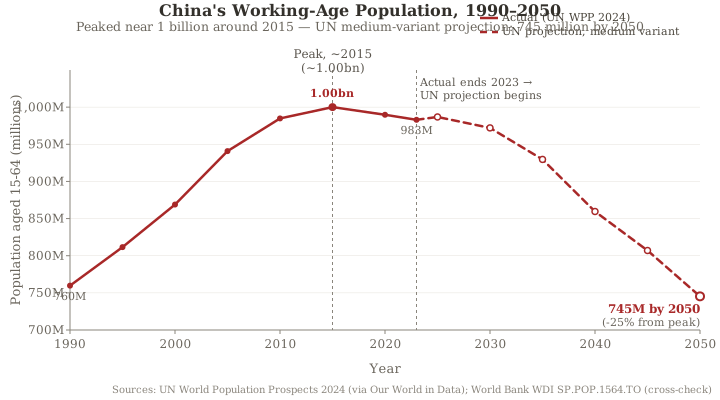
Where demographics enter. Growth accounting splits an economy’s output growth into three contributions: more workers, more capital, and more productivity from each. China’s working-age population peaked around 2015 and is now shrinking; the one-child-policy legacy makes the decline near-irreversible on any horizon that matters for policy. In the accounting, that turns the labor-input term from a tailwind into a drag. Hold that thought, because it has a sharp edge the collapse frame tends to blunt: a shrinking workforce lowers the growth rate. It is not, by itself, a mechanism for an economy to stop functioning.

China’s working-age population (ages 15–64) rose for three decades, peaked around 2015, and is now in a long decline. Schematic; trajectory after UN World Population Prospects 2024 and China NBS.

Why property is macro-consequential. The second driver enters somewhere much more dangerous. Real estate and its supply chain came to account for something like a quarter to a third of Chinese GDP at the peak, and housing became the dominant store of household wealth — the place ordinary families parked their savings. So a property correction is not a sector story the way a struggling airline is a sector story. It is a hit to the largest single component of demand and to the balance sheet of nearly every household at once. That is why the bears are right to put property at the center of the collapse case, and it is why the question of whether property brings down the whole economy is the question Stage 3 has to answer.

One boundary, stated up front. The property crisis is engaged at its full apparatus depth — the developer cascade, the leverage mechanics, the soft-landing-versus-lost-decades wager for the property sector specifically — in the companion walkthrough “Is China’s property crisis a controlled demolition or a collapse?” Here, property is one driver among several in a broader question, and it is engaged at the does-it-bring-down-the-whole-economy altitude. We name the driver; we do not re-derive the real-estate-credit machinery.

For the growth-accounting decomposition that demographics enters through — the labor-input term and the empirics of convergence — see Economics Ch 13 §13.6 (Convergence and Growth Accounting); for why a property correction registers as a macro shock rather than a sector one, the national-accounts framing is Ch 7 §7.1 (Gross Domestic Product). The reform-era growth miracle this whole question is a claim against — the 800-million-out-of-poverty arc, the investment-led catch-up — is the spine of History Ch.17 (China’s reform and the Asian century), and the apparatus that explains why that miracle happened is the sibling walkthrough “Why are some countries rich and others poor?” — the success this walkthrough asks whether is ending.

观点

“China is more fragile than it appears. The Communist Party will fall, and probably sooner than later.”

— Gordon Chang, The Coming Collapse of China (2001), which forecast collapse by 2011 — re-issued annually since

The collapse that was always five years away

Gordon Chang predicted China’s collapse by 2011, then re-predicted it every year since. The track record is a meme. But strip away the timing and his structural points are the ones the careful bears still make today. Which part is wrong?

The cliff and the floor

“The working-age population is shrinking, the property market that held household wealth is in free fall, prices are falling, and confidence has broken. This is twenty years of structural fragility finally cashing in — all at once.”

— The collapse thesis, stated in its own voice

Argue the bear case at full strength, because it is not a strawman. The demographic decline is real and irreversible. The property crater wiped out paper wealth across the household sector and took local-government finances with it. The deflation prints of 2023–24 are the signature of an economy where demand has cracked and nobody wants to spend. Put those together and you have not one problem but a bundle that arrives simultaneously, each one feeding the others — the falling prices deepening the debt, the lost wealth crushing the spending, the shrinking workforce removing the growth that would have outrun all of it. The bears are describing something genuinely alarming.

“Adverse demographics shape an economy’s growth rate. They do not, by themselves, end it. Japan ran the same demographic film starting in the 1990s — and got stagnation, not collapse.”

— The first calibrating push-back (the full counter is built in Stages 2–3)

This is only the opening push-back, not the verdict. But notice what it does to the bundle. Demographic determinism proves too much: run it on Japan and it predicts a 1990s collapse that never came — what came instead was thirty years of slow growth. So “the workforce is shrinking” tells you the growth rate is falling, which nobody disputes; it does not tell you the economy stops. And the property crater, the most frightening driver, is exactly the one whose mechanics belong to a different question — whether the credit machinery cascades is engaged at apparatus depth in the property-crisis walkthrough. The bear case is alarming. Whether it is collapse depends on machinery this stage has deliberately not yet shown you.

Where this leaves us

The collapse case is vivid, and the structural fragilities behind it are real. But “vivid” and “real” are not “collapse.” The two drivers the bears lead with are a growth-rate problem (demographics) and a sector problem that touches every balance sheet (property). Whether they compound into an economy-ending event is precisely the question the apparatus has to settle, and we have not run it yet. The number to carry forward is not “collapse: yes or no.” It is: how hard does the high-growth era end, and does it cascade?

The bears say the engine itself is broken — that the investment-and-property machine that built the miracle has hit a wall, and there is nothing behind it. Are they right? To answer that, you have to look at what actually drives growth at China’s stage, and what happens when the easy gains run out.

Stage 2 of 4

Is the growth model exhausted?

“China is at or near its peak as a global power. The growth model that propelled its rise is exhausted, the demographics are turning, and the easy catch-up is over. The dangerous question is what a peaking power does next.”

— Hal Brands & Michael Beckley, the “Peak China” thesis (Foreign Affairs, 2021)

This is a different claim from Stage 1, and a more careful one. Not “China collapses” but “the growth model is exhausted and the rebalancing is hard.” This is the credible bear case — and it is the one the mainstream largely concedes. The question is whether “the catch-up engine is finished” means what the strong-form collapse case wants it to mean.

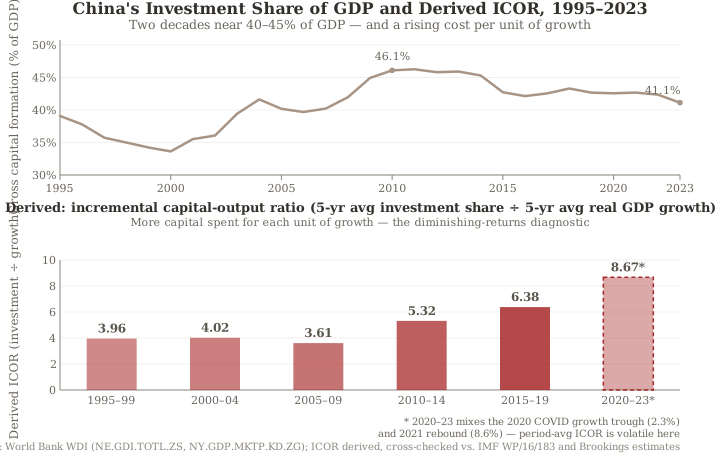
Why the catch-up engine slows. Growth from accumulating capital runs into diminishing returns. The first highway through a region transforms it; the tenth parallel highway barely moves the needle. China spent two decades investing 40–45% of GDP — building the bridges, the factories, the apartment blocks that a poor, capital-scarce economy desperately needed. That phase has an end built into it: as the capital stock catches up, each additional unit of investment buys less growth. The diagnostic is the incremental capital-output ratio, and it has been rising for years — more investment, less growth per yuan. The Solow framework predicts exactly this deceleration as an economy approaches its steady state.

The surplus-labor reserve runs out. The other catch-up tailwind was people moving from low-productivity farming into higher-productivity factories — the Lewis dual-sector dynamic, where a vast rural reserve lets industry expand for decades without bidding up wages. That reserve is largely drained. Past the Lewis turning point, wages rise, the cheap-labor edge erodes, and growth has to come from somewhere harder: productivity, not more workers or more capital.

Growth accounting decomposes output growth into the contributions of capital, labor, and total factor productivity:

$$\frac{\dot Y}{Y} = \alpha \frac{\dot K}{K} + (1-\alpha)\frac{\dot L}{L} + \frac{\dot A}{A}$$

China’s past growth leaned on the capital term ($\dot K/K$) and a positive labor term ($\dot L/L$). Demographics now turn the labor term negative; diminishing returns shrink the payoff to the capital term. The only term that can sustain growth at the frontier is productivity, $\dot A/A$ — and whether China can lift it is the open question, not a foregone failure.

直觉模式

You can only build so many bridges before the next one isn’t worth building. For thirty years China was a country that needed bridges, and building them produced fast growth. Now most of the bridges that pay off are built. To keep growing, the country has to get better at making things rather than just making more — and that is a genuinely different, harder kind of growth. It is also the kind every rich country runs on, so it is not impossible. It is just not automatic.

The middle-income trap. This transition — from catch-up growth to productivity-led growth at the frontier — is empirically the hard part. Most middle-income economies stall there; the leap from middle to high income is the rare outcome, not the default. China is attempting it at unprecedented scale, with adverse demographics and a deteriorating external environment. That is a real risk. It is also, crucially, a risk, not a verdict: the same apparatus that flags the trap also notes that China is still well below the US productivity frontier, which under Solow convergence means catch-up room remains.

The formal home of diminishing returns and the Solow/Ramsey steady-state is Economics Ch 13 §13.1 (The Ramsey-Cass-Koopmans Model); the question of whether China can move to productivity-led growth is the §13.4 Romer endogenous-growth question. The Lewis turning point and the middle-income-trap literature live in Ch 20 §20.2 (The Lewis Model). The investment-share trajectory and the rebalancing-debate arc — from Wen Jiabao’s 2007 “unbalanced, uncoordinated, unsustainable” onward — sit in History Ch.17, with the East-Asian developmental-state comparators (Japan, Korea, Taiwan) in Ch.14 (The post-war golden age and decolonization). For the intellectual lineage — Solow to Romer on the growth side, Lewis and the structuralist founding on the development side — the development tradition’s home is History of Economic Thought Ch.16 §16.1 (Lewis and the structuralist founding), and the whole growth lineage can be traced on the intellectual-lineage timeline in growth mode.

观点

“The investment-led model is exhausted. Without a decisive shift to household consumption, China cannot sustain anything like its past growth — and the rebalancing has been talked about for fifteen years without being done.”

— the rebalancing case, after Michael Pettis, The Great Rebalancing (2013) and rolling commentary

“Peak China”: the careful bear case

This is the bear case the mainstream takes seriously — not collapse, but exhaustion. The growth model that worked for the catch-up phase doesn’t work at the frontier, and the rebalancing is genuinely hard. How much of it is right?

Exhausted engine, or room to converge?

“You cannot grow forever on investment that earns less and less. China’s investment share is unsustainable, the returns have collapsed, and until household consumption rises sharply there is no engine to replace it.”

— Michael Pettis, the rebalancing-imperative case

Pettis is the most rigorous voice for the exhaustion case, and his argument is an accounting one, not a mood. If investment’s marginal return has fallen below its cost, continuing to pour 40%-plus of GDP into it destroys value and piles up debt — which is exactly the rising-ICOR, rising-debt pattern the data show. The only sustainable replacement is household consumption, and that requires a deliberate transfer of income and security to households that the political system has resisted for fifteen years. On this reading the slowdown is not a temporary cyclical dip; it is the structural consequence of an exhausted model that has not been replaced. The development-economics lineage this sits inside — Lewis through the modern structuralists — runs along the growth lineage on the History of Economic Thought timeline.

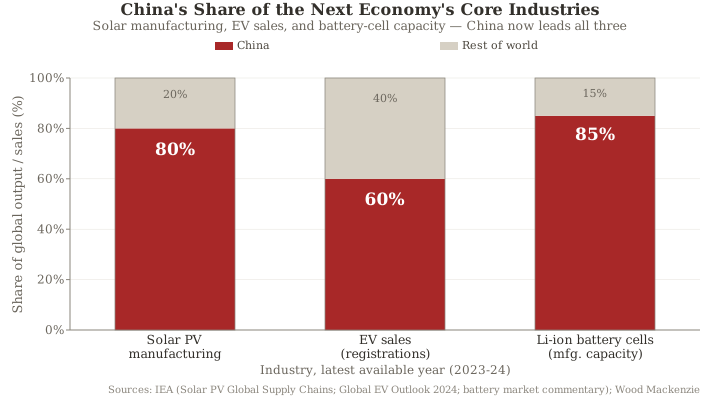
“China is still far below the technological frontier, and in the industries that will define the next economy — EVs, solar, batteries — it is now the frontier. Catch-up growth is not exhausted; it has moved up the value chain.”

— the convergence-still-has-room case, after Lin Yifu’s new structural economics

This is a genuine counter, not a softening — and it is why the concession to the bears ends as a question of how much, not a settled bear win. Solow convergence says an economy below the frontier has room to grow faster than the frontier as it closes the gap, and China’s per-capita productivity is still a fraction of the US level. The empirical bite is that China has demonstrably moved to the frontier in whole industries: it leads the world in electric vehicles, dominates solar and battery manufacturing, and is pushing into advanced semiconductors and aviation. That is productivity-led, $\dot A/A$ growth — precisely the term the pessimists say China cannot generate. The bull case is not that the model never had to change. It is that the change is already visibly underway in the sectors that matter most.

Where this leaves us

The investment-led model is exhausted — Pettis is right, and concede it in full: the catch-up engine has hit diminishing returns and the rebalancing is the load-bearing task that remains. But “the catch-up model is over” is not “growth is over.” The apparatus predicts deceleration toward a lower steady-state rate, somewhere in the 2–4% range, not a crater. Whether China clears the productivity transition is genuinely open, and the value-chain evidence cuts the optimistic way. The middle-income trap is a real risk; it is not a verdict. The diagnosis stands; how hard the slowdown bites stays open — and that is the honest shape of the answer, not a dodge.

But there is a darker version of the bear case — not “growth slows” but “the financial system blows up.” Trillions in property and local-government debt, an off-balance-sheet layer no one can fully measure, and a chorus warning of China’s Lehman moment. Is the fragility a slow grind, or a cascade waiting to detonate?

Stage 3 of 4

Cascade, or slow grind?

“If we are too optimistic when things go smoothly, tensions build up, which could lead to a sharp correction — what we call a ‘Minsky moment.’ That should be particularly guarded against.”

— Zhou Xiaochuan, then-governor of the People’s Bank of China, October 2017 — read by the bears as a warning from inside the building

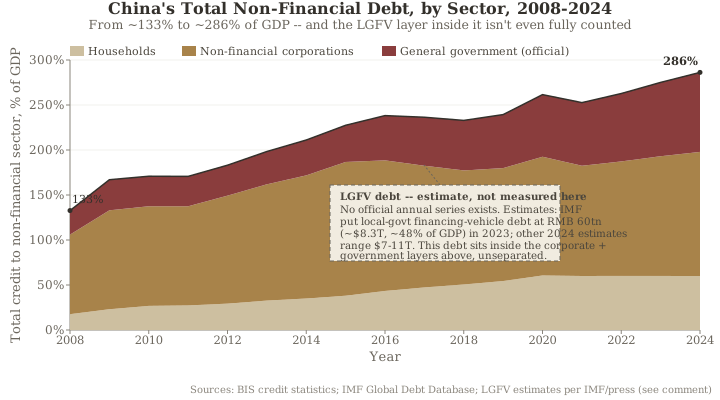
When China’s own central-bank governor uses the word “Minsky moment,” the bears hear a confession. Total debt around 290% of GDP, a local-government financing-vehicle layer estimated north of \$10 trillion that nobody can fully measure, land-sale revenue collapsing. Is this China’s Lehman waiting to happen?

The boundary again, sharper here. The property-sector mechanics — the developer cascade, the leverage channel, the chronology — are engaged at apparatus depth in the property-crisis walkthrough. This stage engages the LGFV-and-debt overhang at the systemic-risk altitude only: does the fragility cascade into a collapse of the whole economy, or doesn’t it? We are asking about the run, not re-deriving the developer balance sheets.

The debt overhang is real, and the channel is demand. Start with the bear arithmetic at full strength. The debt is large and concentrated in the riskiest places: developers, and local governments whose off-balance-sheet financing vehicles borrowed against land values that have now fallen. When a whole sector tries to deleverage at once — households, developers, and local governments all paying down debt rather than spending — the result is the balance-sheet recession Richard Koo described in Japan: monetary policy pushes on a string, because the problem is not the price of credit but the unwillingness to borrow at any price. That is the transmission belt by which a financial problem becomes a growth problem, and it is exactly what the deflation prints of 2023–24 look like.

Now the structural counter: a run needs a door. A cascade — the mechanism collapse actually requires — is not the same as a fragile balance sheet. A cascade is a self-reinforcing run: creditors flee, asset prices crash, the fire sale forces more selling, capital flees the country, the currency breaks. Every link in that chain needs a door to run through. China’s institutional structure has bolted most of those doors. The banks are state-owned and can be directed to forbear and roll over bad loans without a market-clearing event. The capital account is closed and capital controls keep household savings domestic, so there is no balance-of-payments run to trigger a currency crisis. The central government has fiscal space to socialize losses across the system over time. None of this makes the debt disappear. It changes the shape of the risk — from a fast cascade to a slow grind.

The government budget constraint shows why time is the lever. Debt dynamics evolve as:

$$\dot b = (r - g)\,b - s$$

where $b$ is the debt-to-GDP ratio, $r$ the interest rate, $g$ the growth rate, and $s$ the primary surplus. A cascade is what happens when a market forces $r$ up sharply and refinancing fails all at once. A state that controls its banks and its capital account can hold $r$ down administratively and stretch the adjustment over years — converting an acute solvency event into a chronic drag. The arithmetic of insolvency is not repealed; it is rescheduled.

直觉模式

A bank run needs an open door — a way for everyone to demand their money back at once. Close the door, and the same bad loans are still bad, but nobody can stampede. You get a slow, grinding workout instead of a sudden crash. China has closed the doors that turned 2008 into a cascade: its banks answer to the state, its borders are sealed against capital flight. The fragility is real. The stampede is the part the institutions block.

The government-budget-constraint substrate is Economics Ch 16 §16.3 (The Government Budget Constraint); the balance-sheet-recession / demand-drag channel runs through the New Keynesian zero-lower-bound apparatus in Ch 15 §15.8 (The Zero Lower Bound); and the state-capacity framing — why state-owned banking and a closed capital account function as commitment devices that modulate the apparatus rather than replace it — is Ch 18 §18.2 (New Institutional Economics). The 2008 balance-sheet-recession parallel and the 2009 RMB 4-trillion stimulus that built much of today’s leverage are the spine of History Ch.19 (The 2008 crisis and after). For where this whole post-2008 macro-finance reading sits intellectually — Koo, the Minsky revival, the credit-and-balance-sheet turn — see History of Economic Thought Ch.17 §17.2 (the post-2008 reckoning), or trace the modern end of the money lineage on the timeline. The autocratic-state-capacity question this counter leans on is the subject of the sibling walkthrough “Are autocracies better at long-run planning?”; the post-2008 macro post-mortem is “Did economics cause the 2008 crisis?”, and the menu of recession mechanisms this fragility sits within is “What causes recessions?”

China’s total non-financial debt climbed toward roughly 290% of GDP, with a large and opaque local-government financing-vehicle (LGFV) layer (red). Schematic; magnitudes after BIS and IMF estimates.
观点

“This is China’s Lehman moment. The property defaults will cascade through the financial system, the LGFV layer will crack, and the whole edifice comes down.”

— the recurring “China’s Minsky moment” claim (Evergrande-era news cycle)

China’s Minsky moment

The scariest version of the bear case: property plus LGFV plus local-government debt detonate into a systemic cascade — a Chinese 2008. The debt arithmetic is real. So why hasn’t it happened?

Will it cascade?

“When households, developers, and local governments all deleverage at once, demand collapses and no interest-rate cut revives it. That is a balance-sheet recession, and China is in one.”

— the financial-fragility case, after Richard Koo

The fragility voice, at full strength. The numbers are not in dispute: debt near 290% of GDP, an LGFV stack estimated above \$10 trillion, local-government revenue gutted as land sales collapse. Koo’s point is that you do not need a dramatic crash to get a lost decade — you only need everyone to prioritize paying down debt over spending at the same time. Then the central bank cuts rates and nothing happens, because the problem is not the cost of borrowing but the absence of anyone willing to borrow. The demand drag is the channel through which the financial overhang becomes a years-long growth depression, and the deflation prints say it has already begun.

“There will be no Lehman in China, because there is no market that can run. The state owns the banks, controls the capital account, and can socialize losses on its own timetable. A grind, not a cascade.”

— the state-control-levers case, after Nicholas Lardy

The counter does not deny a single number; it denies the cascade. Lardy’s argument is that the arsenal China holds — state-owned banks that can carry bad loans indefinitely, capital controls that pen household savings inside the country, a central government with room to recapitalize — removes every trigger a Western-style financial collapse needs. The crucial distinction is slow grind versus fast cascade: a fragile balance sheet that the state can manage down over a decade is a serious drag on growth, but it is not the self-reinforcing run that turns a financial problem into an economy-ending one. This is the autocratic-state-capacity argument at its sharpest — the deeper treatment of whether that capacity is a durable strength or a deferred fragility is the subject of the long-run-planning walkthrough.

Where this leaves us

The fragility is real: the debt is large, the LGFV layer is opaque, and the balance-sheet-recession drag is the channel through which it bites demand. But a cascade requires a run, and a run requires an open door — and China’s state-owned banking, closed capital account, capital controls, and central-government fiscal space close those doors. China gets a slow grind, not a Lehman. The state levers do not make the headwinds vanish; they change the shape of the risk from cascade to grind. This is the single strongest reason the collapse frame fails: the mechanism collapse needs — the run — is exactly the one China’s institutions are built to block.

So: not collapse, but not the miracle either. A growth model that is exhausted, demographics that will not reverse, a financial system that is fragile but state-backstopped. What does that actually add up to — and which version of the future are we in?

Stage 4 of 4

The verdict: slowdown, not collapse

“The deceleration is real and the structural problems are serious. But the collapse talk tells you more about the people predicting it than about China. This is a slowdown of historic proportions — not an ending.”

— the “deceleration, not collapse” reading, after Adam Tooze and Michael Pettis

The collapse-predictors said 2011, then every year since. The careful bears say “Peak China.” Now pull the three debates together and ask what the apparatus actually returns. Look at the line, not the headline: the reform-era hockey-stick is bending, not breaking.

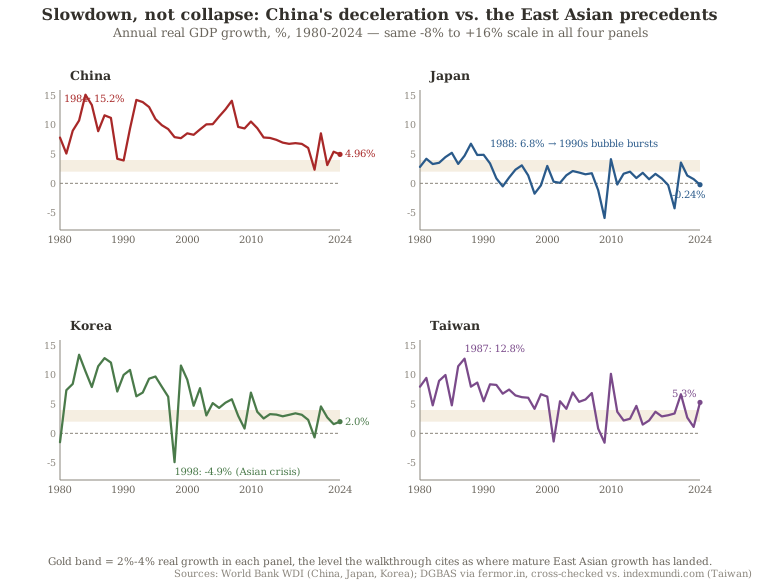
No new apparatus here — this is the three rungs from Stages 1–3 re-applied to a single question: where does this land? Growth theory says an economy that has exhausted capital-deepening and lost its labor tailwind decelerates toward a lower steady-state rate — in China’s case, the apparatus points at roughly 2–4%, not a crater. Development economics says the place it lands is a middle-income transition, and the comparators are instructive: Japan after 1990, Korea and Taiwan after their catch-up phases all stepped down from miracle growth to advanced-economy growth without collapsing. Institutional economics says the state has the levers to govern the descent, which is why the descent is a grind rather than a cascade. Put together, the apparatus does not return “collapse.” It returns “deceleration to a lower steady state, governed but hard.”

The long-run-trajectory reading is Economics Ch 13 §13.6 (Convergence and Growth Accounting); the middle-income-transition landing is Ch 20 §20.8 (Contemporary Development); the state-capacity-governs-the-descent reading is Ch 18 §18.2. The East-Asian precedents — Japan’s post-1990 deceleration, Korea and Taiwan’s middle-income transitions — sit in History Ch.14 and Ch.17. And the trajectory the verdict is about — a decelerating, not cratering, GDP-per-capita line — is visible directly on the map.

The frame question is settled: not collapse. What is genuinely open is the magnitude — how hard the slowdown bites. Here are its two sides, each at full strength.

观点

The lost-decades reading

The rebalancing never gets executed at scale, the precautionary-savings trap persists, and China grinds into 1–2% growth with chronic slack — a Japanese path.

观点

The clean-step-down reading

The state executes the household-side rebalancing, the economy steps down to a stable 3–4%, and China completes the middle-income transition the way Korea and Taiwan did.

What the apparatus returns

“The rebalancing toward household consumption is the load-bearing remaining step. Everything else — the debt, the property, the demographics — resolves better or worse depending on whether China takes it.”

— Michael Pettis, on the parameter that decides the magnitude

Pettis names the parameter the whole magnitude question turns on: whether the state executes a household-side rebalancing — safety net, financial reform, income transfer to households — at sufficient scale. Execute it, and the savings re-allocate, consumption replaces failing investment, and China steps down cleanly to 3–4%. Defer it, and the precautionary-savings trap entrenches and the economy grinds toward 1–2%. This is not a vague hope; it is a nameable policy choice with an observable track record, and four years in, the response has been incremental rather than decisive.

“The economic deceleration is one question. Whether the Party falls is an entirely different one. Confusing the two is how the collapse frame keeps being wrong.”

— the separation the collapse frame refuses to make

The verdict insists on the separation the collapse frame collapses. “The economy decelerates” and “the regime falls” are different claims with different evidence, and the apparatus this walkthrough uses speaks only to the first. A slowdown to 2–4%, or even a Japan-style grind to 1–2%, is a story about growth rates and rebalancing — not a forecast of political rupture. This walkthrough forecasts neither collapse nor regime fall; it declines the political prediction the bears smuggle in, and confines itself to what the economic apparatus can actually decide.

The verdict

First, firmly: the collapse frame is wrong. China is not collapsing, for three reasons the apparatus backs. First, the collapse-predictors have a two-decade losing streak, and demographic determinism proves too much — run it on Japan and it predicts a collapse that became a stagnation. Second, the state holds cascade-breaking levers a market democracy lacks: state-owned banks, a closed capital account, capital controls, central-government fiscal space — the doors a run needs are bolted. Third, a deceleration from 10% toward 2–4% is a normal middle-income transition, roughly where Japan, Korea, and Taiwan landed — it is the high-growth era ending, not the economy ending.

Second, conceded in full: the structural headwinds are real. The bears are right about the diagnosis: demographics are adverse and locked in, the investment-and-property model is exhausted, the consumption rebalancing is genuinely hard, and middle-income-trap risk is real. The high-growth era is over. What remains open is the magnitude — a clean step-down to a stable 3–4%, or a stall into a Japan-style 1–2% trap — and it turns on one nameable parameter: whether the state executes the household-side rebalancing at scale. Four years into the property correction, the response has been incremental. The frame is settled; the magnitude is the live question; and naming it that way — rather than performing a false both-sides on the collapse question the mainstream firmly rejects — is the position.

Where this leaves us

  1. The collapse thesis, at full strength. The demographic cliff and the property crater are real and visceral — but one is a growth-rate problem and the other a sector problem that touches every balance sheet, and neither is yet a collapse mechanism.
  2. The growth model is exhausted. The catch-up engine has hit diminishing returns and the Lewis labor reserve is drained — conceded in full. But exhaustion of the catch-up model means deceleration toward a lower steady state, not a crater, and the productivity transition is genuinely open.
  3. The fragility is real but state-backstopped. The debt and the LGFV overhang are large, and the balance-sheet-recession drag is the channel that bites demand — but a cascade needs a run, and state-owned banking plus a closed capital account close the door. A slow grind, not a Lehman.
  4. Slowdown, not collapse — with the magnitude named. The collapse frame is wrong (firm); the high-growth era is over and the rebalancing is hard (conceded); and the open question is how hard, turning on whether the state executes the household-side rebalancing at scale.

The honest verdict refuses both slogans. It refuses to award the collapse case a win — the frame has been wrong for twenty years, the state holds the levers that break a cascade, and a deceleration to 2–4% is what every middle-income transition looks like, not an ending. And it refuses to pretend the slowdown is not real — the demographics, the exhausted model, the hard rebalancing are exactly what the careful bears describe, and the apparatus concedes every one of them. What it will not do is forecast the politics: economic deceleration and regime crisis are different questions, and only the first is on the table here.

So the live disagreement is not whether China collapses — it doesn’t — but how hard the slowdown bites, and that turns on a single policy choice the next few years will reveal. The collapse is the most over-predicted event in modern economics. The slowdown is the most under-appreciated certainty.