Is the welfare state insurance, redistribution, or stabilization?
The same unemployment check is a risk payout, a transfer from rich to poor, and a brake on the next recession. Which one is it really?
The welfare state as insurance
“Social Insurance fully developed may provide income security; it is an attack upon Want. But Want is one only of five giants on the road of reconstruction… The others are Disease, Ignorance, Squalor, and Idleness.”
— William Beveridge, Social Insurance and Allied Services (the Beveridge Report), 1942
Beveridge built the postwar welfare state on a single word: insurance. You pay in while healthy and employed; you draw out when sick, jobless, or old. Eighty years later, mainstream public economics has turned that founding rationale into a refined body of theory, and it still reads the welfare state first of all as a way to insure the risks that no private market will touch.
Start with why the private market leaves a gap to fill. Health insurance unravels under adverse selection: the people who most want coverage are the ones the insurer least wants to cover, so the price climbs until only the sick are left buying. Unemployment insurance is wrecked by moral hazard: an insurer cannot easily tell a genuine layoff from a quiet decision to stop looking. Retirement saving founders on annuity-market failure and on our own tendency to under-save for a future self we discount too steeply.
Social insurance is the apparatus that picks up what the private market drops. Its near-unanimous support is easiest to see from behind a veil of ignorance: imagine choosing the rules before you know whether you will be born healthy or frail, into a stable trade or a dying one. From there, a risk-averse person votes for the pool every time, as a contract she would sign on her own behalf. That is why the welfare state’s clients include the rich: everyone faces the risks, so the insurance is universal even when the financing is progressive.
Once the welfare state is insurance, its design questions become actuarial. How generous should a benefit be? The answer balances the consumption you smooth against the job search you blunt, the Baily-Chetty rule for the optimal replacement rate. How is the whole tax-and-transfer system best tuned? That is the Mirrlees / Diamond-Mirrlees-Saez program of optimal social insurance, which treats the welfare state as a single mechanism jointly solving for risk-pooling and the equity it can afford. Hold the insurance side as primary for now; Stage 2 will pull on the equity thread the same machinery contains.
The Baily-Chetty condition sets the optimal unemployment-benefit replacement rate where the consumption-smoothing gain equals the moral-hazard cost:
$$\frac{\Delta c}{c} \cdot \gamma \approx \varepsilon_{1-e,b}$$where $\Delta c / c$ is the consumption drop on becoming unemployed, $\gamma$ is the coefficient of relative risk aversion, and $\varepsilon_{1-e,b}$ is the elasticity of unemployment duration with respect to the benefit. A bigger consumption drop or a more risk-averse population justifies a more generous benefit; a more elastic job-search response argues it back down.
A benefit is worth most when losing your job would otherwise crater your spending, and worth least when it just pays people to keep looking a little longer than they would have. The right number sits where the help to someone in genuine trouble stops being worth the extra weeks of search it buys. That trade-off, cushion versus incentive, is the insurance design problem.
The market-failure rationale and the moral-hazard apparatus live in Ch 4 §4.2 (Adverse Selection) and §4.3 (Moral Hazard); the optimal-tax machinery that frames social insurance as a designed mechanism is in Ch 16 §16.7 (Ramsey and optimal taxation). For the intellectual lineage, Beveridge working inside the Keynesian-era settlement, see History of Economic Thought Ch.8 (The Keynesian revolution).
The insurance framing at full strength
Read the welfare state the way Diamond, Mirrlees, and Saez read it, and the moralized arguments fall away. A welfare state is the apparatus by which a society pools the major life-cycle risks — unemployment, disability, longevity, the cost of falling ill — that private contracts cannot price without collapsing. The rich are also covered because they face the same uncertainty about which giant will come for them. The design questions are technical — what replacement rate, what waiting period, what coverage breadth — because an insurance scheme is a thing you tune. On this reading the welfare state is close to a Pareto improvement: a contract risk-averse citizens would write for themselves if they sat down before knowing their luck.
Gøsta Esping-Andersen pushes the same framing one step further: the welfare state, he argued, achieves decommodification, it lets people maintain a livelihood without total reliance on selling their labor on whatever terms the market offers that week. It is the political force inside the actuarial story. A worker who knows that losing this job will not mean losing the house bargains differently and votes differently from one who does not. Taken seriously, the insurance framing is the discipline’s mature account of a question Beveridge was answering correctly: how does a society free its members from the tyranny of the next paycheck without pretending risk away?
What this framing does not ask is the obvious next question. Insurance pools risk, but whose risk, and out of whose pocket? The moment you notice that the contributor and the beneficiary need not be the same person, you have left the insurance frame and entered the next one.
“Programs for the poor are poor programs. Universal benefits build the coalition that keeps them generous; means-tested ones are forever on the chopping block.”
— the universalist case, after Walter Korpi & Joakim Palme, “The Paradox of Redistribution,” 1998
Should social insurance be universal or means-tested?
The insurance framing wants everyone in the pool. The redistribution framing wants the money to reach the people who need it most. They give opposite answers to the same design question, and that is the tell that two framings are at work.
Where this leaves us
The insurance framing is correct as a necessary condition. No welfare state can be defended without reference to the market failures it repairs; the risks are real and the private alternatives really do unravel. But it is incomplete as a sufficient one. Insurance alone cannot account for the fact that the system moves resources between different households, and it is silent on what the whole apparatus does to the business cycle. Keep insurance as the layer where the welfare state’s risk-pooling rationale is captured correctly, and read on for the two layers it leaves out. The postwar buildout this framing relies on, from Beveridge’s Britain to the embedded-liberalism settlement, is the spine of History Ch.13 (The Bretton Woods order) and the OECD-wide expansion of Ch.14 (The postwar golden age and decolonization). (The comparative-political-economy reading runs through Gøsta Esping-Andersen’s The Three Worlds of Welfare Capitalism (1990), a political-sociology source that sits outside the history-of-economic-thought lineage and is cited here directly.) The redistribution-instrument story is the spine of the sibling walkthrough Is inequality a problem economics can solve?; the stabilization story belongs to Does government spending help the economy? The postwar welfare state is itself one major moment in the broader twentieth-century arc traced by the state-formation thread.
Beveridge’s Five Giants are not the only frame the welfare state has lived under. The same unemployment cheque, from the same federal program, reads differently when you stop asking what risk does this insure against and start asking whose pocket does this money come from, and whose does it land in. If the insurance framing is right, the welfare state is a contract we would all sign blind. If the next framing is right, it is the institutional shape of one coalition’s claim on another’s income.
The welfare state as redistribution
“The reduction of inequality that took place in most developed countries between 1910 and 1950 was above all a consequence of war and revolution and of policies adopted to cope with these shocks. The resurgence of inequality after 1980 is due largely to the opposite political shifts of the past several decades.”
— Thomas Piketty, Capital in the Twenty-First Century, 2014
Read it Piketty’s way and the welfare state stops being a risk pool and becomes a verdict on distribution. Its transfers move money between people, the higher-earning to the lower-earning. On this framing the design questions are no longer actuarial; they are political. How progressive should the rates be? Whose benefit gets means-tested away? And what was the great post-1980 rollback if not a redistribution running in reverse?
The redistribution framing builds on the surplus-and-incidence apparatus. Who actually bears a tax is not who legally pays it, the burden settles on whichever side of the market is less able to move, a question of relative elasticities. That is the ground the redistribution framing stands on: every transfer has a real incidence, and the welfare state is the machine that decides where it falls.
The optimal-tax mechanism we just met under the insurance framing is the same mechanism the redistribution framing uses. Mirrlees’s optimal income tax trades an equity gain against an efficiency cost: the social planner picks a tax schedule given how strongly labor supply responds, how inequality-averse society is, and how fat the top tail of incomes runs. Diamond and Saez turn the same logic into a number, an optimal top marginal rate that rises with the right-tail Pareto parameter and falls with the elasticity of taxable income, a rate that sits above today’s statutory top in most rich countries. The machinery has not changed since Stage 1. Only the question we are putting to it has.
Piketty adds the structural worry the static optimal-tax frame can miss: if the rate of return on capital persistently exceeds the growth rate — $r > g$ — inherited wealth concentrates faster than earned income can catch up, and a welfare state that taxes only income is bringing an instrument to the wrong fight.
The Diamond-Saez optimal top marginal tax rate is
$$\tau^{*} = \frac{1}{1 + a \cdot e}$$where $a$ is the Pareto parameter of the top income distribution (lower $a$ = a fatter top tail) and $e$ is the elasticity of taxable income with respect to the net-of-tax rate. A fatter top tail and a less responsive tax base both push the revenue-maximizing top rate up, the same calculus that Stage 1 ran for insurance, now run for the share of the pie.
How high can you push the top tax rate before the rich either stop earning or start hiding it? That ceiling depends on two things: how concentrated the very top incomes are (more concentration, more to gain from taxing them) and how much top earners actually change behavior in response (more dodging, less to gain). Plug in plausible numbers and the revenue-maximizing top rate comes out higher than most countries currently charge.
The surplus-and-incidence baseline lives in Ch 3 §3.4 (Consumer and producer surplus) and §3.5 (Tax incidence); the Mirrlees mechanism that turns private information into an optimal schedule is in Ch 12 §12.1 (The revelation principle); and the same Ramsey-and-optimal-taxation anchor that carried the insurance reading in Stage 1 carries the Diamond-Saez top-rate calibration here, in Ch 16 §16.7. For the lineage of distributional analysis, the modern revival runs through History of Economic Thought Ch.17 (Modern pluralism).
The redistribution framing at full strength
Read the welfare state the way Atkinson, Piketty, and Saez and Zucman read it, and the actuarial language starts to look like a costume. A welfare state is the apparatus by which a society enforces a distributional choice over what its economy produces, who keeps how much. That is why its design questions are political-economic: the rate schedule, the means-testing thresholds, the breadth of coverage defined by whose benefit it is, are all fights over shares, conducted in the vocabulary of fairness. Anthony Atkinson spent a career insisting that the welfare state is the institutional form society’s answer to inequality takes, and that the answer is a choice, not a discovery.
The framing also has to be honest about its strongest opponents. The contraction-regime case — Friedman and Hayek in theory, Reagan and Thatcher in office — held that a sprawling transfer state dulls the incentives that make economies grow, that high marginal rates drive effort and capital abroad, and that “redistribution” is a polite name for one group voting itself the earnings of another. Thatcher’s claim that there is no such thing as society, only individuals and families, was a redistribution argument run in reverse: deny the collective subject and you deny the collective claim. Clinton’s 1996 welfare reform, ending the federal entitlement, was the same logic adopted by the center-left. Take that case at full strength and the redistribution framing earns its reply: the post-1980 turn did not abolish the welfare state; it redistributed it upward, changing whose income the tax-and-transfer system pressed on hardest, and Piketty’s $r > g$ warns that leaving wealth untouched lets concentration outrun any income tax you care to set.
What this framing does not engage is what the transfers do to the economy as a whole. It treats a cheque as a claim on the pie’s division, and misses the injection of demand that lands in the next quarter’s output. That is the scale the third framing operates at.
“There’s class warfare, all right, but it’s my class, the rich class, that’s making war, and we’re winning.”
— Warren Buffett, interview with The New York Times, 2006
Is the welfare state class war or social contract?
One side hears “redistribution” and pictures a contract everyone signed; the other hears it and pictures a raid. The redistribution framing makes the question evaluable without forcing you to pick a villain.
Where this leaves us
The redistribution framing is correct as a positive description of what the welfare state’s design and contraction politics actually contest, rate progressivity, means-testing thresholds, whose income is taxed at what rate, whose benefit is means-tested away. It complements the insurance framing: the same Mirrlees / Diamond-Saez machinery admits both readings, jointly optimizing risk-pooling and the share-of-the-pie. Keep redistribution as the layer where the political-economic contest over distributional shares is captured correctly, the post-1980 story is unintelligible without it. The contraction decades, read as redistributive rollback, are the spine of History Ch.16 (Stagflation and the neoliberal turn); the within-country inequality widening that re-energized this framing after 2000 runs through Ch.18 (Globalization and the great moderation). The comparative trajectories of the rich-world contraction — Britain, the US, Germany, France — are legible at a glance in the GDP map. The deep lineage runs from History of Economic Thought Ch.3 (Classical political economy), where Ricardo first made distribution the central question, through Ch.4 (Marx), with whose class-conflict frame the Atkinson-Piketty tradition stays in productive tension. For the instrument-design depth — top rates, wealth taxes, the mechanism behind them — the sibling walkthrough Is inequality a problem economics can solve? goes where this stage only points. The reframe that asks whether the underlying question is poverty or distribution is taken up directly in Is poverty about poverty, or about distribution?; whether the post-1980 contraction was a coherent policy turn at all is contested in Did neoliberalism actually rule?
The same machinery that Stage 1 read as insurance and Stage 2 read as redistribution has a third reading, one that shows up in neither literature because it operates at a different scale entirely. When the unemployment cheque goes out in a recession, it is a risk payout (Stage 1), a transfer from rich to poor (Stage 2), and a macroeconomic act: it keeps a jobless worker spending, and through that, keeps the downturn from feeding on itself.
The welfare state as stabilization
“The expanded unemployment benefits and the stimulus payments were the single most important reason the pandemic recession did not become a depression. They put money in the hands of people who spent it, immediately, and where it counted.”
— the stabilization case, after the 2021 Furman–Summers exchange on the American Rescue Plan
Even economists who normally argue the welfare state in insurance-and-redistribution terms reached, after 2008 and again in 2020, for a third vocabulary. Jason Furman and Lawrence Summers disagreed sharply on how much stimulus was too much, but both argued in the language of aggregate demand, multipliers, and who spends a marginal dollar. That is the stabilization framing, and the apparatus that makes it precise is the most recent of the three.
Begin with the multiplier. A dollar of government transfer raises output by more than a dollar when the recipient spends it and the recipient’s grocer spends part of that, and so on down the chain, the Keynesian-cross logic that the sibling walkthrough on government spending develops at depth. The welfare state’s distinctive contribution is that it fires this mechanism automatically: in a recession, unemployment claims rise, SNAP enrollment grows, EITC eligibility broadens, all without a single new vote in Congress. These are the automatic stabilizers. Help arrives at the speed of the downturn.
But not every dollar stabilizes equally. The heterogeneous-agent macro literature — Kaplan and Violante’s HANK models, building on the Parker-Souleles-Johnson rebate studies — shows that the marginal propensity to consume is near one for credit-constrained, hand-to-mouth households and near zero for unconstrained savers. A transfer that reaches a liquidity-constrained family is spent; the same transfer to a comfortable saver mostly vanishes into a bank balance. So the welfare state’s distributional design, which household the cheque reaches, is also its stabilization design, because it sets the multiplier.
The accounting confirms the mechanism matters in bulk. Cross-country estimates — Auerbach-Feenberg, Dolls-Fuest-Peichl — find that automatic stabilizers absorb something like a third to a half of a cyclical income shock in OECD economies, with the share varying by how generous and how far-reaching each welfare state is. From there the policy guidance follows: design the welfare state countercyclically, with triggers that widen unemployment benefits in recessions and narrow them in booms. The 2008–2013 emergency benefit extensions are the canonical positive case; the 2020 pandemic top-ups were the largest such experiment ever run.
In a heterogeneous-agent setting, the fiscal multiplier on a transfer is the MPC-weighted average across recipients:
$$\mathcal{M} = \sum_i \omega_i \cdot \text{MPC}_i \cdot (1 + \text{second-round effects})$$where $\omega_i$ is the share of the transfer reaching household type $i$ and $\text{MPC}_i$ is that type’s marginal propensity to consume. Direct the transfer toward high-MPC, credit-constrained households and $\mathcal{M}$ rises toward and past one; direct it toward savers and it collapses toward zero. The stabilization case for a program is conditional on its MPC profile.
A stimulus cheque only stimulates if someone spends it. Send it to a family living paycheck to paycheck and it is spent before the week is out, rippling through shops and wages. Send it to someone with a comfortable cushion and it mostly sits in savings, doing nothing for the economy that issued it. The whole stabilization payoff turns on the cheque being cashed by someone who would otherwise have gone without, which is why who the welfare state reaches decides how well it stabilizes.
The multiplier mechanics that automatic stabilizers operate inside live in Ch 8 §8.4 (IS-LM and the multiplier); the fiscal-multiplier treatment, including how it varies with conditions, is in Ch 16 §16.8 (Fiscal multipliers), the same public-finance chapter that carried the insurance reading at §16.7 in Stage 1 and the redistribution reading at §16.7 in Stage 2, now read for stabilization at §16.8. The depth on multipliers-by-recipient-liquidity and the zero-lower-bound case belongs to the sibling walkthrough Does government spending help the economy? The intellectual lineage runs from History of Economic Thought Ch.8 (The Keynesian revolution), Alvin Hansen named the automatic stabilizer in the 1950s, through the monetarist and Lucas-critique attack on stabilizer thinking in Ch.10 (The counter-revolution), to the heterogeneous-agent revival in Ch.17 (Modern pluralism).
The stabilization framing at full strength
Hansen saw it first and Kaplan and Violante have formalized it: the welfare state is a piece of macroeconomic machinery. A welfare state is the apparatus by which a society stabilizes its own aggregate demand against shocks without anyone having to decide to. Its design questions are macroeconomic: whose MPC profile carries the load, what countercyclical triggers should widen transfers in a slump, how far the system reaches into the credit-constrained households where a marginal dollar actually moves spending. In crises the framing becomes visible. The apparatus that looked like a cost line in good years is, in a downturn, the thing holding the floor.
Three episodes make the case concrete. The 2008–2013 emergency unemployment-benefit extensions kept spending up in the communities hit hardest, and the contrast with European austerity, which cut stabilizers precisely when they were most needed and deepened the slump, reads, in retrospect, as a controlled experiment. The 2020 pandemic response — the enhanced unemployment top-up, the stimulus payments, the expanded food assistance — was the largest deliberate use of the welfare state as a stabilizer in history, and the recession it was meant to cushion ended faster than almost anyone forecast. Then in 2022 the expanded child allowance lapsed, child poverty climbed straight back up, and the lapse became a live test of whether the country had absorbed the stabilization lesson or merely tolerated it under emergency conditions.
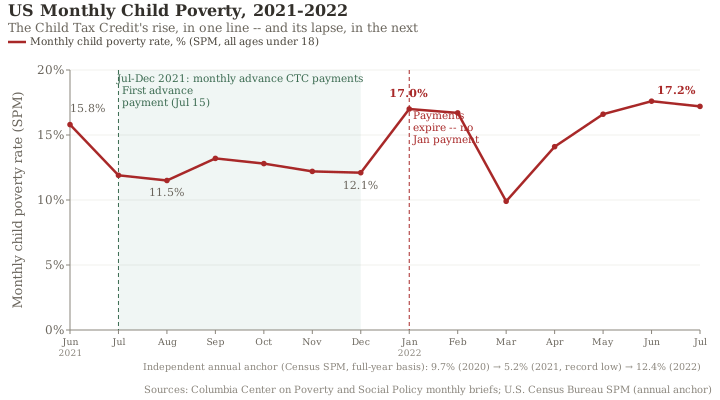
The framing is careful about what it claims. Transfers stabilize conditional on reaching high-MPC households. Send the money to savers and the stabilization case for that program weakens. The framing does insist that the standard attack on the welfare state, that it is a fiscal cost to be minimized, systematically under-counts: a benefit that prevents a deeper recession can pay for itself in output that a static cost accounting never sees.
Three framings now sit on the table — insurance, redistribution, stabilization — each inhabited at full strength, each producing policy guidance the other two do not. The question Stage 4 has to answer is which one is primarily operative, and when.
“The expanded Child Tax Credit cut child poverty nearly in half in six months. When it expired at the end of 2021, child poverty shot back up almost as fast.”
— on the 2021 expansion and its 2022 expiration, after Columbia’s Center on Poverty and Social Policy
Did the 2021 child allowance work?
The cleanest live test of the three-framing question. The same policy reads as a poverty program, a redistribution, and a stabilizer, and whether you call it a success depends on which framing you grade it under.
Where this leaves us
The stabilization framing is correct as a positive description of what the welfare state does to the business cycle: automatic stabilizers absorb a real fraction of cyclical shocks, the multiplier on a transfer tracks the recipient’s liquidity, and this macroeconomic role is invisible to both the insurance and the redistribution apparatus, it surfaces only when the welfare state is read as a macroeconomic instrument. And it settles one question the other two cannot answer: how to design the welfare state to perform across the cycle. Insurance leads to optimal-replacement-rate design; redistribution leads to progressivity-and-coverage design; stabilization leads to countercyclical-trigger design, three different drawing boards. The stabilization test of the welfare state runs through History Ch.19 (The 2008 crisis and after), which carries the benefit-extension and pandemic-response record. For the fiscal-multiplier-by-liquidity depth, especially the zero-lower-bound case, the sibling walkthrough Does government spending help the economy? goes further; for when automatic stabilizers are the only stabilizer that works once monetary policy is exhausted, see Can central banks control the economy? The political-stability function of welfare-state insurance, distinct from this macroeconomic-stability function, is the subject of Does democracy cause growth?
Three framings, one welfare state. The same unemployment cheque, the same Social Security payment, three different rationales producing three different apparatuses and three different sets of policy guidance. The mainstream agrees the welfare state has all three effects. It is split on which framing is first-order: for which program, in which sub-discipline, in which political moment.
The verdict: primary framing by scope
The easiest move now is to pick one framing and be done, declare the welfare state “really” insurance, or “really” redistribution, or “really” a stabilizer, and discharge the question. That move throws away everything the walk through three framings just bought. The harder move is to notice that the question has been quietly operating at three different scopes at once, and that the answer is different at each.
“Which framing is primary?” has no single answer because it is really three questions wearing one coat. The primary framing varies by program, unemployment insurance and old-age pensions are not the same kind of thing. It varies by sub-discipline, a public economist, a comparative political economist, and a macroeconomist look at the identical apparatus and see different first-order objects. And it varies by political moment, the welfare state is defended and attacked on whichever grounds the era makes legible. Name the scope and the framing follows; refuse to name it and you get the talking-past-each-other that passes for welfare-state debate.
By program
Go program by program and the “all three” answer resolves into a clear ranking each time.
| Program | Insurance | Redistribution | Stabilization |
|---|---|---|---|
| Unemployment insurance | secondary | secondary | primary |
| Old-age pensions | primary | primary | tertiary |
| Healthcare insurance | primary | secondary | tertiary |
| SNAP / food assistance | secondary | primary | secondary |
| EITC | secondary | primary | secondary |
| Child allowance | tertiary | primary | tertiary |
By sub-discipline
Mainstream public economics reads the welfare state as insurance plus redistribution, jointly optimized. The Diamond-Mirrlees-Saez framework solves for both at once, which is itself the discipline’s mature synthesis of the first two framings. Stabilization registers as an important but second-order property.
Comparative political economy reads it as decommodification, insurance and redistribution operating together, with the institutional configuration of delivery as the central analytical move. Esping-Andersen’s three-worlds typology (liberal, conservative, social-democratic) classifies welfare states precisely by which configuration of insurance-plus-redistribution they deploy, which is why this tradition tends to collapse the first two framings into one.
Macroeconomics reads it as a set of automatic stabilizers. The insurance and redistribution properties matter to a macroeconomist mainly because they determine which household the transfer reaches and therefore what the multiplier is, but the first-order question is the stabilization profile. The comparative-political-economy reading, with its decommodification claim, is one instance of the broader markets-vs-states binary; and the welfare state itself is one of the apparatuses through which "the economy" became a distinct object of political action.
By political moment
Expansion regimes, the 1945–1973 OECD core, defended the welfare state primarily on insurance grounds: Beveridge’s Five Giants, the Bismarckian social-insurance inheritance, the Great Society’s insurance-against-poverty rhetoric. The redistribution rationale was present but subordinate, and the stabilization rationale stayed largely implicit.
Contraction regimes — from Reagan and Thatcher onward, through post-2010 European austerity — attacked the welfare state on fiscal-cost, moral-hazard, and redistribution-as-class-warfare grounds. The defense in these moments reaches for redistributive justice or insurance-against-uncertainty; the stabilization defense is the strongest available and the least deployed, because it needs an apparatus the public conversation is not carrying. Whether the contraction era amounted to a coherent policy turn at all is contested in Did neoliberalism actually rule?; the fiscal-cost and demographic-pressure argument that fuels these contraction moments is engaged directly in Is the welfare state sustainable?
Crisis regimes — 2008–2013, 2020–2021 — push the stabilization framing to the foreground: benefit extensions, the child allowance, EITC and food-assistance expansions all read, in the moment, as macroeconomic instruments. The welfare state’s macro-insurance properties become legible to public discourse exactly when the cycle is in trouble, and the contraction that follows recovery is partly a re-veiling of the framing that the crisis briefly exposed.
The verdict
“Is the welfare state insurance, redistribution, or stabilization?” is not one question, because it is being asked at three scopes at once. By program, the primary framing varies, unemployment insurance is stabilization, pensions are insurance plus redistribution, healthcare is insurance, the means-tested transfers are redistribution. By sub-discipline, it varies, public economics sees insurance plus redistribution, comparative political economy sees decommodification, macroeconomics sees stabilization. By political moment, it varies, expansion defends on insurance, contraction attacks on cost, crisis reaches for stabilization. Naming the three scopes, and which framing is primary within each, is the answer.
Each assignment above comes with a reason: unemployment insurance is primarily stabilization because of its MPC profile and the fiscal-multiplier evidence. The refusal to crown one framing globally is the finding: the welfare state is genuinely all three, and the discipline that reads it well is the one that asks which scope it is standing at before it answers. The next time you meet a welfare-state claim in the wild — a column, a campaign promise, a budget projection — ask three questions before you grade it. Which program is this about? Which sub-discipline is making the claim? Which political moment is doing the framing? Answer those, and the claim’s framing, and what it is quietly leaving out, comes into focus.
Where this leaves us
We started with one unemployment cheque and three readings of it. Beveridge’s framing made it insurance, a payout on a risk private markets cannot price, a contract you would sign behind a veil of ignorance. Piketty’s framing made it redistribution, a transfer between people, the standing outcome of a fight over shares that the post-1980 decades ran in reverse. The stabilization framing made it a macroeconomic act, a dollar placed in a hand that would spend it, holding a recession’s floor. None of the three is wrong. The same machinery answers a different question depending on which one you put to it, and whoever carried just one framing as their default has been blind to two-thirds of what the welfare state does.
The honest verdict is calibrated, not global. Carry that and the welfare-state arguments you meet stop being a clash of slogans and become legible: each speaker is grading the same apparatus under a framing they have usually not named, and now you can name it for them.